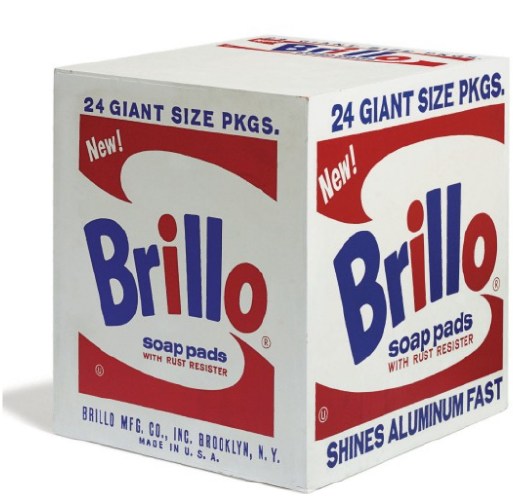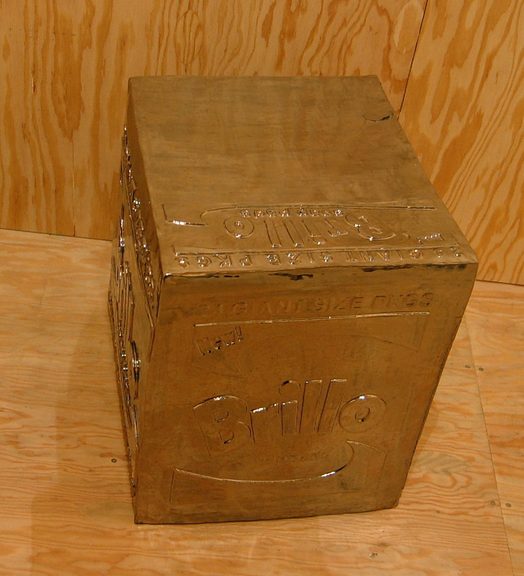
Warhol Foundation Cardboard Brillo Box

three one thousand dollar warhol brillo box cardboard collectables stacked, white yellow, green on a wooden table with a marcel wanders egg vase on a shelf underneath, and a wall of bookcases in the background, via avantarte dot com
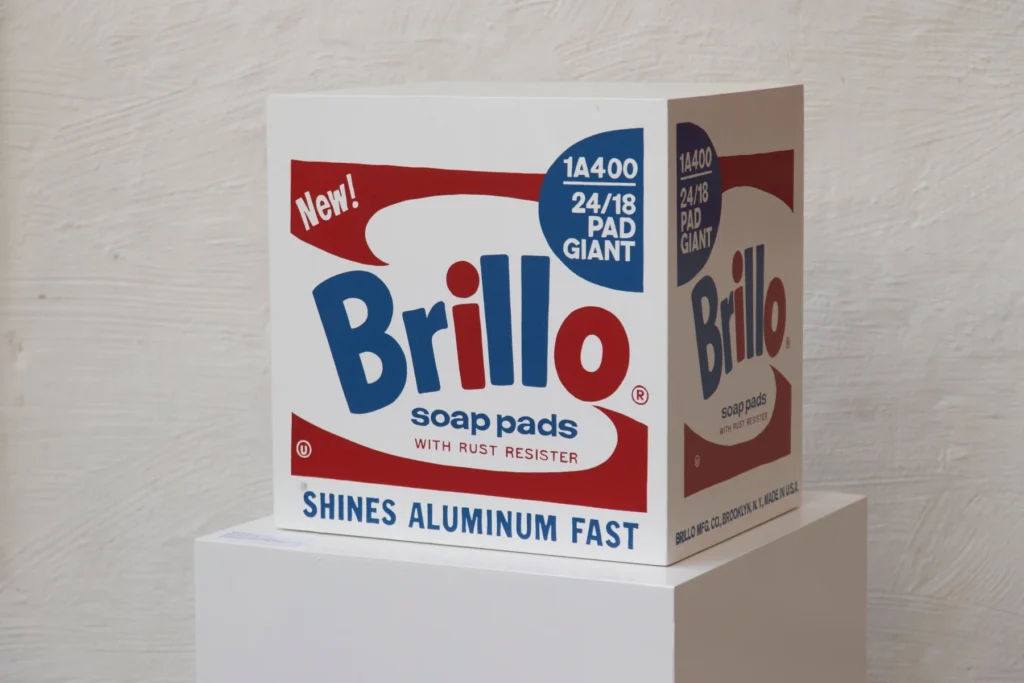
Warhol Foundation x Avant.Arte Brillo Box Collectables, 2026, starting at 7 x 7 x 5.75 in., $978., via

Beyoncé. Louis Vuitton. The Andy Warhol Foundation for the Visual Arts. Truly we are in a WTF thousand-dollar limited edition box moment.

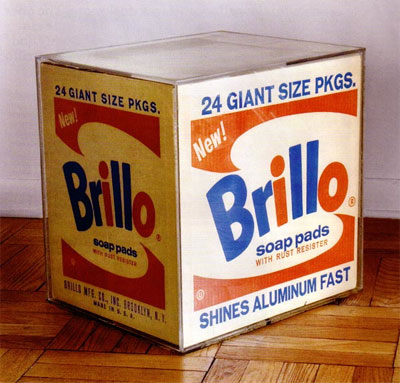
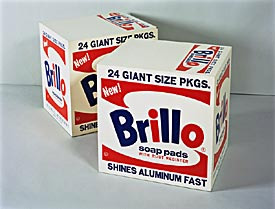
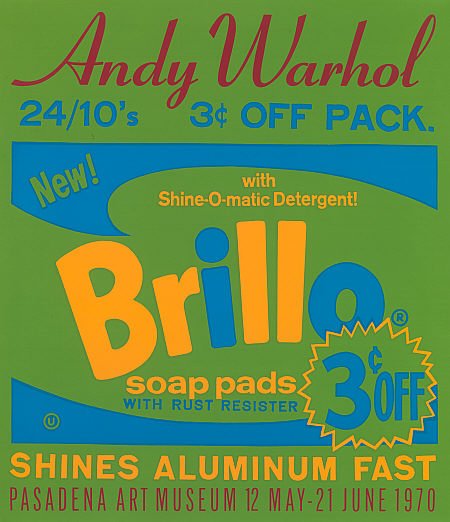
The Warhol Foundation has licensed three of its copyrighted and trademarked versions of AbEx painter James Harvey’s iconic Brillo Box design to Avant.Arte, which has turned them into three collectable cardboard boxes, framed flat or ready to assemble, each in a limited edition of 1,000. Yellow Brillo boxes were rare. Green ones were non-existent [this colorway is from a poster for a 1970 show in Pasadena.] But churning out hundreds of boxes, in slightly varied dimensions, fabricated by someone else, at a distance, with vague authorization, were definitely the norm for Warhol’s Brillo Boxes.

a disembodied white guy's hand scrunches the corner of a white  foam warhol brillo box against a white void
Warhol Foundation x Fab Brillo Pouf, 2013, 39 x 39 x 39 cm, via Fast Company

And it turns out to be the norm for Warhol Foundation Brillo Boxes, too. In 2013 there was the Brillo Pouf, produced for Fab in coated foam [by Quinze & Milan, the marketing studio whose commercially produced Burning Man pavilion turned out to be part of an ongoing Lexus campaign to debut a new model at Art Basel Miami Beach.]

a yellow warhol brillo box copy in plywood with a lid sits on a plywood rietveld zigzag chair copy, with half a dozen other zigzag chairs in the background in a variety of minecraft block ass paint textures, and a wall of yet more plywood cubes, some with arty doors, all from the plywood paradise that is dope! art [sic] gallery
Plywood Brillo Box with actual lid, 40 x 40 x 39 cm, amidst the plywood splendor of Dope!’s Shanghai showroom or whatever idek

There’s a possibly bootleg plywood box with a lid introduced as an edition of 500 in 2016, which seems to live on as a DIY kit produced by Chinese Plywood Mill?

the bottom face of a kidrobot plush warhol brillo box cube looks like a yellow tshirt stretched across a foam cube, but it's authentic enough to be authorized by the warhol foundation, which claims copyright and registered trademark on this object, and armely or whatever the name of the company that owns the brillo trademark. for sale at the mca chicago
Just look at the IP maneuvering required to bring the 12 x 12 x 12 in. Warhol Foundation X kidrobot plush Brillo Pillow – LARGE ($90, $81 for members) to your MCA Chicago shopping cart.

Any of Avant.Arte’s boxes are too small to hold the Warhol Foundation x kidrobot Brillo Plush – LARGE, but they probably fit one of kidrobot x Warhol Foundation’s 2017 Brillo Blind Boxes. Each Brillo tin holds one of sixteen Warhol Foundation plush or vinyl mini collectibles. According to this rarity ratio, 1/12 were white vinyl mini Brillo Boxes, and 1/48 were yellow.

two photos from ebay seller couture supreme of a display case of 24 kidrobot blind box brillo box tins, one with the case closed and looking most like an actual warhol brillo box, even tho it's printed all over with kidrobot collectable text, and the other with the lid open and the 24 shrinkwrapped tins inside. the box seems to have been photographed in a medieval times dungeon
24 KIDROBOT x ANDY WARHOL BRILLO BOX MINI-SIZED BLIND BOXES WITH COLLECTIBLE ANDY WARHOL OBJECTS IN DISPLAY CASE, $219.95 from ebay seller Couture Supreme (4551)

Unlike the Warhol Foundation, I’m just going to stop.

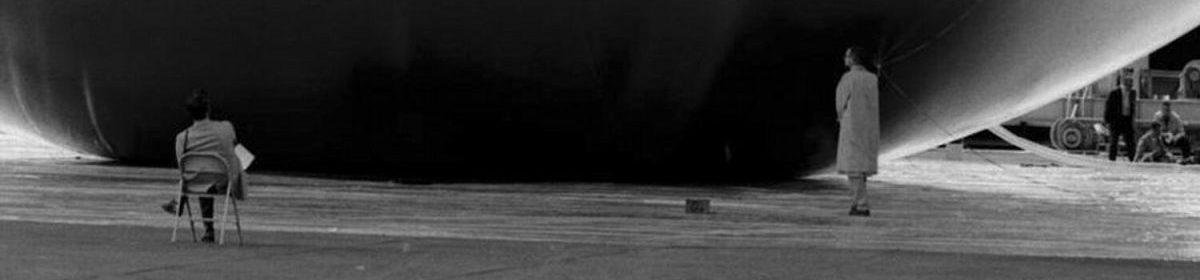
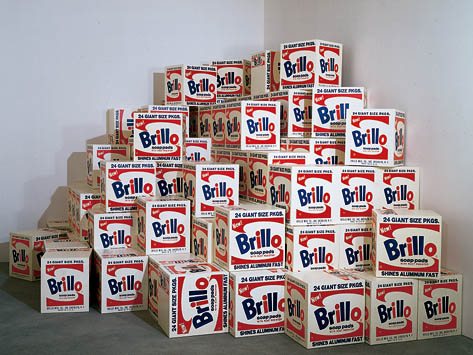
[FEW MINUTES LATER UPDATE] I can’t stop. @ware.ian just pointed out there are also 100 “lifesize” cardboard Warhol Foundation Brillo Box Collectables, which simultaneously evokes and has no relation to the 500 actual cardboard Brillo boxes Pontus Hulten shipped to Stockholm for Warhol’s 1968 show at the Moderna Museet. Hulten went on to fabricate entire generations of Brillo Boxes after lying about having received Warhol’s authorization to do so in 1968. I, for one, would like to see a Stockholm-Type cardboard Brillo box.

a black and white 1968 photo by Nils-Göran Hökby of a giant wall/mountain/pyramid of cardboard brillo boxes stacked eleven high, with some stacked asew, and some slightly artful asymmetrical stacks in the foreground, at the moderna museet in stockholm, where curator pontus hulten decided to save on shipping by buying 500 actual boxes from brillo rather than bring over a significant number of warhol painted wood versions.
1968 installation at Moderna Museet of actual Brillo boxes, photo: Nils-Göran Hökby

Previously, related: ‘The Oberlin Brillo Boxes‘
Facture-Checking Warhol’s [sic] Brillo Boxes

When You’re Pontus Hultén They Let You Do It

Being Pontus Hultén must have been absolutely amazing, the king of all he surveyed. He was the founding director of at least three modern art museums and one of the most influential figures in 20th century art. A groundbreaking curator, a friend to major artists, and a stone cold crook.

Hultén made the first re-creation of Tatlin’s lost Memorial to the Third International for an exhibition at the Moderna Museet, which, great.

With permission from Duchamp, Hultén made exhibition copies of Duchamp sculptures, including the first copy of the Large Glass, for the Moderna Museet in 1961, which Duchamp signed as recognized copies on his visit to Sweden. No problem, but watch this space.

In 1968 Hultén bought hundreds of actual cardboard Brillo boxes, from Brillo, for a Warhol exhibition, and had a few made of wood in Stockholm, maybe 10-12, and not more than 15, with, if not Warhol’s permission, then his awareness. OK.

a red and blue on white wood cube sculpture of a brillo box, made in 1990 by pontus hulten who, when he sold them, told people they were from 1968, on a white pedestal against a white wall, being sold by a guy in denmark at multiplesinc dot com
More power to the Danish Banksy dealer who got Marian Goodman’s domain name, and who is holding out hope that he can recoup on this Pontus Hultén Malmö Type Brillo Box. Hang in there, Hultén may turn out not to be a crook!

But then in 1990, after Warhol’s death, Hultén had 105 more Brillo boxes made in Malmö, which he said were made in Stockholm in 1968. He donated or sold these boxes all over the place until his death in 2006, based entirely on his association with Warhol, and his own assertions of authority. He sold 40 to Duchamp dealer Ronny van de Velde with certificates of authenticity saying they were from 1968. But Warhol never authorized these, and he definitely didn’t do it after he was dead. It turns out many people in the Swedish modern art world knew Hultén’s Brillo racket. Not OK.

An entire investigation and report on the various fabrications of Brillo boxes was conducted by the Warhol Foundation in 2010, which declared all the Hultén boxes to be Hulténs, not Warhols. (This, after Hultén got the Warhol Authentication Board to approve and add 94 1968-I-mean-1990 Stockholm/Malmö boxes to the catalogue raisonné in 2004.) Shady, a bummer for a few collectors, but kind of hilarious.

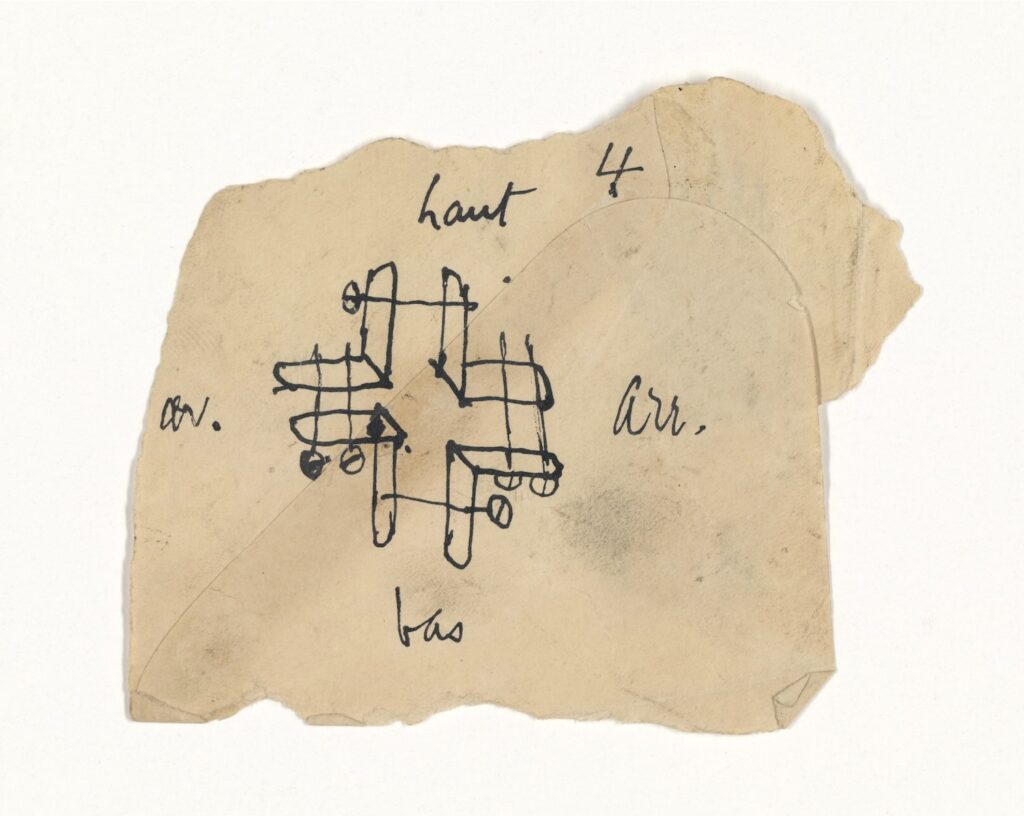
a torn fragment of a grimy envelope from 1920 has a sketch of four corner elements coming together at a cross intersection, with what look like pins or screws holding each arm together. in french is written haut bas, av., arr., top, bottom, front, and back. this diagram by marcel duchamp was stolen by museum director pontus hulten in 1960, and recovered in 2018
up, down, front, back: Duchamp’s 1920 sketch for Rotary Glass Plates, jacked by Pontus Hultén in 1960 from Yale University Art Gallery.

But in 1960 Pontus Hultén also straight-up stole at least four Duchamp drawings from Yale University Art Gallery. Katherine Dreier had donated Duchamp’s 1920 sculpture Rotary Glass Plates to Yale in 1941 as part of the Société Anonyme. Hultén visited the sculpture for what Yale’s extraordinary provenance note for this sketch on an envelope of the Rotary Glass Plates says was to consider it “for inclusion in an exhibition.”

What he was doing was studying how to refabricate it. The 1961 exhibition, Movement in Art, for which Hultén and Ulf Linde fabricated all the Moderna Museet’s Duchamps, including a Rotary Glass Plates. [Actually, Linde made the Large Glass; Hultén made Rotary Glass Plates with Per Olof Ultvedt and Magnus Wibom.]

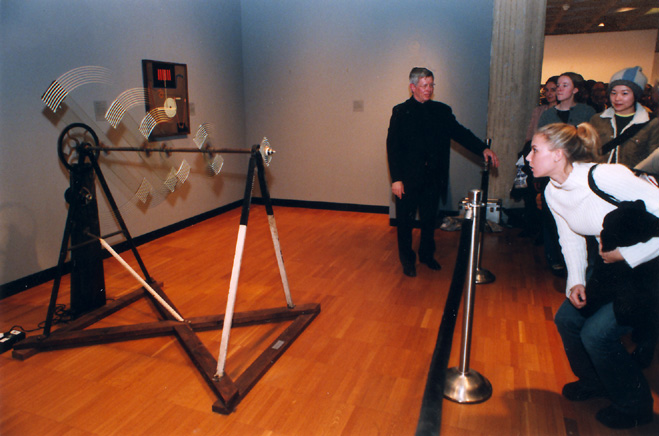
in a warmly lit gallery at yale, a white woman behind a stanchion with her hair pulled back like a soccer player leans down to align her vision with the axle of marcel duchamp's sculpture where five spinning glass plates create the optical illusion of concentric circles. the x-based apparatus has a motor at back. the axle is supported at eye level for a shorter person. duchamp made this in 1920, and katherine dreier donated it to yale in 1941. it is rarely turned on, though, and perhaps the man in front of the stanchion in this photo, wearing an all dark suit, is one of the yale engineering professors who restored the sculpture in 1999. a crowd in the background is perhaps waiting for this white lady to finish so they can take a turn.
After some engineering professors restored it in 1999, Yale turned on Rotary Glass Plates for a two-day Duchamp/Johns symposium in 2000. image: Yale Bulletin

Yale writes that “Hultén reportedly removed the sketch, along with three others, from the artwork’s storage box.” I think it illustrates how to clamp the painted glass plates to the central axle on which they rotate. Hultén apparently gave the sketch to Linde as a birthday present, and his widow, along with Duchamp scholar Paul B. Franklin, returned it to Yale in 2018. No word what or where the three others are, but Yale clearly has some idea.

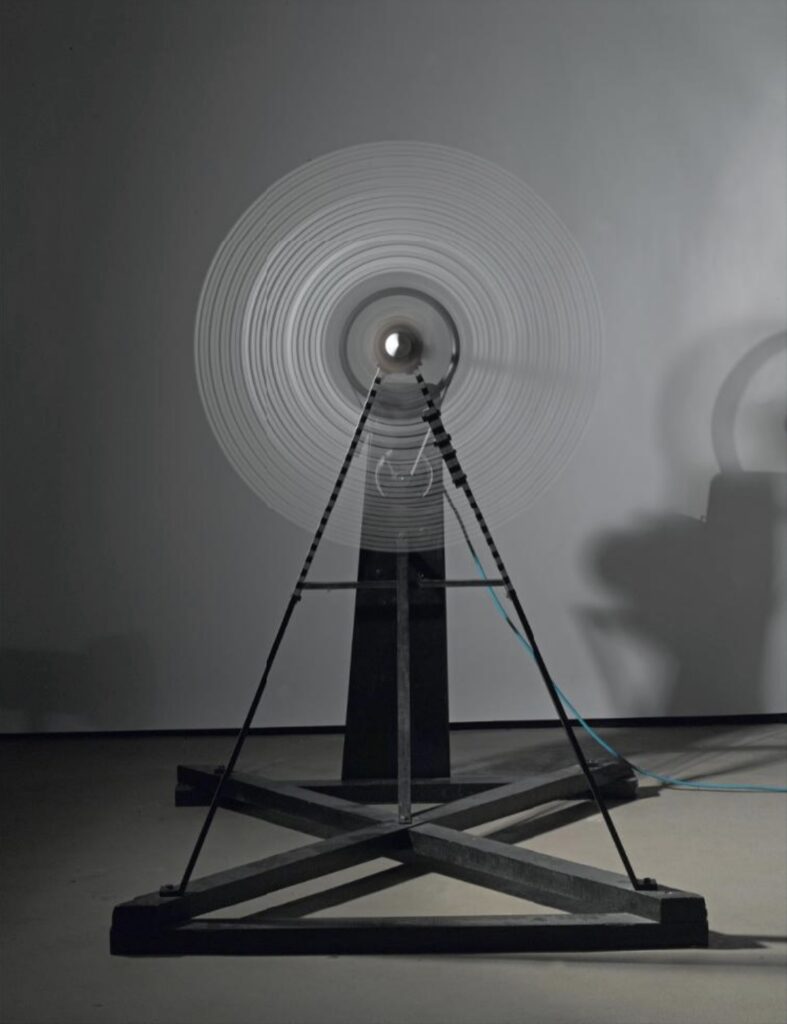
a black painted apparatus on an x-shaped frame holds five glass plates along a spinning axle, with motor at the back. here the timelapse photo depicts the plates spinning so that the stripes painted on them create the optical illusion of concentric circles. the pompidou made this 1979 replica of duchamp's 1920 sculpture, rotary glass plates, under shady museum director pontus hulten, who stole sketches for it from yale university in 1960.
Marcel Duchamp? Rotative Plaques Verre, 1920/1979, a purchase by the Centre Pompidou

It turns out Hultén made another Rotative Plaques Verre, in French, for the Pompidou in 1979. In 1980 Hultén’s Pompidou published a facsimile set of 289 Duchamp notes and scraps with Paul Matisse, Duchamp’s step-son, with the originals in the collection. Nothing in there seems obviously stolen from Yale.

[Shoutout to rare and amazing artbooks dealer Yoshi Hill for posting the buck wild archive entry to his Instagram yesterday.]

Paul Thek’s Birthday Cake Of Flesh

Fred McDarrah, 10-24-64 Paul Thek “Birthday Cake of Flesh” Stable Gallery, 7.25 x 4.5 in., image via Sotheby’s

I lost out on everything I bid on in Kenny Schachter’s fourth no-reserve sale at Sotheby’s, which ended today. The one I got outbid on the most, at least percentage-wise, was Fred McDarrah’s October 1964 photo of Paul Thek and his sculpture, titled, “Birthday Cake of Flesh.” Estimated at USD 300-400, the print sold for $4,410. [It is, of course, of Thek, not by Thek. Is this a record price for a McDarrah, though? Three vintage prints of McDarrah’s Kusama photos sold for $5,040 last year]

The print was in a selling exhibition at Sotheby’s London in 2019-2020. Maybe Schachter, who’s been hyping and trading Thek works a lot the last few years, picked it up there.

The photo was at the Stable Gallery, where Thek had his first show, which McDarrah covered for the Village Voice. The notes and stamps on the back of the print relate to the caption and size for printing the photo in the paper. So this print’s seen some stuff.

Birthday Cake is, of course, made of pigmented wax that resembles a pyramid of slabs of meat, part of Thek’s Technological Reliquaries series. According to Cynthia Hahn’s The Reliquary Effect, Thek also titled the work, Josef Albers Homage to the Square. And though I can see how the top-down view of a 4-tier pyramid by itself would work, the strong diagonals of the vitrine’s steel, and the horizontal bands etched or painted into the sides seem like they’d obliterate the reference. Is the cake even a pyramid? Or is it a ziggurat?

Paul Thek, Birthday Cake, 1964, but dated in Parkett and beyond as 1967, photo: D. James Dee

NEXT MORNING UPDATE: Bryan Hilley’s search for other photos of Birthday Cake turn up a mystery that is a problem. This color photo of Birthday Cake by D. James Dee ran in black&white in Holland Carter’s 1991 Parkett essay on Thek, one of the first reassessments of the work after Thek’s death in 1988. [pdf] And it’s given the date of 1967.

All the other Technological Reliquaries are listed as 1965-66, which would make Birthday Cake a late Reliquary, even a culmination. Also, Cotter reads the glassed off meat as wistful commentary on the liberation of the Summer of Love, which, at 35, had just passed Thek by. Obviously, Cotter’s take is more involved than that, and boomers can bemoan the telescoping passage of time all they want. But it seems important to understand Thek’s work to know the time and place he made and showed his work, and for Birthday Cake and other meat works, it was October 1964 at the Stable Gallery, six months after Andy Warhol showed his Brillo boxes there.

Paul Thek, Meat Piece with Warhol Brillo Box, 1965, image: whitney.org, where they get the timeline right in their 2010 audioguide

I think he was up to something else.

More Aaron Kuriloff, Please

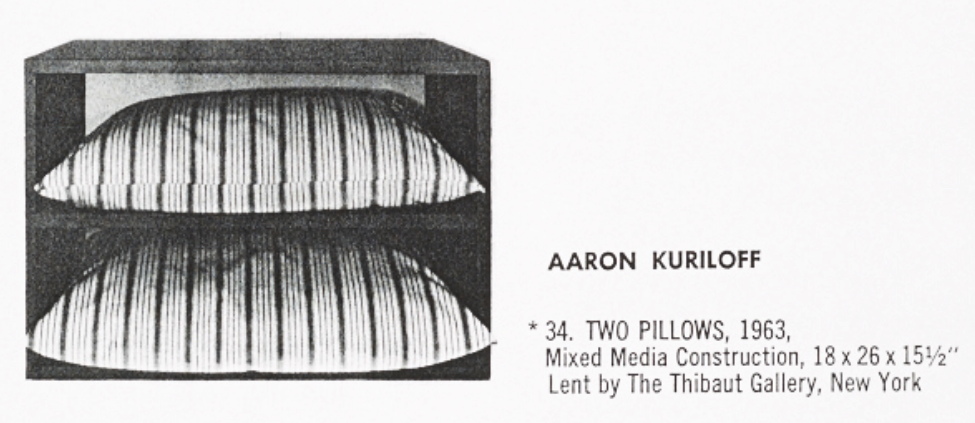
kuriloff_two_pillows_dwan_boxes_aaa.jpg
Aaron Kuriloff, Two Pillows, 1963, image and caption from Walter Hopps’ Boxes catalogue, Dwan Gallery, 1964, image: aaa.si.edu
In his Dwan Gallery catalogue essay, James Meyer calls him “a now-forgotten trader in readymades,” but I recognized Aaron Kuriloff’s name from Donald Judd: Complete Writings 1959-1975. Judd reviewed Kuriloff’s April 1964 show at Fischbach Gallery for Arts Magazine. He did not like it, dismissing the artist’s lightly assisted readymades as domestic misfires done better by George Brecht.
Now that I’ve seen some pictures, though, I’m kind of intrigued. For Boxes, the February 1964 group show organized by Dwan Gallery director John Weber, Andy Warhol sent three Brillos and a Heinz Ketchup, scooping the Stable Gallery by a month. And Kuriloff sent Two Pillows, 1963 [above], in which blue ticking-covered pillows were inserted in a blue-painted wood shelf.
No wonder Judd didn’t like it. I bet Haim Steinbach would, though. And Mark Stahl, who had a similarly promising-but-brief career with similarly found objects in the 1980s.
No less than Brian O’Doherty liked Kuriloff’s work, too. He reviewed the Fischbach show for the Times:

Both these shows, one [George Ortman] turn­ing symbols into objects, the other [Kuriloff] objects into symbols, make a new cross‐roads where the traffic is getting heavier –a cross‐roads at which Jas­per Johns originally planted his painted flags, breaking our reflex responses to the most loaded of symbols.

I’ll add some more images of Kuriloff’s works from 1963-67, the only period I’ve been able to find so far, and let’s just have a fresh look.
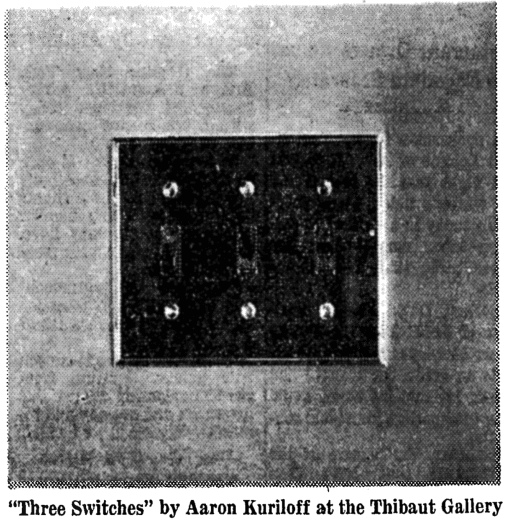
three_switches_aaron_kuriloff_thibaut_nyt_14dec1963.jpg
Aaron Kuriloff, Three Switches, 1963, Thibaut Gallery, image via nyt
The Times has at least two other reviews of Kuriloff’s work, both illustrated. In December 1963, he was in “Hard Center,” a group show at Thibaut Gallery organized by Elena and Nicolas Calas. From Brian O’Doherty’s review it sounds like it focused on the recontextualization as art of mass or consumer objects, an early example of Pop getting in formation. And the artist list shows just how far Pop has shifted since: Robert Breer, Nicolas Calas, Kuriloff, Walter de Maria, and Robert Morris. There’s a catalogue out there somewhere.
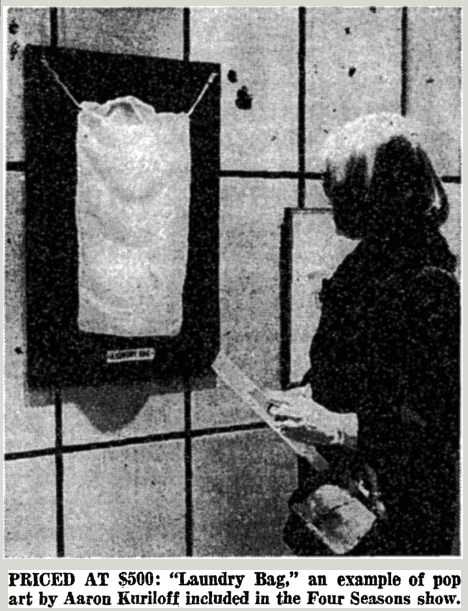
kuriloff_laundry_bag_4seasons_nyt_15mar1965.jpg
Aaron Kuriloff, A Laundry Bag, installed in 1965 at The Four Seasons, image: nyt
In 1965 Kuriloff is mentioned in a benefit sale/exhibition held at the Four Seasons. It seems kind of a mess, frankly, and the Times report doesn’t do it much justice, just sneering at now-acclimated art audiences not rioting over Pop Art. Kuriloff’s A Laundry Bag was just that, mounted against a green background, with a label, Erased de Kooning Drawing-style. Priced at $500 for mental health charity, it’s not clear if it sold.

Pasadena Style Brillo Box Redux

brillo_blum_pasadena.jpg
Will you look at that, another one of Irving Blum’s Pasadena-style Brillo Boxes is coming up for auction in the morning at Christie’s, with an estimate of $400-600,000. [The last Blum Pasadena Brillo box I wrote about sold for $782,000 in 2010.]
These Blum boxes are always/both listed as “acquired from the artist,” but they are actually part of an extra batch of at least 16 boxes which artist/curator/editor John Coplans had made as extras for the 100 boxes Warhol authorized for Coplans’ 1970 retrospective at the Pasadena Museum. The actual 100 were donated to the museum, but the overages were dispersed among Warhol’s friends, curators, dealers, and collectors in Los Angeles.
Oddly, the pair Coplans got from Warhol, which he donated to Oberlin College, are classified as “reserve boxes” for the exhibition; their somehow lesser status means they have never been published or exhibited outside the college.
Meanwhile, other of the 16+ which go through dealer or collectors’ hands are classified as regular, ol’ cash-n-carry Brillo Boxes.
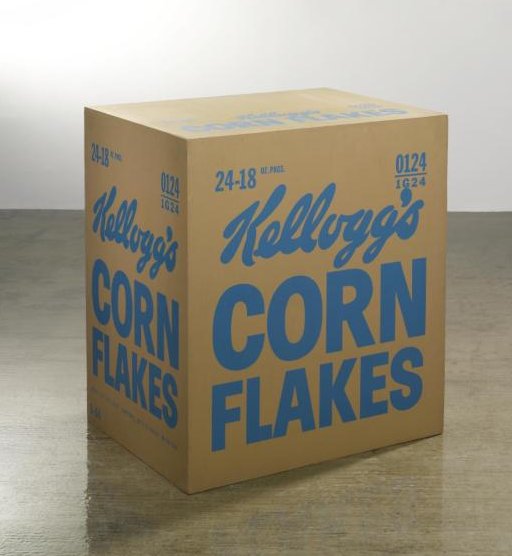
Still no word on the whereabouts of the 10 to 33 Kellogg’s Corn Flakes boxes that went missing from LACMA, from the 100 Warhol authorized and donated to that museum at the same time.

Stainless Steel Brillo

rirkrit_brillo_16miles.jpg
So awesome. Is there nothing that can’t be made better by Rirkrit chroming the hell out of it?
Fear Eats The Soul, Rirkrit Tiravanija, through April 16 at Gavin Brown’s Enterprise [gavinbrown.biz]
Awesome photo of chrome stainless steel Brillo Box and wok, one of many by Andrew Russeth [16miles.com]
Previously: Enzo Mari X Rirkrit Tiravanija
Extensive Brillo Box coverage on greg.org

There’s One! Irving Blum’s Pasadena Type Brillo Box

brillo_blum_pasadena.jpg
The close follower of the Warhol Brillo Box saga will surely find amusement in the details of Lot 137: a Pasadena Type box that once belonged to Warhol’s early early LA dealer Irving Blum at Christie’s upcoming Morning After sale.
You know, things like the date [“Executed in 1964-1969.”] and the provenance [“Irving Blum, acquired from the artist”].
Which, like the so-called Oberlin Boxes John Coplans got from Warhol for curating his first museum show, was one of the 16 or so extras made when Warhol authorized Coplans to fabricate 100 for his Pasadena Art Museum show in 1970.
Nov. 11, Lot 137: Pasadena Type Brillo Box, est. $350-450,000 [christies.com]

Oh, The Places You Go, Little Brillo Box

castelli_brillo_corbis.jpg
Bob Adelman, Castelli’s house, 1965, fairly ganked and shrunk via corbis]
Now that they’re selling for a million dollars or whatever, it’s hard to imagine how Warhol’s Brillo Box sculptures were perceived at the time they were made.
When they were lowly $300 sculptures, mechanically produced in seemingly endless supply, they were treated like furniture, traded and given away like party favors or the curatorial equivalent of hostess gifts. They were a medium of social, not economic currency. [At least not direct economic currency. Even from his early days as an illustrator, Warhol was already familiar with the art gift’s ingratiating self-promotion.]
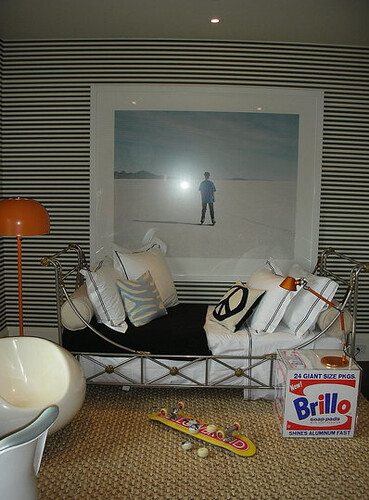
boy's bedroom
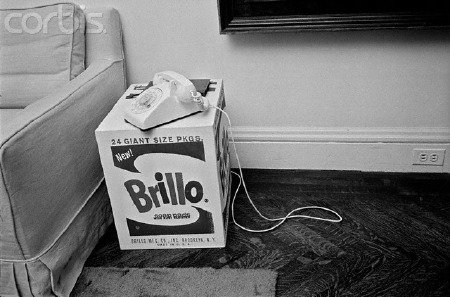
The most common exhibition strategy for a Brillo Box was as a table. Two of the three Boxes I’ve seen in private collections were encased in Lucite and placed next to chairs. One had a lamp on it. The photo above [from janee’s flickr] shows what looks like a Stable Gallery box being used as a kid’s table in a San Francisco decorator showhouse. In 1988, Leo Castelli told New York Magazine he used two encased Brillo Boxes as side tables, but in 1965 when Factory photographer Bob Adelman snapped this picture at Castelli’s house, it was just the box and the phone. [See the full-size image at Corbis.]
irving_sandler_brillo.jpg
Irving Sandler’s original Brillo Box, signed by its designer, Jim Harvey, image via]
The Warhol Authentication Board’s report on the Pontus Hulten affair captures both the gift and furniture aspects of the dozen or so Boxes made in 1968:

Of the six Stockholm type boxes known to exist, three were given to [curator and later museum director Ollie] Granath as “souvenirs” for having helped Hulten with the Moderna Museet exhibition. Hulten kept the other three for his own use; two served as bedside tables for his children. [pp.9-10]
…
Of the three that Hulten kept, one was later given to the silkscreener who made the Malmo type boxes. [p. 10]

[Hmm, I wonder if Castelli’s 1988 sale of his end table “to European collector” for $50,000 motivated Hulten to trade one of his own Stockholm type table/”souvenirs” in order to, uh, complete his edition?]
oberlin_brillo_boxes.jpgThe report also mentions the 100 Pasadena type boxes, plus “as many as 16” additional Boxes identified in the CR that were “given as gifts or sold.” Two of those 16 are the Oberlin Brillo Boxes, [right] which Warhol gave to Pasadena Art Museum curator John Coplans, who later donated them to the college’s Allen Museum.
All this gifty goodness and casual domestic use leads me to speculate that LACMA’s “missing” Kellogg’s Corn Flakes boxes–10 known, plus at least 33 and maybe more, if they produced as many as Pasadena did–were treated as thank-you gifts to donors who paid for their fabrication, or were sold to “friends and family” of the museum. So keep your eye out.

Facture-Checking Warhol’s Brillo Boxes

warhol_brillo_christies_98.jpg
The Brillo Box formerly known as Stockholm type, and formerly known as being by Andy Warhol, sold at Christie’s in 1998.

So awesome. The Beverly Hills art dealer Robert Shapazian’s bequest to the Huntingon Museum of 10 Brillo Boxes by Andy Warhol has brought the whole tangled Brillo Box versioning and authenticity debate back into the news. As the LA Times’ Christopher Knight reports, Shapazian’s Brillo Boxes include one 1964 Stable Gallery box–and nine Pontus Hulten Boxes, made by the legendary founding director of the Moderna Museet. And the Pompidou. And MoCA.

Until this summer, those nine would have been called Stockholm Type. But following the completion of the Warhol Authentication Board’s 2+year investigation and the release of their 27-page report [Jul 19, 2010 pdf via LA Times], the 105-120 or so Stockholm Types have been split into Stockholm Types and Malmo Types.

Hulten had somewhere between 10 and 12, but not more than 15, boxes made after his 1968 Warhol exhibition at the Moderna Museet closed. He did this, he said, because Warhol told him to “make them over there.” Hulten apparently pocketed that date and authorization. When, in 1990, he had 105 Boxes fabricated in Malmo for a series of exhibitions, he referred to an “old authorization.” The only thing missing, it seems, was documentary evidence of this readymaking on Warhol’s side.

There was extensive context provided to show that fabricating works was part of Hulten’s standard practice–he had replica Tatlins and replica Duchamps made, including, even, a Large Glass, which Duchamp later signed [as a “copie conforme”]. Hulten’s texts and statements show he considered Duchamp and Warhol as readymade brothers.

Following the logic of Duchamp and taking it to another power, Hulten interpreted Warhol’s 1964 Stable Gallery box sculptures not as factured works of art, but as repeatable, ready-made objects, that were interchangeable with real Brillo Soap Pads cartons or replicas.

And then the Board does what authentication boards do: it examines the physical details of each type of box, distinguishing Warhols based on the traditional notion of the character of their painted surface, or facture. Stockholm types were “painted and sanded multiple times to achieve a high degree of finish before they were printed,” but Malmo types “appear to have been painted with a roller.” Stockholm types have mitered corners, but Malmo types [and Stable Gallery types, for that matter] have abutted joints. Malmo types are made with a nail gun, Stockholm types were nailed by hand. And so on.

The conceptual difference between these two approaches to Warhol’s work is fascinating, and Hulten clearly felt justified and correct in the way he had his Brillo Boxes made. The fact that Hulten’s 1968 boxes were made in 1990 seems to have been more broadly known and accepted within the Scandinavian museum and art community. But he also did not have any problem “misrepresent[ing] the works and falsif[ying] their history” to the Estate, the Board, and the Catalogue Raisonné.

And so, the Board has reclassified all Hulten boxes as “exhibition related copies” [Stockholm] and “exhibition copies” [Malmo]. Any questions?

‘The Oberlin Brillo Boxes’

oberlin_brillo_boxes.jpgHow much of this is really unanticipated, unexpected, unsurprising, and ultimately, unauthorized?
The Allen Memorial Art Museum at Oberlin College [no relation] has two Warhol Brillo Boxes from 1970. It describes them as “(enlarged refabrication of 1964 project).”
Then this:

Exhibitions
Warhol gave the Pasadena Art Museum one hundred boxes fabricated for the Andy Warhol exhibition, held 12 May – 21 June 1970. Oberlin’s boxes were among a group [!] of reserve boxes produced at this time but not exhibited. Nor have they subsequently been exhibited outside of the museum.
Literature
The Oberlin Brillo Boxes
None. [italics added]

Or as the Warhol Art Authentication Board described it in their letter to owners of Stockholm Style boxes, “Warhol agreed to have facsimile editions of his 1964 box sculptures produced.” Pasadena had theirs produced in May 1970 by the Jan Art Screen Processing Company, Pasadena. And Warhol subsequently donated the hundred to the museum.
warhol_pasadena70.jpg
Silkscreened Brillo exhibition poster, 1970, in the collection of the National Gallery of Scotland]

Warhol’s decision to enlarge the boxes’ dimensions–the 1970 boxes are 20x20x17 in., compared to the 1964 boxes’ 17x17x14–and donate the results to a museum not only draws a distinction between two otherwise identical works, it preserves the value of the “originals” in the market. [Brillo Boxes were $300 each in 1964. And Gerard Malanga says Warhol was upset that almost all the box sculptures returned, unsold, from the Stable Gallery show. I’d expect more had sold by 1970, though, so there would be more collectors who would not want to see Warhol cranking out a hundred more here and a hundred more there as needed.]
But what of this “group of reserve boxes”? Oberlin’s dutiful report about not exhibiting them out of the museum, combined with no published citations of “The Oberlin Brillo Boxes” sure makes it sound like they exist apart from “authentic” Brillo Boxes. So where’d they come from?

Provenance
Gift of the artist to John Coplans (1970)
Lent to the museum by Coplans in January 1980, then given in memory of Ruth Roush in December 1980.

Coplans was not just an artist. He wrote about the 1962 Ferus Gallery show of Warhol’s Campbell’s Soup paintings in a magazine he’d just co-founded, Artforum. [He became its editor in chief in 1971]. And he was a curator at the Pasadena Museum. In fact, he curated Warhol’s 1970 show. So he made the boxes. And kept the extras. At least some of them. [A 2005 Sotheby’s sale catalogue notes that 93 1964 boxes have been identified, along with 94 of a “presumed set of 100” from Stockholm, and a “set of 100” for Pasadena, “with an additional 16 identified to date.” So the answer, apparently, is 16.] [sept. 2011 update: apparently Sotheby’s has removed reference to the 2005 sale of a Stockholm Brillo box from their website.]
Now check this out:

For the 1970 retrospective of Warhol’s work at the Pasadena Art Museum, John Coplans suggested that Warhol make a set of 100 Brillo Soap Pad boxes based on his 1964 box. The entire set has remained in the museum’s collection (now known as the Norton Simon Museum). At the same time, Betty Asher suggested a set for the Los Angeles County Museum of Art. Using the same silkscreen printer as for the Brillo Soap Pad boxes, Warhol produced a set of 100 Kellogg’s Cornflakes boxes for LACMA. In both cases, the boxes were made a few inches larger to differentiate them from the 1964 versions.
Mrs. Asher was a collector and the assistant to curator Maurice Tuchman, as well as a member of the Contemporary Art Council whose mission was to bring new art to LACMA. The full set of boxes was included in the 1972 – 1973 show that inaugurated LACMA’s contemporary galleries and celebrated the work of the Contemporary Art Council.
The Los Angeles County Museum of Art retains fifty-seven of the 1970 Kellogg’s Cornflakes boxes in their collection. Another ten boxes, including the present work, are known to be in collections outside of the museum.

That’s from the catalogue for Sotheby’s contemporary evening sale in May 2009, where a “Kellogg’s Cornflakes [Los Angeles Type]“ sold for $482,500. It’s listed as cat. no. 936.67 in the Warhol catalogue raisonné. [updated Sotheby’s link. -Sep 2011]
warhol_lacma_sothebys.jpg
So Warhol authorized 100 Cornflakes. The Contemporary Art Council paid for fabrication. The “entire set” was exhibited in a 1972-3 show called “Ten Years of Contemporary Art Council Acquisitions: Inaugurating the New Contemporary Art Galleries,” yet the Warhol Authentication Board says these editions “were donated by Warhol to the museums.” And yet LACMA only has 57, with another 10 known to be on the loose. Doesn’t that leave 33 unaccounted for? And were there really only 100? [When this particular box sold at Sotheby’s in 1999, for $57,000, the catalogue entry said, “Andy Warhol created this work in 1970 in an edition of 100, through the Contemporary Art Council fund for the Los Angeles Museum of Contemporary Art. Approximately 60 boxes are extant, the majority of which are in the collection of [LACMA].” So it sounds like they’ve flushed out a few more in the intervening decade. Also worth noting, is that the provenance begins with LACMA. Were these taken in, then deaccessioned? How’d that go down?]
And except for the involvement of collectors [who are also volunteering as curatorial assistants while serving on museum auxiliary acquisition committees, and who are apparently skimming anywhere from 10 to 33 Warhols off the top], how are the LACMA edition overages a work, and the Pasadena/Oberlin is not? Is it because they’re above and beyond the documented/authorized 100? And yet they were given by the artist. And given by the recipient, within the Warhol’s lifetime, to a museum? A museum that had close ties with Warhol’s gallery? And in memory of another prominent collector of Warhol’s work?
When none of these boxes was worth very much [which is to say, for the first 30 years of their existence], this was all a quaint theoretical bauble. Which is now being used to determine whether a box should sell for $100,000, $500,000 or $1 million–or nothing.
Andy Warhol, Brillo Boxes, 1970 [oberlin.edu]
12 May 09, Lot 4: Andy Warhol, Kellogg’s Cornflakes [Los Angeles Type], est $200-300,000 [sothebys.com]

The International Symposium for Andy Warhol’s Brillo Boxes

bidlo_not_warhol_1991.jpg
The Moment has a Q&A with Mike Bidlo
, whose work, Not Warhol (Brillo Boxes, 1964), 2005 is currently on view in the Lever House lobby:

Did you ever meet him [Warhol] more formally?
Yes, at a party at Jean-Michel Basquiat’s loft. There was a big group of people there, but I knew he knew who I was. It was a little awkward.
What about Gerard Malanga?
I was with him on a Brillo Box symposium in Nuremberg, Germany [in 1999] with Arthur Danto and others. He might come to the opening. To me he’s the expert.

Malanga is the expert because he, along with Billy Name, did much of the fabrication of those first Stable Gallery Brillo Boxes in 1964. But everyone knows that story. What I want to know about is this “Brillo Box Symposium.”
According to a footnote at warholstars.org, The International Symposium for Andy Warhol’s Brillo Boxes was held “under the auspices of the Akademie der Bildenden Kunste in Nuernberg, Friday, 19 November 1999.” Danto presumably discussed his 1998 paper, “The End of Art,” which took Brillo Boxes as the inflection point of a 3,000-year art historical cycle or something.
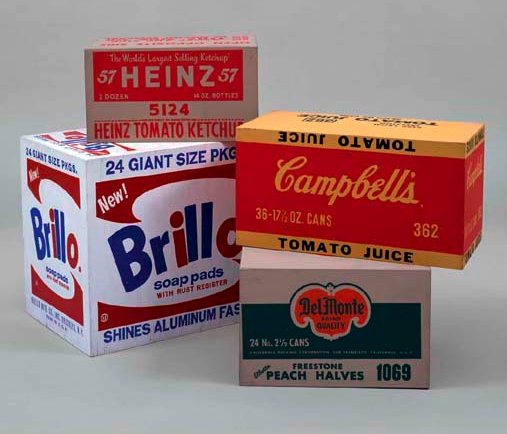
Malanga’s paper titled, “How we made the Brillo Boxes,” was reprinted in his 2002 book, Archiving Warhol. It provides the most familiar accounts of Malanga, Billy Name, and Warhol painting, turning, screening, and turning all seven varieties of the box sculptures in the first couple of months of 1964. [Four Stable Gallery boxes sold at Christie’s in 2006 for $973,000.]
warhol_boxes_64_christies.jpg
But the 1964 Brillo Boxes aren’t the only ones Warhol made. Or Bidlo. Or–well, hold on. Back to The Moment:

If your Brillo Boxes shouldn’t be considered a simple substitute for the originals, what should New Yorkers be looking for?
There are so many more layers. When you start peeling back the layers you see that Warhol did all these different versions himself. There’s the Stockholm version, there’s the Pasadena, the original Stable gallery version. So really it’s about learning about the different providences [provenances? -ed.] of the piece, the situations that they were made for.

The image above is from the Tate Magazine, of Not Warhol (Brillo Boxes, 1969), 1991, and is Bidlo’s replica of the 100 boxes Warhol authorized the Pasadena Museum to fabricate in 1969-70 [LACMA was allowed to refabricate 100 Kellogg’s boxes. Warhol donated both sets of boxes to the respective museums.]
And before that, there were the 100 boxes Warhol authorized Pontus Hulten and the Moderna Museet to make in Sweden for the 1968 show organized by Kasper Koenig. Or was it 500? Or was that 500 actual cardboard Brillo Boxes bought from the company and 100 wooden ones to fill in? Or 10?
Until 2007, everyone thought they kind of knew. Or they didn’t think much about it. Then some Swedish investigative journalists from Expressen reported that no wooden boxes were ever exhibited in 1968, only cardboard.
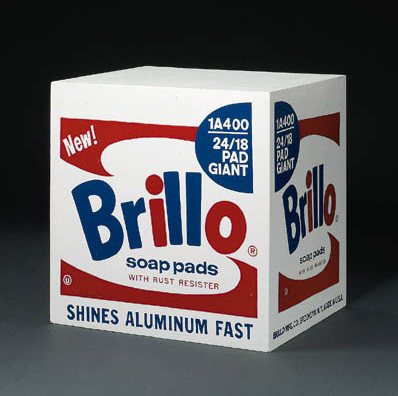
And the 94 1968 “Stockholm Type” Brillo Boxes which passed the Warhol Authentication Board’s test, and were accepted into the 2004 catalogue raisonne, were actually part of a batch of 105 boxes Hulten fabricated in 1990, three years after the artist’s death, in Malmo, Sweden. And that Hulten represented them as 1968 works in shows in St Petersburg and Copenhagen that year. And that he sold at least 40 of them in 1994 as 1968 works. [Does that include this group of 10?] And that he gave six of them to the Moderna Museet in 1995 as 1968 works.
warhol_brillo_christies_98.jpg
Yow. “Provenance: Acquired directly from the artist by Pontus Hulten, Stockholm” – Christie’s, 1998.
The Authentication Board hastily examined the Stockholm Type boxes and issued a letter to owners, saying there were two types of Stockholm Box, one of which might actually have been made in 1968 or so. Maybe there are 10 of those. But there are no documents so far authorizing either those 10, or the 105 Hulten made, only the Stable Gallery and the Pasadena boxes, that’s it. So far. And yet they fully accepted the Stockholm Boxes, no sweat. At this point, the only thing the Warhol Foundation people are saying is that they had nothing to do with this mess.
But what in the world was Pontus Hulten thinking? I mean, come on, the guy’s a modern art museum demigod who founded the Moderna Museet, the Pompidou, and MoCA. It’s not like he really could have just thought, “What the hell, I’ll order me up 100 Brillo Boxes and start showing, selling, and donating them as if they’re from 1968.” Could he?
Did Hulten get authorization from Warhol in 1968, then not really use it [all], and just assume it was still valid? ArtNews quotes an unidentified source as saying that Hulten fabricated his 1990 boxes at the Malmo Konsthall with the help of its director [and Hulten’s friend] Björn Springfeldt. Surely he could characterize how he and Hulten talked about the motives and assumptions for the production. [Factcheck: ArtNews says Springfeldt was director of Malmo Konsthall in 1990 when these boxes were fabricated. Actually, he had quit in 1989, to become director of Moderna Museet. He succeeded Olle Granath, who had succeeded Hulten, and who had been a co-curator of the Warhol show, and who was directly involved in its installation. He also owns three Stockholm Style Brillo Boxes he says were made in 1968. If there’s anyone in the Swedish museum world not directly implicated in this story, would you please raise your hand?]
How different is Hulten’s situation from, say, Giuseppe Panza’s later controversies over authorization and remote fabrication of work by artists like Judd, Flavin, Andre, and Nauman? Does this Brillo Boxes question dovetail with the emergence of artists’ certificates and minimalist-style, no-artist’s-touch production? Are there other examples lurking out there where artists phoned a piece in, then didn’t actually get involved–or even see–the final product? I’m going to guess yes.
If ever there were a time for another Brillo Box Symposium, it’s right now.
“Andy Warhol’s famous Brillo Boxes,” from the Frankfurter Allgemeine Zeitung, August 2007 [myandywarhol.eu]
2007 Authentication Board letter explaining the history and production of Warhol’s box sculptures [zimblo.com]
Nice hustle, Art News: “The Brillo Box Scandal,” Nov. 2009 [artnews.com, link updated to archive.org Sept. 2016]