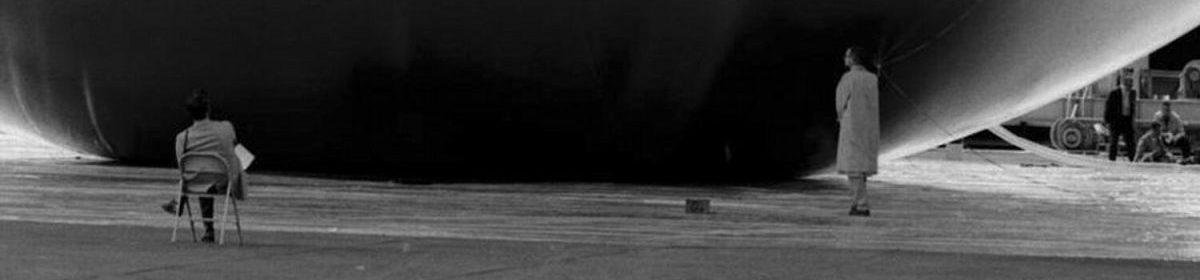
An undated photo mislabeled as “War Art” on eBay, but which was, in fact, a photo of the JFK memorial wreath sculpted by Louis Féron, acquired by Oak Spring Garden Foundation, via Ploughshares
An absolutely fascinating story about a lost JFK memorial sculpture unfolded in 2022-24 at the otherwise serene enclave of the Oak Spring Garden Foundation, the former estate of Bunny Mellon.
It seems to have unfolded twice, or at least to be recounted twice. So far. And I am enthralled by both accounts, which art historian Andrew Wasserman just laid before me. Except now I must repent of some of my judgments of Mrs. Paul Mellon, or at least allow her more grace.
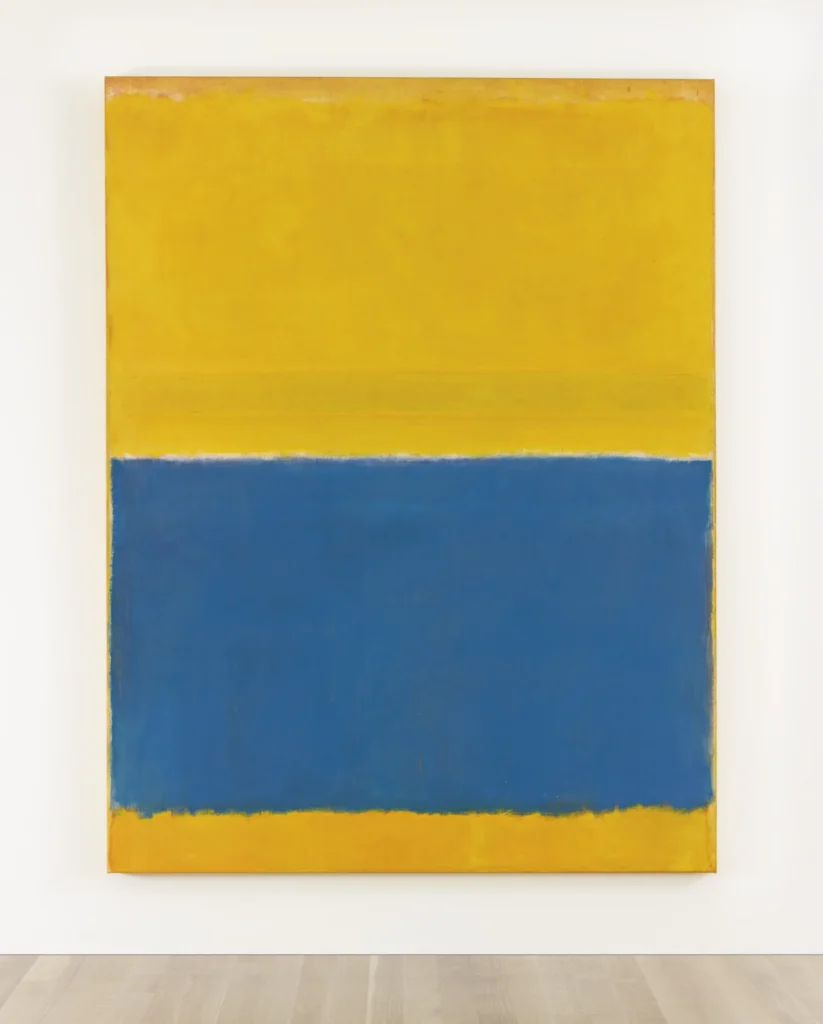
“As we stand enraptured by the stunning resplendency of Mark Rothko’s Untitled (Yellow and Blue) we bear witness to what can only be described as an unequivocal masterpiece of twentieth-century art history.”
I still contend that the auction catalogue essay is an underappreciated genre of art writing, and the 4,000-word lot essay for Sotheby’s 2015 sale of this prime Rothko feels worth a read. Especially so because Artnet reports that the auction house is selling the painting again this fall. And so we will have another essay with which we can index the way these classical Ab Ex artworks are positioned, and how their sellers, at least, imagine them to be understood.
In 2015 that meant namechecking everyone from Giotto to Niezstche and evoking the physical experience of standing in front of the painting in the most intense language you can muster. This manifestation is quoted after the jump, if you can handle it.
As for how the buyers understood things, we must piece together our own conclusions. Untitled (Yellow and Blue) is one of nine Rothko paintings Bunny and Paul Mellon acquired from Marlborough Gallery beginning in 1970, immediately after the artist’s death, and so right in the thick of the fiduciary malfeasance that prompted Rothko’s children to sue.
This and at least seven other Mellon Rothkos were promptly included in the National Gallery’s first show of modern art, in 1973.
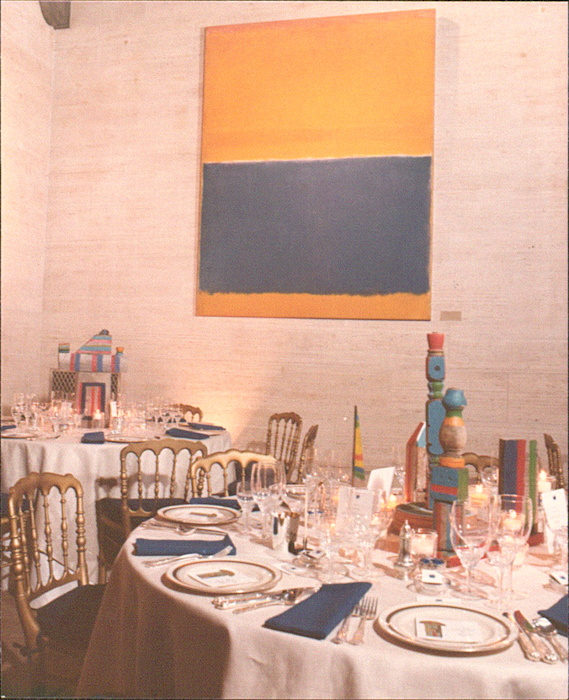
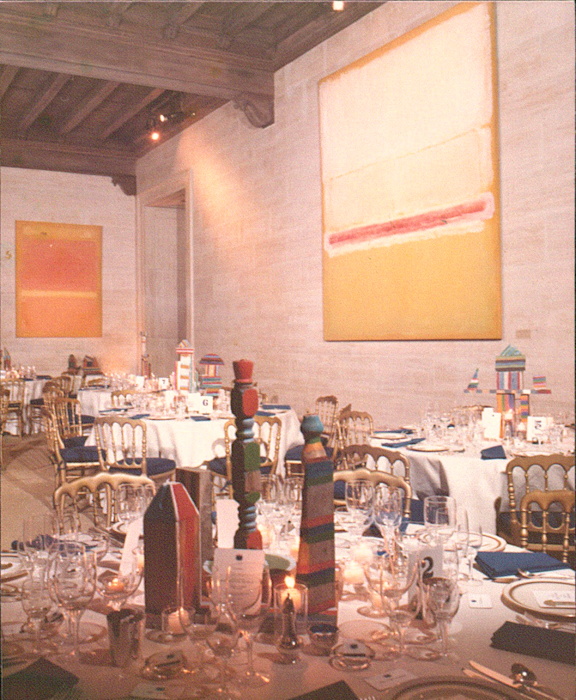
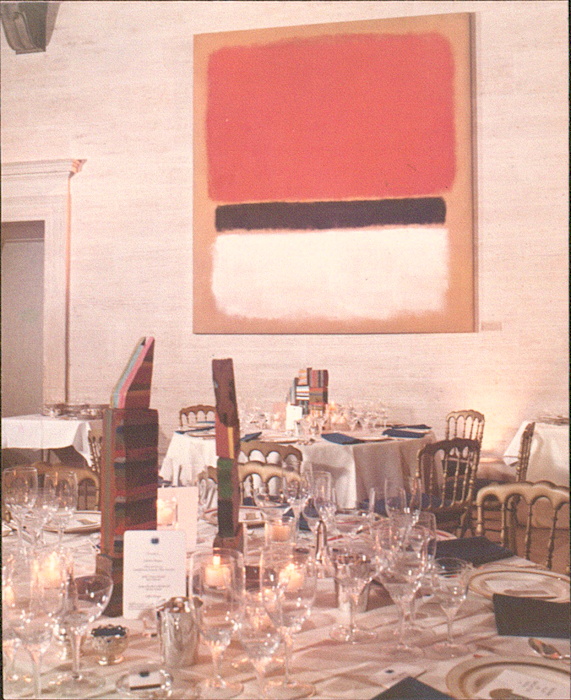
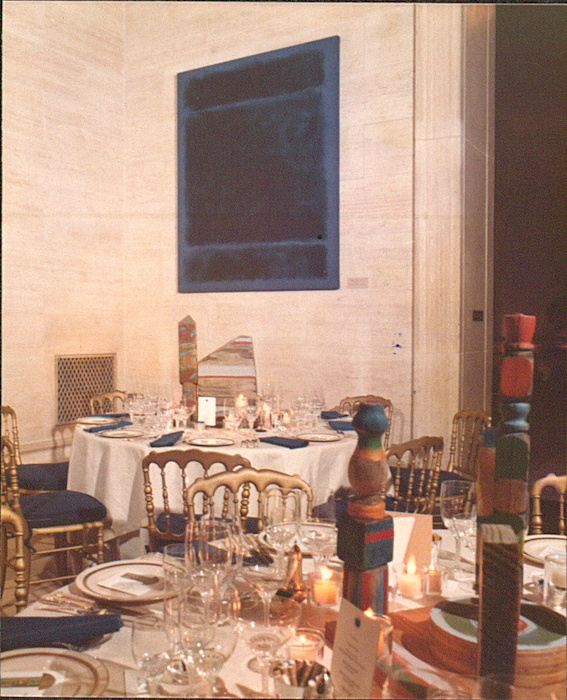
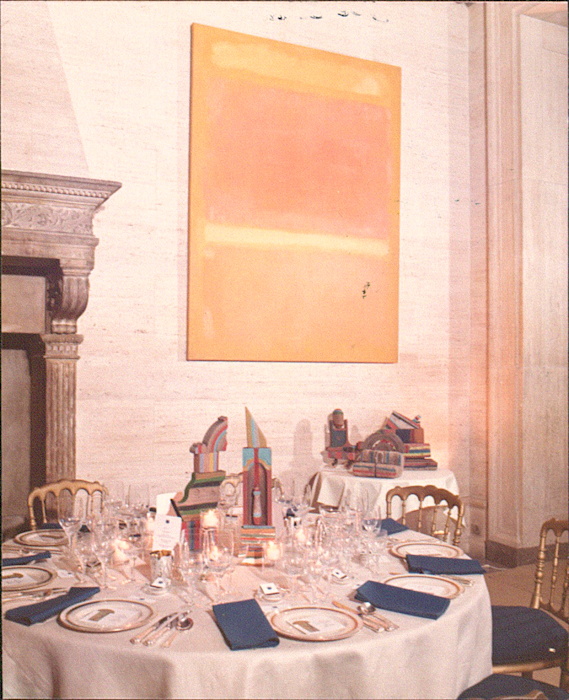
Mark Rothko painting and Betty Parsons sculptures at a 1973 dinner in the National Gallery of Art, image via the Betty Parsons Collection at the Archives of American Art
Some time between Paul’s death in 1999 and 2006, when it was shown at the Palazzo Grassi, Bunny, by then in her nineties and rushing to spend several hundred million dollars before she died, sold the painting to François Pinault.
In June 2013, Pinault sold it through his auction house, Christie’s, along with a Fontana, to Eric Tan, a cutout for Jho Low, the Malaysian money launderer. [According to the Feds, the $79.5 million invoice was $36m for the Fontana, and so $43m for the Rothko.] In October 2013, Tan gifted the works, along with a $3 million Calder, to Low, with three copy & pasted “gift letters.”
[Because legal filings are another underappreciated genre of art writing, the excerpts of the gift letters included in the US Justice Dept’s 2020 forfeiture filing against other laundered artworks, a Warhol and a Monet, are also after the jump.]
In April 2014 Low borrowed $107 million from Sotheby’s Financial Services, pledging up to $285 million in artworks as collateral, including the Rothko, then he instructed them to sell artworks until the loan was repaid. Sotheby’s put the Rothko in their May 2015 Modern/Contemporary sale, where it was purchased by Russian oiligarch Farkhad Akhmedov for $46.5 million as part of his attempt to conceal $600 million while divorcing his wife Tatiana Akhmedova.
Tatiana was awarded title to the Rothko, other art, a yacht, and an apartment, in 2016, but some of the assets had been secretly transferred to the feuding couple’s son, and in 2020, she was still suing to receive them. When Sotheby’s publishes the updated provenance, perhaps we’ll know if Tatiana is the present seller. Artnet says the consignment was only just arranged, which may be why Sotheby’s pushed back their Hong Kong sale. But if you need to convert eight figures in a somewhat portable but rather traceable masterpiece, November 8 is your lucky day.
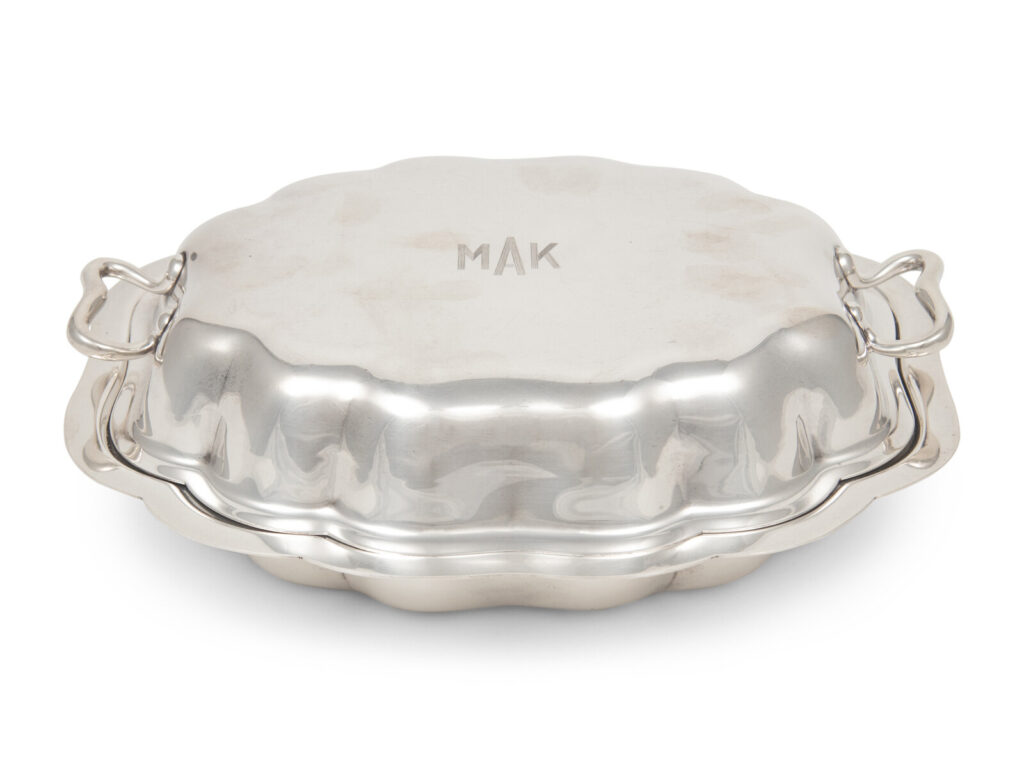
The Embassy Scroll by Lunt Silversmiths was the official silver pattern for U.S. embassies and consulates around the world.
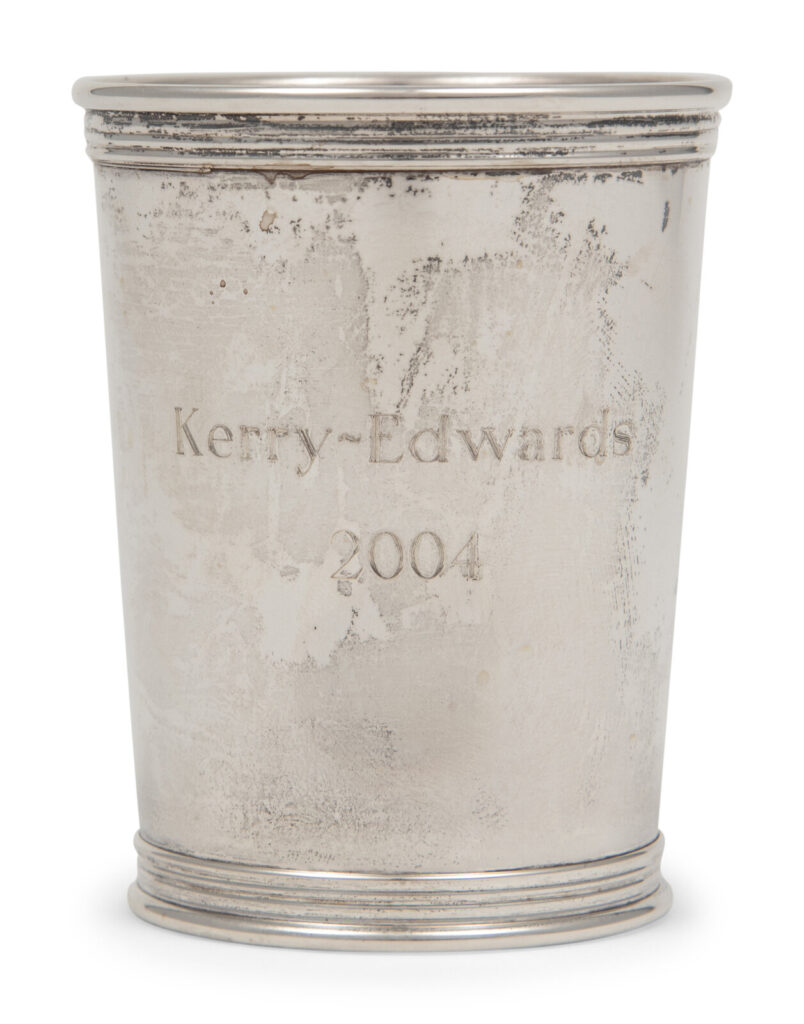
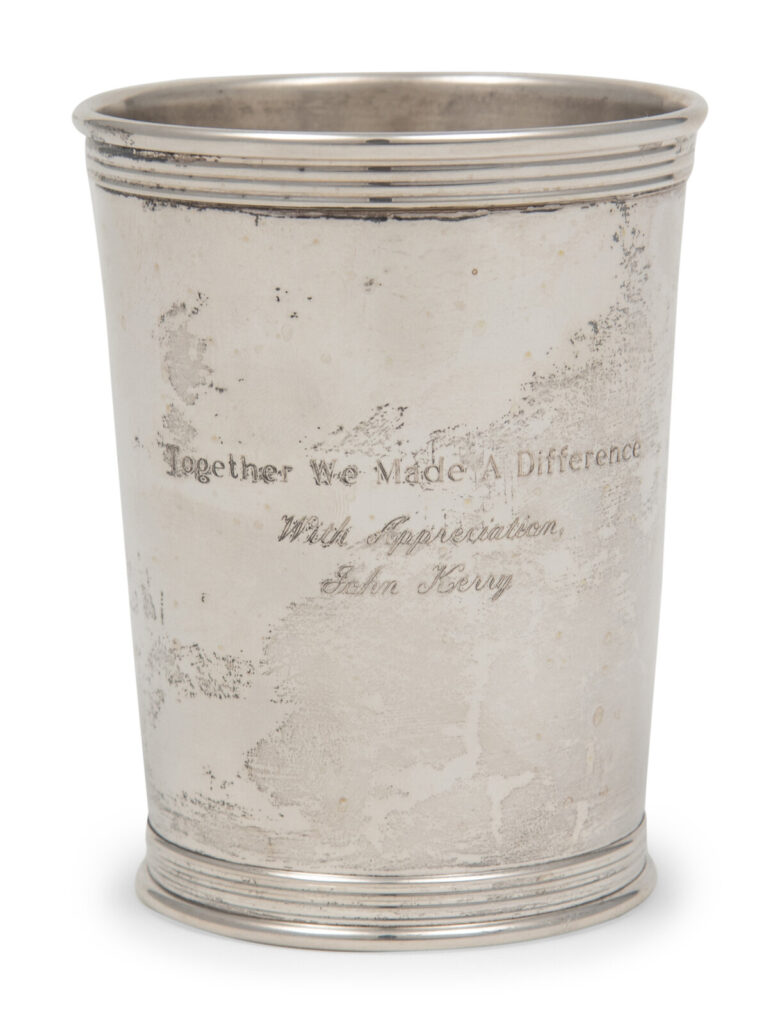
A Kerry Edwards 2004 Commemorative Mint Julep Cup in silver by Lunt Silversmiths, 3 3/8 in. tall
Lunt also made commemorative mint julep cups, a form of gift that evolved in Kentuckian horse racing society.
This sterling silver commemorative mint julep cup was made by the Kerry Edwards 2004 campaign for the U.S. Presidency. “Together we made a difference/ With Appreciation/ John Kerry” is engraved on the verso.
If there was a difference made in the 2004 presidential election, it was the failure of a decorated war hero turned opponent to fend off the attacks of a draft dodger turned war criminal in the middle of an historically unpopular and unjust war.
John Edwards’ 2008 campaign for president was derailed by the revelation that he had a child with a webvideo documentarian after his wife was diagnosed with breast cancer. Edwards also seduced Bunny Mellon to give him over seven hundred thousand dollars during his presidential race, but not as a campaign contribution. He used the money to cover up his affair. Lunt Silversmiths, a family business founded in 1902, sold its trademark to Reed & Barton in 2009 and was dissolved in bankruptcy. John Kerry became Secretary of State during Barack Obama’s second term. Albright died in 2022.
Here are photos of Betty Parsons’ sculptures on the dining tables at the opening dinner for the National Gallery of Art’s first exhibition of modern art, held in 1973. On the walls are many Rothkos.
The exhibition, American Art Art Mid-Century, curated by visiting MoMA alum Bill Seitz, was made up entirely of loans from private collections, because the NGA had basically no modern works, and had only barely begun to even accept works by still-living artists. [That Gorky, Kline, Newman, Pollock, Rothko, and David Smith were all dead by 1973 hadn’t helped them get into the collection.]
When J. Carter Brown became the NGA’s director he made the controversial decision to hold VIP dinners in the museum itself. NGA president Paul Mellon’s wife Bunny, renowned for her gardening and interior design acumen, took upon herself the role of planning flowers and decor for many of these special events.
I have yet to track down the checklist, but the show’s press release [pdf] says there were 26 works by 23 artists installed in the temporary exhibition galleries on the main level. Yet these photos show at least eight Rothkos, in a room which I believe is on the far west end of the ground level.
According to Bunny Mellon: The Life of an American Style Legend, by noted centenarian socialite biographer Meryl Gordon, Mrs. Mellon asked Parsons to provide some of her painted found wood sculptures-a letter in the Archives of American Art [p.23] says “10 or so,” but Gordon says 14, and I count like 28-to “adorn [the] tables” at the dinner. Parsons’ datebook [p.132] shows she attended.
Mrs. Mellon was a frequent customer and friend of Parsons. Parsons exhibited her own sculptures and paintings in Washington DC’s Studio Gallery beginning in 1972, and would later show Bunny’s daughter’s artworks in New York. There is an invoice [p.16] in the Archives of American Art for printing table cards for the NGA dinner. I think they’re the gilt-edged ones in the bottom of the picture above.
It struck me that as a dealer, Parsons had been instrumental in the careers of many of the artists in the show. Yet her own artwork was being relegated to decoration. But Gordon notes that Bunny also loaned the Rothkos. Which might mean Bunny’s concept for the dinner was a two-artist show. Notice above, the table under the Rothko which has nothing but Parsons sculptures on it. Also, wow, every place setting has its own ashtray and embossed matches.
Quoting Lee Hall’s 1991 illustrated biography of the gallerist, Gordon wrote that Parsons worried the partygoers “will hate my work.” She also wrote that all “her table sculptures for the National Gallery sold out.” Wait, what?
These photos, from the National Gallery of Art, are in the gloriously digitized Betty Parsons Gallery papers at the Archives of American Art. [aaa.si.edu] Meryl Gordon spoke about her biography of Bunny Mellon at the NGA on October 15, 2017 [nga.gov]
The press release for American Art at Mid-Century says the show is the first of two, but I haven’t found the second [nga.gov, pdf] Buy Bunny Mellon: The Life of an American Style Legend via bookshop.org [amazon]