This honestly feels like a monkey paw wish situation.
To celebrate 20 years of me nagging them about merch, Glenstone has just launched merch. And it’s got Jeff Koons or Andy Goldsworthy on it.
Glenstone 20th anniversary limited edition t-shirt with one of four illustrations by Jordan Awan, $40. and Glenstone 20 black hat with white embroidered logo, $35. via glenstone
OK, the fox t-shirt with the Serra Contour in the background is kind of nice. And the hats. And the totes.
R.H. Quaytman, ד Chapter 24, 2012, 20 x 20 in., ink and gesso on plywood, selling at Rago Arts
You were staring at R.H. Quaytman’s painting on the auction website, wondering if you were going blind trying to figure out what was happening. This is not something that would happen if you’d seen it installed at the Museum Abteiberg in Mönchengladbach in 2012. Because you’d know immediately that you were standing in front of a 20 x 20 inch plywood panel with a beveled edge, that had an image screenprinted on it of a slightly crushed black cardboard box with a die cut square window near the top, and a library label wrapped around the side.
Ellsworth Kelly, Seaweed, 1949, oil on canvas, 72.4 x 99.7 cm, 📷: @albemuth at the Philadelphia Museum of Art, where it was a 2023 gift of the Ellsworth Kelly Foundation
I forget what a delight it is to read Ellsworth Kelly’s catalogue raisonné, especially the first volume, which covers Kelly’s years in Paris. As Yve-Alain Bois, who’s writing the CR, has noted frequently, Kelly was exploring and discovering and inventing so many things that would become the focus of his decades-long career. Between this generative importance and Kelly’s own exhaustive archiving, Bois wrote an essay filled with new insights and historical detail for basically every painting.
I’d forgotten all this when I saw @albemuth post his photo of Seaweed, the largest painting Kelly made during his 1949 stay on Belle-Île, off the Atlantic coast near Nantes. It’s one of several fascinating, mostly white paintings from the moment, that toggle between the seemingly abstract and the diagrammatic, including two favorites, Toilette and Kilometer Marker, which were both in the EK100 show at Glenstone in 2023.
And I’d completely forgotten that these white works especially were part of Kelly’s grappling with Picasso, whose spindly, spiky linear postwar paintings loomed over Kelly’s sojourn in Paris. Kelly threaded a path between Picasso’s distorted visions and the world as he—Kelly—saw and found it, and then spent seventy+ fruitful years making art in that reality.
Beginning, in important ways, with Seaweed, which Yve-Alain identifies as the first example of Kelly faithfully recording a flat compositional source onto a flat canvas, a crucial non-compositional strategy he—Bois—calls transfer. Kelly splayed the tendrils of a piece of seaweed found on the beach and pinned to the wall of the one-room shack he’d rented on Belle-Île, and then he painted it, and then erased [sic] extraneous parts with white overpainting to complete the picture. And it’s somehow those palimpsests, like shadows, that give Seaweed a vibrational presence. And then there’s that pin, which now looks like the head of some winged creature. But that’s probably just me.
Ellsworth Kelly, Monstrance, CR65, 1949, oil on plywood, 61 x 50.2 cm, as published in the EK CR, Vol. 1
And I’d not forgotten this other fascinating painting from Belle-Île, but really had never clocked it all. Monstrance‘s title refers to the sunburst-shaped stand that holds the consecrated eucharist in a Catholic liturgy. But reading Yve-Alain’s entry for the work, the motif turns out to be based on a sundial-like construction on the facade of a building next to the church on Belle-Île. Tracing the iterations and adaptations through Kelly’s sketches and notes, Bois shows how Kelly processed seeing Picasso’s The Kitchen in Paris, and fused multiple references—to a sun-shaped monstrance he sketched in a Paris museum and to the sundial in front of him—into a single painting.
Ellsworth Kelly, Austin (larget monstrance-shaped detail), 2015, 📷: Jason John Paul Haskins via flickr
And so I’d completely forgotten this Monstrance was connected the other window in Austin, Kelly’s chapel at The Blanton. And I did not realize Kelly left the painting to The Blanton after his death. Which now makes me want to see a stained glass version of Seaweed, tbh.
I’ve been holding back on the Nolandposting since I have yet to see the show, but a couple of people now have noticed what feels likely to be my favorite thing about it: the little scale models of Noland’s artworks.
detail of the Glenstone box in Cady Noland’s Untitled, 2025, as noticed & noted on ig by @devinrmitchell
They’re tools for designing shows, of course, but here, they’re also elements of a larger work, Untitled (2025). It’s a recursive work made of works and arrangements of works, arranged on a tabletop, in a gallery, Cady Nolands all the way down.
I went back to the National Gallery of Art today just to photograph the two major lighting WTF going on right now, but also to celebrate the return of Ellsworth Kelly’s Tiger, an early multi-canvas masterpiece from 1953. The work had suddenly disappeared from the 2023 Ellsworth Kelly show at Glenstone, without a word of explanation.
In completely unrelated news, I remember a few weeks ago talking with one of the conservators at the NGA who said how much Ellsworth loved the Gallery, and had even left a bunch of money to research the conservation of contemporary paintings. Which is good, because [counting Tiger as one,] they have 24 Kelly canvases.
Back to the photo, which also shows Lighting Situation #1, or 1-3: a gallery of three white hot Dan Flavin Tatlin Monuments throwing my ccd out of whack.
Which is fine. But there is a white walled gallery next to it, filled with white paintings. That is a Barnett Newman on the left, The Name II, 1950, very rarely seen. There’s also a Mary Corse, Robert Ryman, Freddy Rodriguez, and an Anne Truitt.
Truitt’s white acrylic and pencil on gessoArundel XI painting suffers the worst. My phone camera is doing a lot of work here, and the painting is still almost unseeable.
You know, to see these photos of Lighting Situation #2, Yellow Gallery, I feel like I’m being a noodge; they really do seem to color correct a lot, even presenting the range of yellows Christo, Truitt, USCO, Kusama, and Mangold used.
Even Olafur’s got two different yellows, in the door and the orb. But it truly is the orb yellow that becomes a collaborator with every other work in the room; it’s really palpable. There is a similar circular pedestal being set up on the mezzanine right now; I wonder what they’ll hang above that one?
I really feel like I can see how these installations came together; the way the curators thought through the challenging situations these light-based objects present; and the factors that brought them to this spot in the first place. And it’s good to remember we really are all going through some stuff right now, as a city, a capital, a nation, and a world.
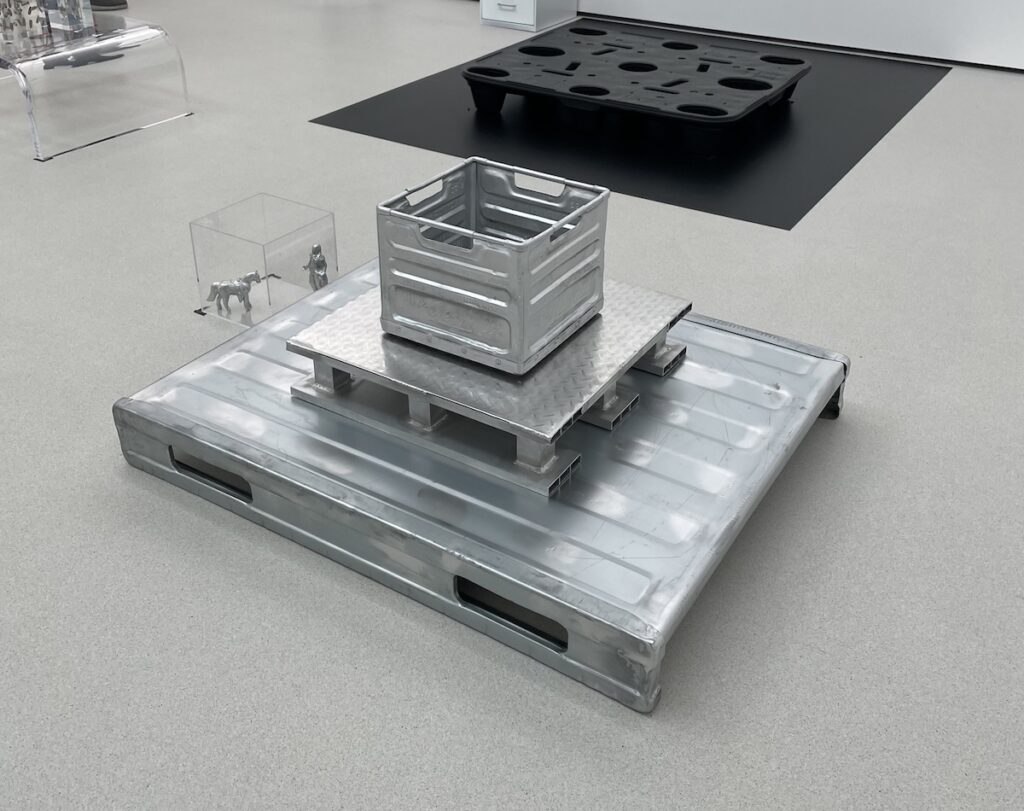
Cady Noland, Untitled, 2024, as installed at Glenstone in October 2024
Now that she’s been having some shows, Cady Noland is known to make changes to installations of her work, even dramatic ones, even last minute. So maybe it was not so surprising to realize she added a new work to the exhibition at Glenstone last October, which came so late in the process it did not appear on the museum’s downloadable checklist.
And while there were also shipping palettes from Amazon stacked in the gallery that were also not on the checklist, the status of this work, Untitled (2024), was only uncovered/confirmed three weeks later, when Alex Greenberger reviewed the show for ARTnews. And it took still more weeks to add it to the checklist, the only prepared information available to visitors.
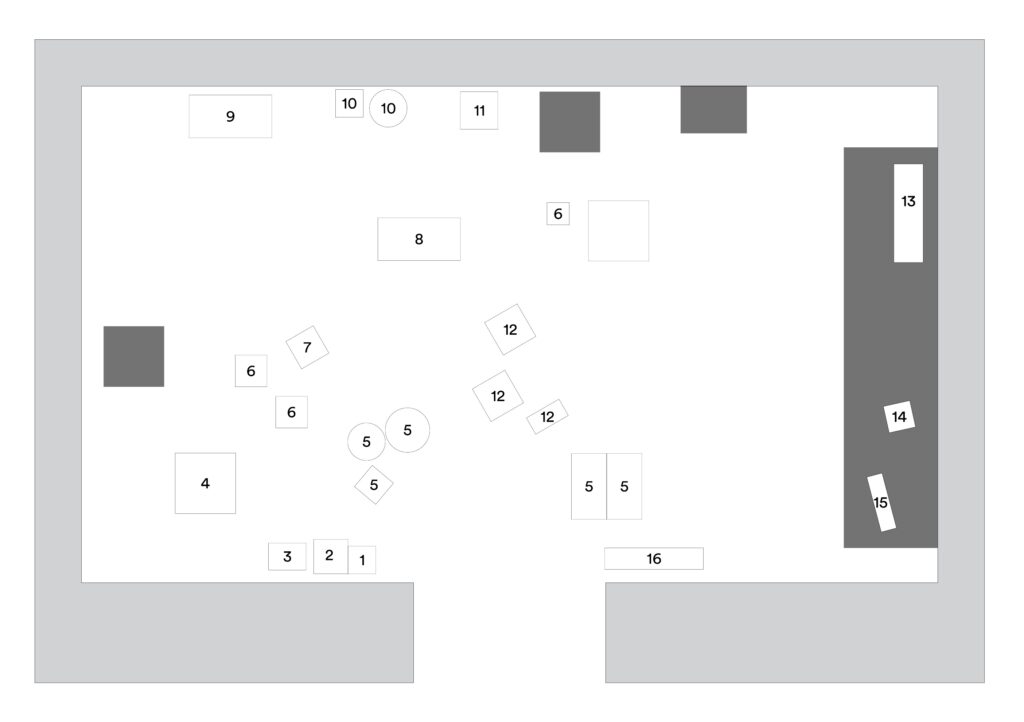
No indication it’s even a work, yet there was time to add an unnumbered square next to the 6
At the time, I wrote that such a move was not an error: “This incompleteness, this inaccuracy, is part of the encounter; this disconnect between what you see and what you’re told is part of the experience.”
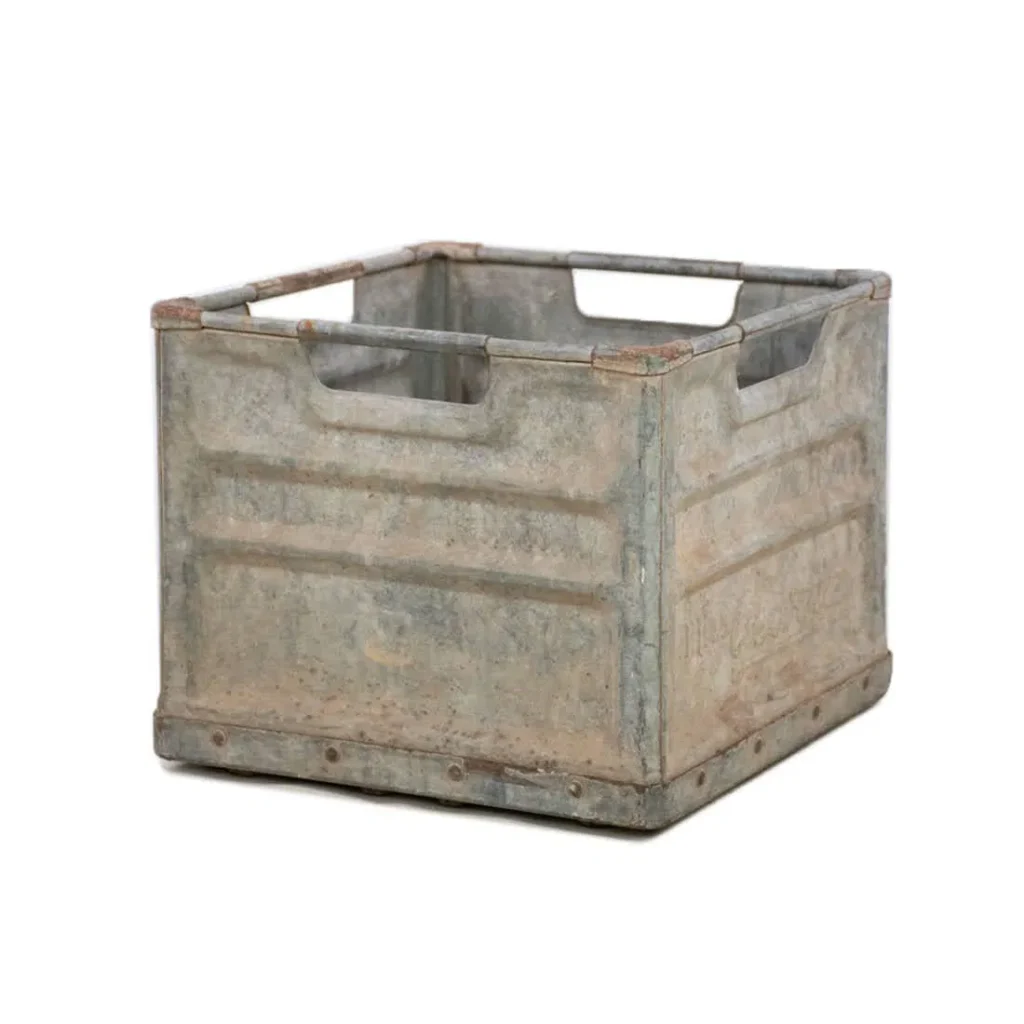
Well, now I wonder if it might have been omitted for reasons other than coy mystery. Because the most prominent elements of the work Noland added are a palette with the Amazon sticker still attached, and a milk crate stamped with a threat from the Pinkertons. The Pinkertons who chase down milk crate thieves, but who are most famous for attacking striking steelworkers on the orders of Andrew Carnegie and Henry Frick.
I had not realized that last summer, before the museum had fully reopened from its remodeling, Glenstone’s hourly workers voted to form a union, and that the Raleses had hired the same anti-union lawyers and consultants as everyone else—including Amazon. Kriston Capps reported on the union’s efforts and voting almost a year ago. That would have been right around the time Noland was installing her show.
There is not much information beyond Capps’ early reporting. The last post on the instagram account for Glenstone Museum Workers Union, affiliated with the Teamsters, was from November 22nd. It says two bargaining sessions were completed, in September and October–and that the November 2024 meeting had been canceled without explanation. A December meeting was TBD. Noland’s show opened October 17th, in what seems to be the middle of a breakdown of negotiations.
To drop a pyramid of unionbusting references in the center of the gallery could be read as a show of solidarity with the union. If anyone knew to look. Now the prolonged omission of the Pinkertons work from the checklist feels like it could have been a move to deflect or diminish the impact of Noland’s gesture of support.
Unless? Do we really know that Noland’s invocation of the Pinkertons thugs isn’t a shoutout to management, an homage to the Fricks of our day, the industrialist connoisseurs who bought basically every major piece of the artist’s work to come up for sale in the last twenty years? If it was, maybe Glenstone would have bought it. Or they would have at least included Noland’s loans in the documentation of the show.
Have you seen me? Ellsworth Kelly, Tiger, 1953, oil on five canvases, collection, NGA
I was listening to a recording of Ellsworth Kelly’s 1999 Elson Lecture at the National Gallery of Art, and I have some questions. Some could probably be answered by a video of the lecture—more of a conversation, with curator Marla Prather—or with a review of Kelly literature I don’t have.
I was not prepared to be taken out a Jenny Holzer exhibition, especially since her most recent show at the Guggenheim seemed so lost. But that was then and there, and this is here—in DC, at Glenstone—and now—in the midst of a fascist crime spree by and against the government.
from the Glenstone extended exhibition guide
It was not the merch in the tiny book nook. It was not the entire gallery of redaction paintings—enlarged, oil-on-linen facsimiles of damning documents of the torture and atrocities of Bush’s Iraq war—though I really do wish this country would not give Holzer quite so much content to work with. Turns out abuse of power comes as no surprise because it happens over and over and over.
from the Glenstone exhibition guide
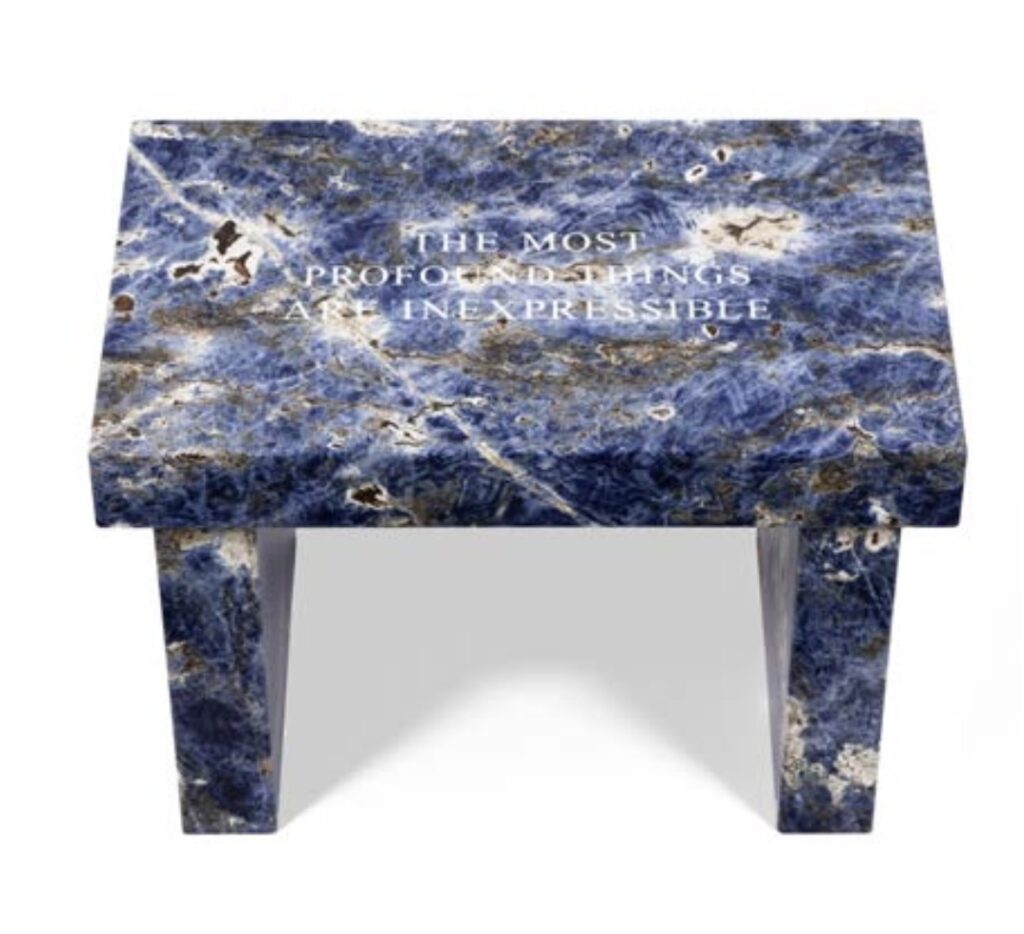
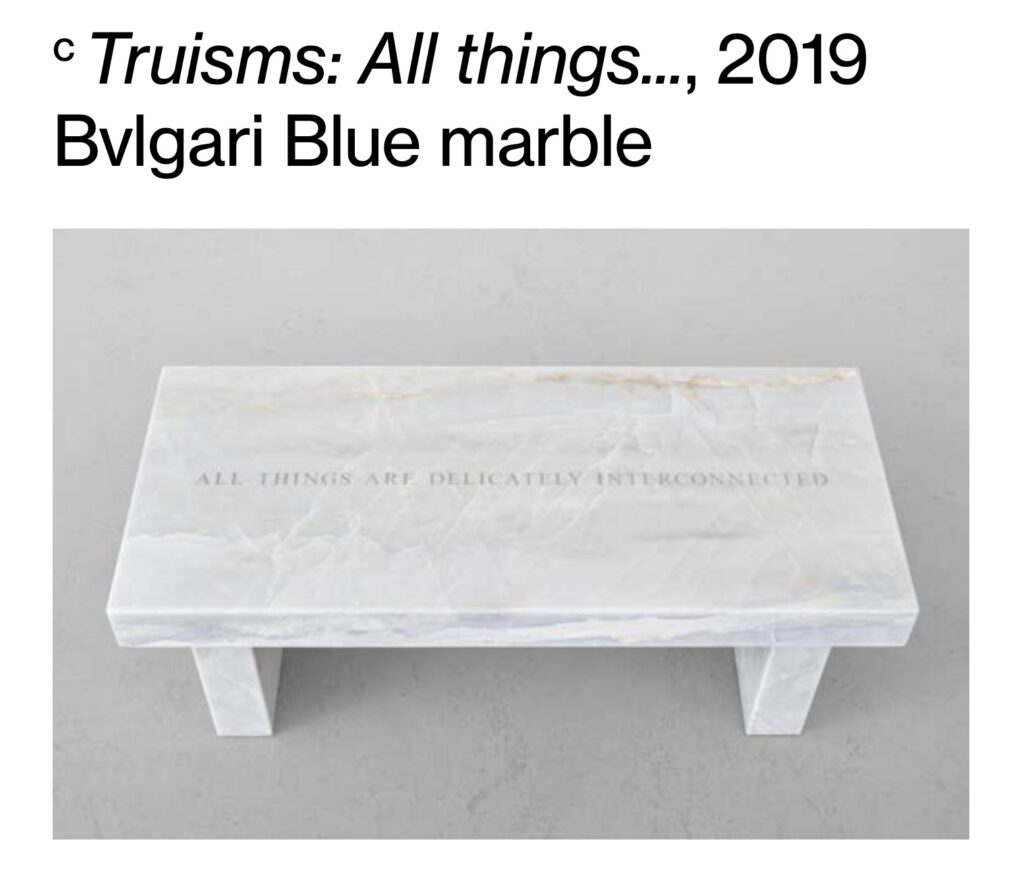
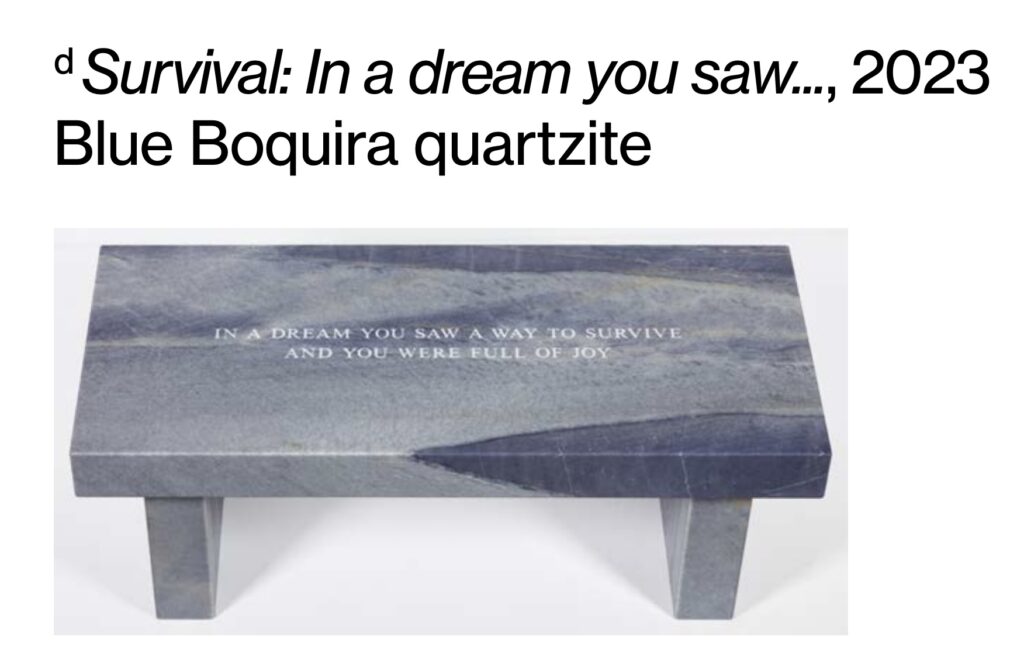
It was the next gallery of the private museum sanctuary, with the large window onto an artfully crafted vista, where Holzer crashed a tsunami of opulence over my unsuspecting head. It was all benches and paintings, not an LED ticker or a bumper sticker in sight. The benches in Blue sodalite. Bulgari Blue marble. Blue Boquira quartzite. Persian travertine and Silver Wave marble. Paintings large and small, single and in rows, cinnabar and lacquer finishes covered in copper and gold leaf, glowing in the morning sun. The extravagance of Holzer’s materials was so relentless, it was wretched. The polish, the weight, the preciousness, the hand, the logistics, the overpowering beauty impossible to ignore.
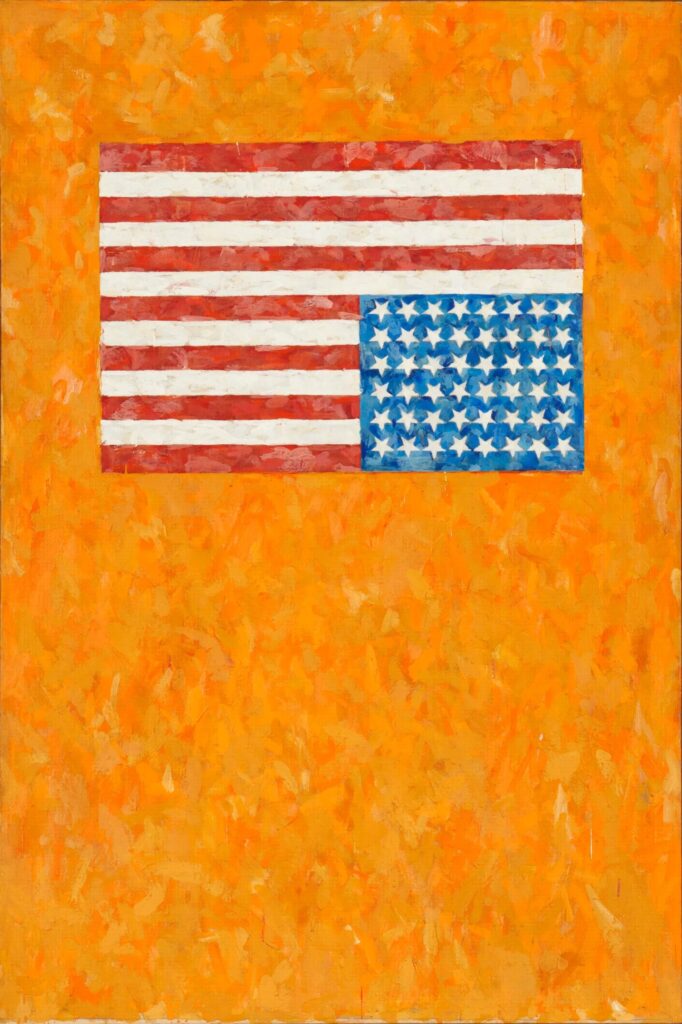
altered installation photo of upside down flag paintings from The Broad’s 2018 exhibition, “Something Resembling Truth,” original image by Eugenio Rodriguez, via artforum
When I first thought of it, it was still within the framework that has dominated art critical discussion of Jasper Johns’ work since the beginning: Is it an upside down flag painting or a painting of an upside down flag?
But this is not the moment for glib rhetorical dualities. Right now an upside down flag does not have to be either “a signal of dire distress in instances of extreme danger to life or property” or a political protest. With active attacks on democratic institutions and the rule of law under the US Constitution, it can be and must be, unfortunately, both.
Whenever I wonder why no one has ever reviewed or analyzed Cady Noland’s 2021 monograph, The Clip-On Method, I wonder if I’m the guy in the hot dog costume or the guy in the color-coordinated suit. I mean, I’ve read both volumes, and refer to them regularly for info and images, but I’ve never written about them, or what they contain, or what it means, and what it tells us about Noland and her practice and the world she sees.
Well, someone finally did, and the results are bleak as hell.
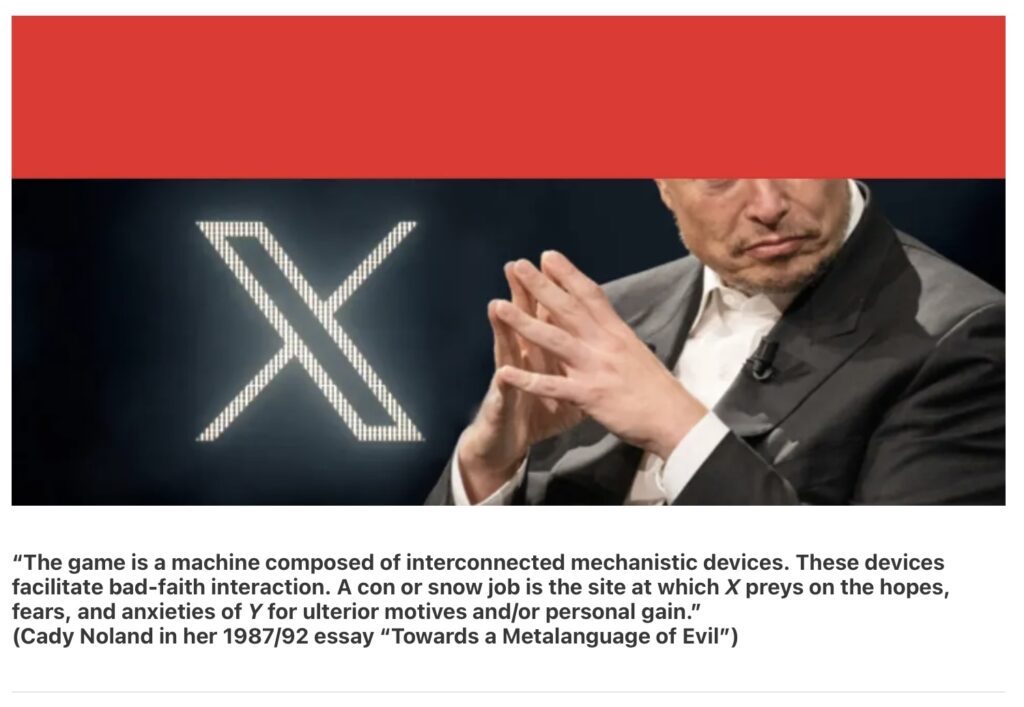
Garrett takes a long, close look at Noland’s work, but also a close read of her texts. He begins with her signature 1987/1992 essay on our culture of the psychopath, “Towards a Metalanguage of Evil,” which has been namechecked for years without, apparently, sinking in. But he then goes deep into the essays and papers Noland included in The Clip-On Method, key texts by sociologists Stephen N. Butler and Ethel Spector Person.
[brb gotta run to a lecture, but the Glenstone Noland exhibition closes tomorrow, so get going.]
Looks like more writeups of the Cady Noland installation at Glenstone are turning up—and more images of it are getting out. Ian Ware at 202 Arts Review has apparently found the same stash of Noland photos online—though he is more assiduous in his image copyright crediting than I was.
And that’s all reason enough to rejoice. But beyond that, Ware has a very interesting, site-specific take on Noland’s take on her works’ new home. He finds a relationship between the temporary walls Noland erected to block a distracting view of the museum’s pond, and the museum’s own temporary walls blocking off the building’s renovations.
He also sees in Noland’s alterations and additions to the installation a critique of the Raleses and their multibillion-dollar project. Here he draws on the larger context of the Raleses’ business dealings and Glenstone’s construction–and the lawsuits with its contractor that precipitated the current closure and renovations of the new museum building—and even some of the lurid investment shenanigans by the contractor’s family—a local real estate dynasty, apparently—that “may as well have been written for a tabloid delivered straight to Noland’s doorstep.”
What feels more resonant—and which I think takes more properly into consideration the involvement of Emily Wei Rales, in curating, collecting, and institution-building—is the exhibition of Noland’s work alongside the text collages of Lorraine O’Grady and the powerful sculptures of Melvin Edwards.
As someone who’s watched the Raleses develop their vision from various vantage points, I feel like they’ve been thoughtful to iterate away from the narrow trophyism of, say, the Fisher and Broad collections. The collecting path from Split/Rocker did not have to lead to Noland, or O’Grady, or Edwards, but here they are. If they do take a couple of hits from an artist they think is significant, I imagine they’d be undaunted, maybe even appreciative. Their venture faces more credibility risk from privileging artists’ approbation than from accommodating their critiques.
But this gets to the crux of Noland’s work today, when the poisonous forces of media, politics and power have outstripped everything she flagged back in the day. Can her new work make a similar impact to her earlier hits? Is that even something she considers? Or does the proliferation of objects trapped and neutralized in acrylic blocks, perched on industrial logistics flotsam target a new, contemporary source of dread we’re still too asleep to realize? And does this luxuriously contemplative installation help us to see, or does it sedate us?
Alex Greenberger not only has a review of Glenstone’s Cady Noland exhibition, he breaks news about it. And he not only breaks news about it, HE HAS PICTURES. Run, click, don’t walk. I’ll wait.
OK, while I think he’s kind of overinterpreted the transgressive unavailability of those black palettes Noland has added to the room otherwise filled by the contents of the artist’s Gagosian show last year, Greenberger is right to notice the slipperiness of the exhibition checklist. There are objects that are on the map, but not on the works list. The stacked palettes are an “element” in this category, and so is another stack of aluminum objects—which turns out to be a 2024 work “on loan” from the artist [scare quotes in the original].
It’s been almost three weeks, and they have not “corrected” their information, and the Glenstone folks get a little coy when Greenberger asks if they will. Now Glenstone is a professionally run and thoughtful institution where the impact of subtle detail is not unappreciated. This incompleteness, this inaccuracy, is part of the encounter; this disconnect between what you see and what you’re told is part of the experience.
[December 2024 update: they have added the loaned work to the checklist. It is “‘Untitled’ 2024, metal crate, metal palettes, courtesy the artist and Gagosian.”]
Let me add another piece of info in turn, which I don’t know whether to believe myself, but that fits: Clip-On Man, the 1989 work at the pavilions’ entrance, listed as being from a “private collection,” is also a loan from the artist.
I read Sidetripping at Glenstone last time I was there, sitting on Martin Puryear’s elegant bench, facing a tastefully manicured wilderness. Gatewood revels in the underbelly of New Orleans as a degraded destination of American freakdom. Burroughs’ text is a highly baked, freeform riff on the photos, which Gatewood put in front of him while working on assignment for Rolling Stone. In subject, luridness, and bleakness, it felt like a touchstone for Noland’s entire project, if not a straight-up Rosetta Stone. I can see why she’d put that at the entrance of her show. [And name her previous show after it, and her book.]
[NEXT DAY UPDATE: I went back to Glenstone today to see this shiny stack I’d seen before, now disclosed to be a new work from the artist. This Pinkerton’s crate situation is a bit overdetermined, I think. There are actually two similar crates of stamped, galvanized sheet metal in the gallery, each with the name of a different regional dairy, and each threatening the involvement of the Pinkerton’s if you steal it. One looks like this, complete but very vintage. The one Alex says was cast certainly has a pristine finish. It could be sandblasted or remade, for sure. I did find a picture of the previously unacknowledged work on the internet:
a previously unacknowledged untitled artwork from 2024 by Cady Noland, seen in an uncredited photo found on the internet, also showing a pallet whose auratic status has yet to be disclosed.
That middle pallet is the one with the Amazon ASIN sticker still on it: the Vestil AP-ST-2424-SB, currently listed on AMZN as unavailable, though it can be easily found on other retail sites.
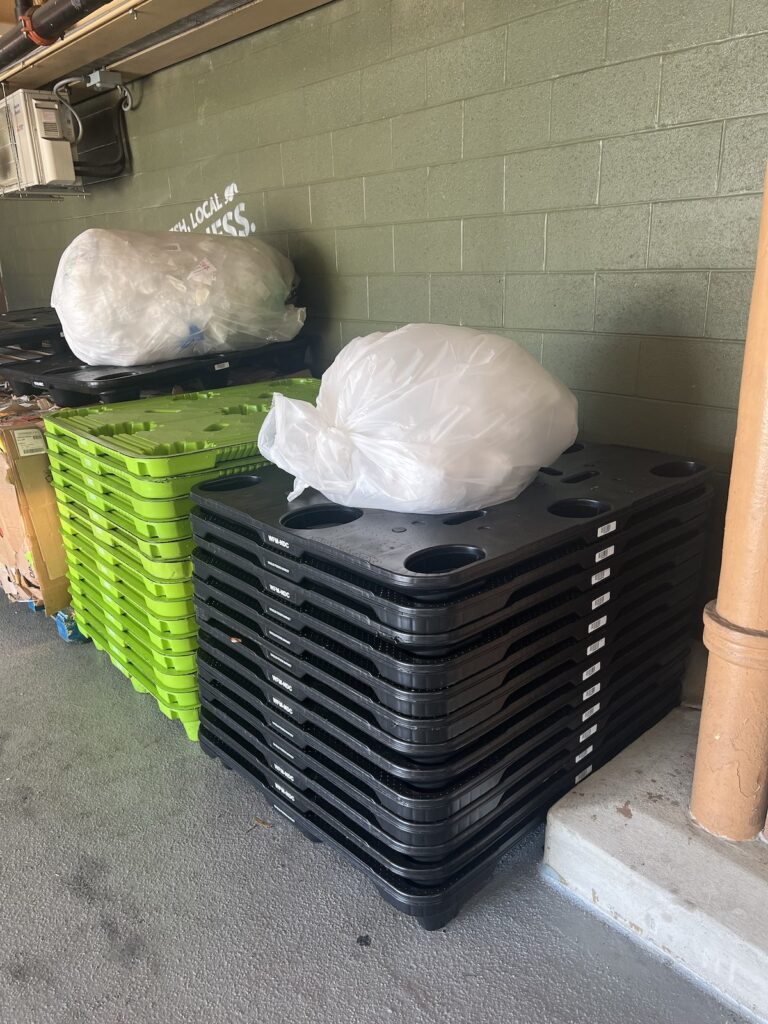
Speaking of Amazon and pallets, that black pallet in the background is of the type also mentioned in Alex’s review. It, too, is findable online, though maybe you need a commercial account to purchase it. I think the “violation of state law” thing is, like the Pinkerton’s warning, a boilerplate assertion of ownership for property that circulates unattended on these mean streets. A cattle brand for corporate assets.
On my way home, I had to return a cursed Amazon purchase, and so made a rare trip to a Whole Foods, where I was greeted by this:
While we wait to hear if these pallets, too, are a previously unacknowledged Cady Noland, we can bring their implication in the monopolistic retail/digital/content behemoth engulfing our world into the unsullied noncommercialism of the Glenstone installation. Also, if, looking back at the Gagosian show it felt like half the non-vintage elements were sourced at The Container Store, remember there is one in Chelsea, right next to a huge Whole Foods. Instead of an artist who has walked away from artmaking, we may have to reimagine Noland as someone making art from the churning world she passes through every day on her way to the gym.
“Beginning October 17, and spanning three rooms of the Pavilions, Glenstone will share a presentation of works by Cady Noland. Developed in collaboration with the artist, this presentation will mark the first major survey by a U.S. museum of her decades-long career.”
Reader, the presentation has been marked. Last year I poured one out for anyone who’d hoped to buy a new Cady Noland work. But now I feel for anyone who’s been trying to buy a major Cady Noland the last 17 years. Because Glenstone got them all. Look at that map; Glenstone has Cady Nolands even Glenstone doesn’t know about.
Three of the six open pavilion spaces are Noland’s work. [The others are two galleries of works by Lorraine O’Grady and Melvin Edwards, and the little library.] The first thing you see as you go down the stairs is not a Noland sculpture, but a Noland architectural intervention. At first it read like an Ellsworth Kelly, if only because architecture-scale Kellys were just on view here. Up close, no, closer, inside it, it read like an Anne Truitt, of the back of the Anne Truitts that had backs.
The no photography proscription is excruciating, and I find myself trying to no spoilers my way through this post, as if it’s feasible to say, let’s discuss it after you’ve seen it. The artist adjusted the space to minimize distraction and focus attention on her work, and it works. They borrowed Clip-on Man. Charles Gatewood’s book with the source image is in the library.
The Raleses purportedly acquired Noland’s entire show last year at Gagosian, but it also somehow fills a space three times the size. There is a lot less tape, except when there isn’t.
There are pallet plinths that are not elements of the work, except when they are. There are foam and carpet blocks that precede an installation, except they’re still here. It’s at once pristine and provisional.
The paper labels remain on the white wall tires. You may not ride the tire swings. The internal gear to lift the massive stockade is freshly lubed, but the crank is padlocked. The chain that connected the bench is gone. Oozewald has its corrected and copyrighted stand. The wear on the corners of one (non-mirror-finish) aluminum panel propped on the floor is enough to make the owner of Cowboys Milking weep.
It’s like this survey surveys not only the range of Noland’s work as she made it, but as it was presented, processed and purchased since. Maybe being cast in acrylic and thoughtfully placed in the contemplative suburban art temple of benevolent billionaires is not, after all, all bad.