Hiroshi Sugimoto Folktales

hiroshi sugimoto's shadowy photo composition of a bunch of single pine trees is printed on two eight panel folding screens which are here installed next to each other and photographed at an angle in a dark gallery
Hiroshi Sugimoto, Trees, 2022, pigment print on rice paper, two eight-panel screens, 71 3/8 x 686 5/8 in. overall? 57 feet? Astronomy missions have been destroyed by imperial/metric confusion like this. how about 181.3 x 686.6 cm, Fraenkel Gallery?

The thing with screens, as with Hiroshi Sugimoto, is that there’s never enough. And so it goes with Hiroshi Sugimoto screens.

I thought I got at least a sense of Sugimoto’s engagement with the byōbu form, of the arc. But there’s more. Fraenkel Gallery has a portfolio with eight examples of what they call photographic screens, mostly from 2021-2. Most are landscapes. One, Lightning Fields, is composed from an earlier series. And one is both. Pine Trees, which was inspired by a screen, finally became a screen itself. Though it seems that the original six-photo compositions have been transformed to eight-panel screens. I’m sure it’s glorious, even if it is only 686 cm instead of 686 inches.

But that’s not where this started, or picked up. While looking for video of the 2001 Sugimoto-produced Noh performance at Dia, I found #NohClimaxSeries, eight video shorts Sugimoto produced with the Japan Foundation in 2022. Sugimoto was initially stuck, then remained in Japan for the first three years of COVID. And eight videos of one- or two-performer scenes from various Noh plays staged on the grounds or in the empty halls of Himeji Castle feel like a pandemic production.

a naturally lit room in himeji castle in japan has wood floor, no furniture except a mostly black folding screen at the back, from which an elaborately costumed noh performer is partially emerging. a performance for the japan foundation produced by hiroshi sugimoto
Screenshot of Hiroshi Sugimoto, Ebira from Noh Climax, 2022, with the artist’s 2014 screen, 《月下紅白梅図》via Japan Foundation/youtube

Sugimoto’s concept was the Noh version of a classical music period performance: “I have always dreamed of seeing the premodern world. A time when people danced in natural settings and played natural, unamplified music under natural light. Electricity has robbed the performing arts of their original spirit.” Performers in antique costumes and masks from his own collection followed a traditional program of plays keyed to the time of day, and performed in natural light. The first one I clicked had a 2014 screen by Hiroshi Sugimoto, Purple and White Plum Blossoms under Moonlight.

Continue reading “Hiroshi Sugimoto Folktales”

Hiroshi Sugimoto Screen Time

a dark gallery space with a noh drama raised platform and catwalk along the back and right wall is lit only by candles on flat holders with reflective panels angling light toward the seated performers in traditional japanese dress. silhouettes of audience members line the bottom of the image. on the back wall behind the performers are two long narrow horizontal photos of a shadowy landscape of standalone pine trees. the design of all this is by hiroshi sugimoto, and the performance took place in october 2001 at the dia center in nyc
Installation view of Noh Such Thing As Time, a performance of Yashima daiji, Oct 3, 2001 at Dia, stage, warōsoku lighting, and photo backdrops by Hiroshi Sugimoto, image via sugimotohiroshi.com [update: ok now I have questions because 蝋燭能, “candle noh,” is a thing, but those candle holders are not the traditional stage floor lights, which look like little paper cones of frites. Is there really only one photo of this event?]

Tickets for Naohiko Umewaka’s performance at Dia 25 years ago today of Zeami’s classic 14th century Noh drama, Yashima, with lighting, stage, and set by Hiroshi Sugimoto, went on sale September 12, 2001. I was not in the mood then, and the punny title, Noh Such Thing As Time, didn’t help. Also something about the two monumental, multipanel photos of pine trees did not sit right with me then or since. I did not like the book. So despite my absolute transfiguration by his 1995 Time Exposed (Buddha Series), it took me a while to accommodate Sugimoto’s explorations of traditional Japanese art and culture into my understanding of his practice.

two long dark horizontal photos, actually composites of six photos each, i think, of singular pine trees on the grounds of the imperial palace in tokyo. by hiroshi sugimoto
Hiroshi Sugimoto, Pine Trees, 2001, six-panel silver gelatin prints, I think, via sugimotohiroshi

But I’ve been thinking about Sugimoto’s large-scale works, and these photos, known as Pine Trees (2001) since May, when I visited Sanjūsangen-dō again, and looked at Tacita Dean’s large-scale pictures of Japanese trees. And I think I get it, sort of. Partially.

two six panel screens with spare atmospheric depictions of a forest of pine trees in various gradations of black ink, as if fog obscures all but a couple of trees. in the tokyo national museum
Hasegawa Tōhaku, Pine Forest, Momoyama era (c. 1590), pair of six-panel byōbu, ink on paper, each 157 x 386 cm, National Treasures in the collection of the Tokyo National Museum

Sugimoto explains his Pine Trees photos, in Japanese artistic terms, as copies of Pine Forest, a pair of 16th century six-panel screens by Hasegawa Tōhaku at the Tokyo National Museum, which are revered as national treasures. Maybe he felt creating photos for a classical traditional context like Noh required this more explicit referential framework. But these are not copies. If only because Sugimoto’s rather stuffed composition–he photographed trees singly or in pairs, I think, on the grounds of the Imperial Palace, and then aligned them in contiguous scenes—lacks the power of Hasegawa’s emptiness.

a dark, almost illegible long horizontal photo of standalone pine trees floats in a white frame in a purposebuilt niche in a lush concrete wall, with a bright white flat light box of the same dimension on a shelf, platform, or perhaps the floor, below it, casting a cold uniform uplight. maybe it's a platform because there is also a small round glass objet underneath it in the center, a stack of geometric forms representing the five elements, with the sphere of water containing a seascape photo, so it stands out here, lit from above in the same white led light. an installation by hiroshi sugimoto on the art island of naoshima
Hiroshi Sugimoto, Pine Trees in Coffin of Light, 2009, Bennesse House Park, via sugimotohiroshi

But it’s the reference to screens as a medium of scale and space that feels fruitful, with more potential, frankly, than the hyper-tastefully melodramatic 2009 installation of Pine Trees in Naoshima, Coffin of Light, which feels like the Minimalist language Sugimoto explored so richly with his Seascapes hit a decorative dead end. [There’s a whole Sugimoto Gallery on Naoshima now, designed by the artist, which I mention—along with this whole post, frankly—because DC is about to get another node in the Unified Sugimoto-verse when the Hirshhorn’s redesigned sculpture garden and Mall tunnel entrance open in a few days.]

a six panel folding screen printed with a single wide format photo of a perfect thicket of wisteria in the center of a shinto shrine courtyard, surrounded by dark tile roofs. the screen is set on a platform in a dark gallery space. by hiroshi sugimoto at fraenkel in sf
Hiroshi Sugimoto, Wisteria of the Kasuga Grand Shrine, 2022, pigment print on rice paper on six-panel byōbu, 200.7 x 518.2 x 41.9 cm, ed. 3, installation view via Fraenkel Gallery

Now about the screens. Sugimoto has now produced at least three monumental photographic editions, pigment printed on rice paper, as six-panel folding screens. He showed two of them at Fraenkel Gallery in San Francisco in 2023. [Next morning update: there’s at least nine, a whole medium.] The dimensions would indicate that they’re intended to be shown standing free on a ground, not extended flat on a wall. The accordion shape echoes in the best way—though the direction of the reference is probably the opposite—the leporello foldout artist book, Sea of Buddha. [By now I guess I’ll note that fine, the Noh Time Like the Present or whatever book was also accordion-style.]

ursus books photo of an accordion style book with a several-page spread of a single dark twilight photo of a series of pine trees composited into one landscape by hiroshi sugimoto
Hiroshi Sugimoto, Pine Trees spread in NOH Such Thing as Time, 2001, this copy at Ursus Books

The one above, of the Kasuga Taisha (Grand Shrine) in Nara, was also shown at the shrine museum in 2021-2, alongside an exhibition of Shintō relics and artifacts curated by Sugimoto. The exhibition marked the journey of the spirit of the shrine to a newly dedicated Shintō shrine on Sugimoto’s oceanview Enoura Observatory in Kanagawa.

In his explorations of time, Sugimoto’s architectural and material paths usually end up at the antique or the archaic, if not the downright prehistoric. He was and always has been an admirer and collector of artifacts, but he’s been making objects and structures not for the now, but for the far future as discovered ruins. Maybe this weaving of his practice into the centuries-old traditions of Japan is, like his embrace of the explicitly spiritual, part of his attempt to, if not necessarily be remembered, then to at least leave a trace.

The 1,001th Buddha

a large, 8x12 ft black and white photo of a seated buddha statue made in the 12th century, the statue that is, not the photo, which was made in the 21st century by hiroshi sugimoto. via lacma
Hiroshi Sugimoto, Sea of Buddha 049 (Triptych), 1995 [sic], image: 94 x 121 in, gelatin silver print in three parts, collection LACMA

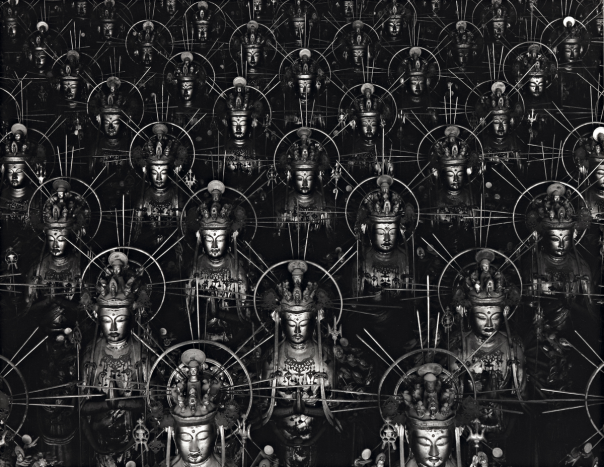
No, there is another. The 48 photos of 1,000 Buddha statues at Sanjūsangendō that Hiroshi Sugimoto photographed in 1995 used to be Time Exposed (Buddha Series), and then Sea of Buddha. But those similar-but-not-indentical, life-sized Buddhas, standing in 10 tiered rows, actually flank a monumental seated Buddha, a 1,001st Buddha.

And it turns out Sugimoto photographed that one, too. I think he showed it for the first time last year at Lisson Gallery in LA, and that’s where the shopaholics on the LACMA collectors committee saw it, and bought it. And thus now LACMA says, “Sea of Buddha is a series of 49 photographs that feature 1,001 statues of bodhisattvas at Sanjūsangendō temple in Kyoto.”

Sea of Buddha 049 (Triptych) is somehow listed as being made in 1995. Let’s circle back to that. It is a triptych because it is three gelatin silver prints mounted together, each one an 8-foot tall section of the 12-foot-wide print. [That’s so close to full-size—the seated figure is 11 feet tall–I’m kind of surprised Sugimoto didn’t go for it.]

About that date. Sugimoto actually produced at least two prints of this seated kannon figure before. He made a unique Sea of Buddha installation for an all-Buddha auction at Christie’s during Asia Week 2014 that included six 16×20 Buddha grid photos, and a large-format 28×36-in. lithograph of the seated Buddha. Which is also how it was presented at Lisson.

a large white cube gallery with a pale grey concrete floor has a very large black and white but mostly black photo of a seated buddha sculpture on the far wall, flanked by three similarly toned (i.e., mostly black) photos of a grid of buddhas wrapping around the side walls. in the center is a fragment of a greek column topped by a spindly stainless steel form whose intricate curves are a 3d interpretation of some mathematical surface formula or something it's not actually clear from the lisson gallery press release, but it's all by hiroshi sugimoto. oh right, there's a figure in black standing next to the far off buddha mural, for scale, and the scale is big and looming above your head.
Not 1,001, but several Buddhas: Sea of Buddha photos installed for Hiroshi Sugimoto: Form is Emptiness, Emptiness is Form, at Lisson Gallery Los Angeles Nov 2024-Feb 2025

I’m going to guess that ratio preserves the scale between the sculptures. That lithograph was described as one of two produced—the other in the artist’s collection—from an “intended edition” of five+1AP. Whether it’s considered a continuation of that edition, or its own thing, that sounds to me like the triptych format print did not exist yet.

This Christie’s essay has another, new, extensive account of the circumstances of photographing the Buddhas, emphasizing the natural light at sunrise, and the two weeks of daily 3-hour access, beginning at 5:30. With a rolling ladder for “elevated framing” and a fixed focus and composition, Sugimoto was able to take up to seven images/day before the monks kicked him out.

hiroshi sugimoto's photo of 33 statues of buddhas is black and white, mostly black
Sea of Buddha 008 again, and it looks like the lens was eye-level with the sixth row of Buddhas. Was that the sixth row, the eighth row, or both?

But this workflow also means that he was not “removing” all the temple’s modernized cruft; he was shooting over it. And he was not “removing” the “fluorescent” lights; he was shooting before the monks turned them on. The 28 carved deity statues on the floor level also do not appear, which is significant, because Sugimoto surely did not have them displaced and replaced 20-28 times. So he shot over those, too. And the focal depth for the first row of Buddhas is different than the third through tenth. Did he do two passes, at two heights—each image shows eight rows, but which eight? Did he leave out the bottom row, which would have been partially obstructed by deity sculptures? Or did shooting down and cropping the Buddhas at their heads solve the problem? Did he and his rig ever cast a shadow across the Buddhas, or did a long exposure erase any human trace?

Lost At Sea Of Buddha

hiroshi sugimoto's photo of 33 statues of buddhas is black and white, mostly black
Hiroshi Sugimoto, Sea of Buddha (008), taken in 1995, gelatin silver print, 47 x 58 3/4 in., ed 5, via Marian Goodman Gallery, which should be a sign of when it was actually produced

Seeing Hiroshi Sugimoto’s show at the Met in 1995 was a life-changer, and then seeing his Time Exposed (Buddha Series) photos and Accelerated Buddha, his 5-minute video, at Sonnabend in 1997 blew my mind.

Sugimoto spent ten days in 1995 photographing the 1,000 12th century kannon Buddha sculptures in the Sanjusangendō in Kyoto, in 48 images. Each identically composed photo shows 33 kannon in eight rows, for 1,584 Buddhas. There are eleven rows of statues, so there’s plenty of room for overlap while still photographing them all.

hiroshi sugimoto's book sea of buddha is a leporello, opened and spread out to reveal the black and white photos of buddhas that seem identical but are not.
Hiroshi Sugimoto, Sea of Buddha, 1997, quarto, ed. 1000, this example via Shapero Rare Books

Like the video, which packs all 48 images in 1,000 times to get to a million Buddhas, Sugimoto published a book, Sea of Buddha, a little leporello that reproduced all 48 images, in an edition of 1,000, for another million Buddhas. [Except, as noted above, it’s technically 1,584 headshots of 1,000 Buddhas.]

The most extensive accounts I’ve found so far of his seven-year process of trying to get permission to photograph the Buddhas were in interviews with Phong Bui and Interview Magazine tied to a 2016 show of large-format prints of the series, retitled as Sea of Buddha, at Pace. Basically, he was a nobody getting nowhere, and either Philippe de Montebello helped, or he didn’t, until a Japanese culture bureaucrat helped him get a deal, and then he just had to pay $10,000, or $15,000. It’s kind of crazy. Sugimoto described his show at the Met as life-changing, but also as his first museum show, which, his own chronology lists fourteen museum shows before that. He said they were shown at the Met, but honestly, I don’t remember them being shown until 1997.

I was at the Sanjusangendō yesterday, and so have been thinking anew about Sugimoto’s work. And besides the shifting explanations, it feels weirdly destabilizing to see how many different formats, editions, and installations there have been over the years, all seemingly with the same date of 1995. Sugimoto’s moved major galleries multiple times, and shown the work in various single and triptych forms, in editions of 5, 15, and 25. Accelerated Buddha was shown on a single monitor in 1997, and as a wraparound three-channel video since, with different soundtracks by Ken Ikeda.

I’m all for artists continuing to make and revisit and rethink and rediscover things about their work. And to continue to push it forward as technology and technique changes. On his own site Sugimoto describes the Sanjusangendō installation as a form of conceptual art, and wonders, a bit disdainfully, “Will today’s conceptual art survive another eight-hundred years?” And I’m like, only if it has an archivist? Because it’s only been 30 years, and things are already confusing af.

[enlightenment update]即是空, 空即是色

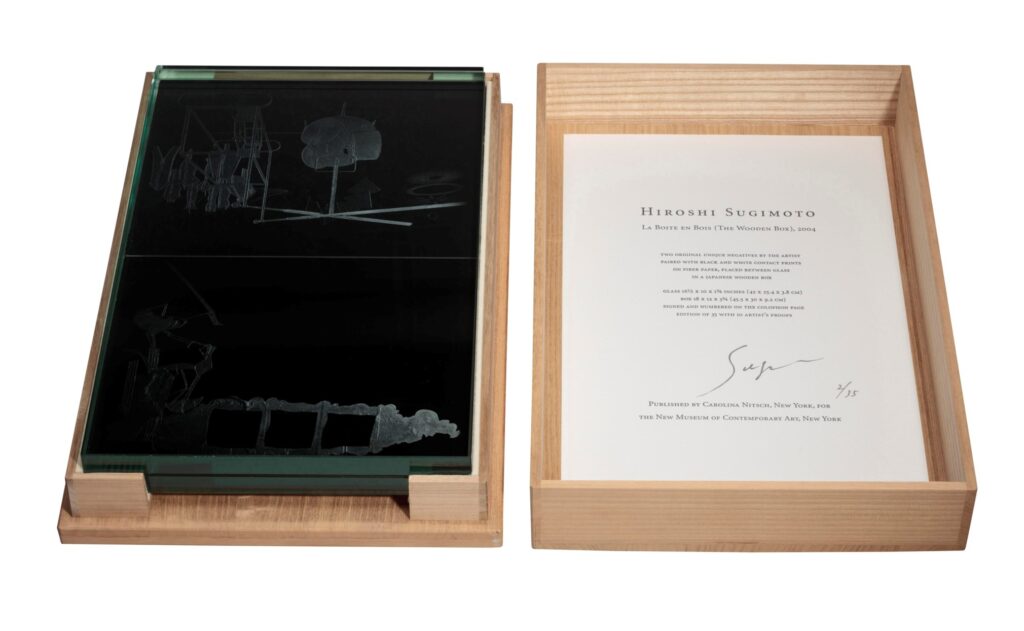
La Boite en Bois en Acrylique

Hiroshi Sugimoto, la Boite en Bois, 2004, ed. 2/35, from Melva Bucksbaum’s 2018 sale at Christie’s

I’ve been a Hiroshi Sugimoto fan for many years now, more or less, though I admit I’m partial to the early hits.

When his fundraising edition for the New Museum came out in 2004, I hesitated and lost the chance, but I haven’t really regretted it too much, until maybe right now.

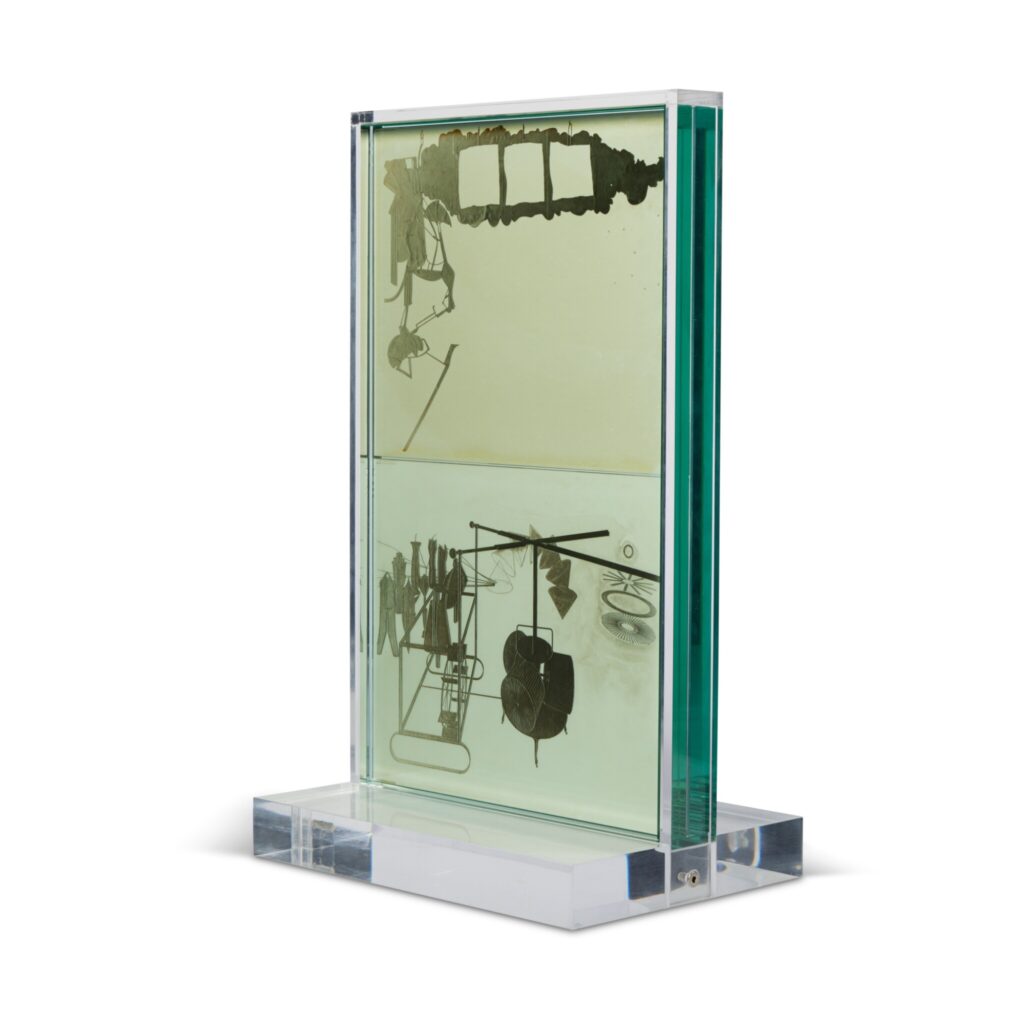
Each of the 45 examples in Sugimoto’s edition is actually a pair of unique 8×10 negatives of the top and bottom of Tokyo University’s replica of Duchamp’s Large Glass, and unique contact prints of those same negatives. These four objects are sandwiched between two slabs of glass, and set in a wooden box.

I worred, frankly, because I didn’t think prints or negatives should be in contact with the glass like that, or necessarily with each other, either. [They’re facing opposite directions, which gives the work its interesting dark/light vibe.] I also wasn’t sure how to show it. Melva Bucksbaum’s example above, sold at Christie’s in 2018, is how I imagined it: put away in a box.

Sugimoto’s la Boite en Bois (Wooden Box), 2004, 45 x 30 cm without the sweet acrylic mount, being sold as lot 118 in Sotheby’s online photo sale ending 10 Apr 2024

But whoever’s selling ed. 31/35 at Sotheby’s right now has figured it out, at least partially. The bois is gone, and the glass assemblage is pinned into an acrylic frame and base. It’s pretty slick, and already going for more than Bucksbaum’s low-numbered example. My window may be closing again. [update: it closed. $20,320.]

Hiroshi Sugimoto Events We Will Unfortunately Miss, Vol. 4

Hiroshi Sugimoto created a stage for a Noh performance at Dia; unfortunately, it was in October 2001, not a real hot time for cultural diversions in downtown New York City. Missed it.
The Noh stage was reinstalled at the Mori Museum at Roppongi Hills, which we also missed.
Now, tonight at the Hirshhorn, two musicians are premiering a piece created for the artist’s exhibition. Then after that, Sugimoto himself will perform as benshi, or stageside storyteller/narrator, for Kenzo Mizoguchi’s 1933 silent masterpiece, The Water Magician. Japanese silents are rarely, shown anywhere these days.

6 and 7 pm: Specification Fifteen, a live world premiere of a new musical work created especially for the Hiroshi Sugimoto exhibition, Lerner Room. For more information about Richard Chartier and Taylor Deupree, visit their websites at http://www.3particles.com and http://www.12k.com.
6:30 pm: Curator’s tour with Kerry Brougher, second level
8 pm: The Water Magician, 1933, Ring Auditorium. Film courtesy of the collection of the National Museum of Modern Art, Tokyo.
Please be advised that seating in the Ring Auditorium is limited, and we anticipate a high turn-out for this event. Ticket distribution for the film, The Water Magician, begins at 7:15 pm. Please form a line just outside the Emergency Exit doors to the right of the Information Desk. Guests may enter the auditorium beginning at 7:45pm. Entry to the auditorium will not be permitted after 8pm. Please plan your visit accordingly.

I’m sure the lines are already out the door. It’d be great if the Hirshhorn had some ticketed events open only to big-time donors. Giving money for exclusive access to taxpayer-funded institutions is a Washington tradition…
Hirshhorn After Hours [hirshhorn.si.edu, non-permanent link]
Hiroshi Sugimoto programmed a Japanese cinema series at The Japan Society last fall [via twi-ny.com]
Midnight Eye has an awesome overview of Japanese silent film and an interview with a leading benshi, Midori Sawato [midnighteye.com]

It’s Definitely Not The Pictures That Are Getting Small

I’ve been a big fan and collector of Hiroshi Sugimoto’s work for over 13 years now [wow. Typing that just now makes me hyperaware of the passage of time, which is par for the course for Sugimoto.] So when I had a chance to meet the artist at a preview of his retrospective show at the Hirshhorn yesterday, I jumped.
It’s really quite a gorgeous show; stunning, even, which I think is atypical of Sugimoto’s work. For all his conceptually driven series, he’s always produced extremely beautiful photographs, don’t get me wrong. And in the last few years, I’ve seen references to the importance of the old-school technical aspects of photography as well. I’m wary of reading it too much as a “Japanese” sensibility, too, even though the Japanese tradition of modernism and minimalism really is a worldview apart from that of the West; but it’s seductively easy to fall back on the myth of the Inscrutable Oriental–or worse, the pathetic, westernized Pop Zen–when praising his work.
Still, let’s face facts: the man has photographed an icon of Buddhism in Kyoto [the sanjusangen-do temple], he’s designed a Noh stage and a Shinto shrine, and his longtime profession has been a dealer in Japanese antiques. And you can’t get much more self-consciously Japanese than all that. But maybe it’s like being an American in Paris being a Japanese in New York; your awareness of difference is enhanced.

sugimoto_hirshhorn.jpg

Back to the stunning, though. Sugimoto’s recent forays into architecture and spatial design are (coincidentally?) timed with a waning–or an impending extinction, to hear him talk about it–of photography as a medium for him. The recent discontinuation of his favored materials and the ascendance of digital photography are rendering him obsolete. Not wanting to go the Sally Mann route by adding another layer of meaning onto his work by choosing to homebrew his materials, Sugimoto said he’s just printing as much as he can while he can, and is looking to other mediums for his work.
The result, oddly enough: giant prints. While some of his newest work, wax figure portrait photos and those mathematical model images, were always larger-than-life-size, with this show, Sugimoto has gone back and printed older work in seductive, giant formats. There are museum dioramas, a movie theater, and, stunningly, seascapes. These giant prints are really objects now, not images; conceptually, maybe that’s always been the case, but it’s certainly a much clearer assertion of that idea than Sugimoto’s ever made. This is doubly true for the dramatically lit Seascapes in the massive, blackout gallery [the museum removed some non-loadbearing walls, and they should never put them back; this is probably the most breathtakingly sublime space the Hirshhorn has ever had.]
But I’m not sure that’s entirely a compliment. Large prints are the new market hotness, and since his most popular works, the seascapes, had long ago sold out their editions, there was little opportunity for the artist to be rewarded for his pioneering work. Now, though, he gets a piece of the action himself, and new collectors get the impressive Sugimoto-brand wall candy they crave; it’s win-win. I guess.
But then I have to look back and wonder; it wasn’t “development” who tore down the movie palaces in Sugimoto’s now-deeply nostalgic photos; it was developers. At one point, his work was not only beautiful, it was marginalized, radical, even, as well as conceptually rigorous. And now, well, this show just arrived from the Mori Art Museum at Roppongi Hills, and you can’t get any more “developer” than that. [And I say that as someone counting developers among my family and close friends. But still.]
Of all people, I’m stoked when artists have the freedom to pursue their vision, and I wouldn’t want to stick Sugimoto in the twee realm of master photographic craftsman if his interests lie elsewhere. But at the same time, when I am instantly blown away by beauty in art, I have to admit, I’m a bit skeptical.
I took an old catalogue for him to sign (Sugimoto’s actually doing a signing and a speech this evening, starting at 6, but we can’t make it), and he graciously dashed off a dramatic “S” and some illegible stuff with a silver pen. When I got home, though, I compared it to a catalogue he’d signed for me eight years ago; it was sober, meticulous cursive, as if he were signing a will, not an autograph. And somehow that seems to make sense.

Hiroshi Sugimoto at the Hirshhorn

Previously: greg.org on sugimoto

Hiroshi Sugimoto: The Kultureflash Interview

sugimoto_math2.jpgSherman Sam interviews the artist Hiroshi Sugimoto about his London show at Gagosian. Sugimoto’s latest works, originally shown at the Fondation Cartier, are photographs of early 20th-century mathematical and mechanical study models from the collection of Tokyo University.
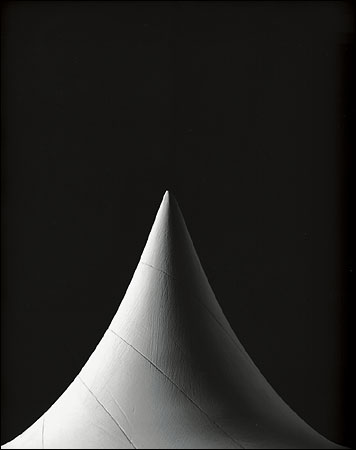
Sugimoto provides some more background on the models, which were also photographed by Man Ray and studied–in their day, in the 1910’s and 20’s–by Duchamp, Brancusi, and others.
By happy coincidence, the same series are on view at Sonnabend until June 11.
Artworker of the Week: Hiroshi Sugimoto [kultureflash]
previously: On Math & Art in France

On Math & Art In France

sugimoto_math.jpg

Although Gustav Eiffel didn’t explicitly use one himself, an American engineering professor has come up with a mathematical expression for the shape of the Eiffel Tower, based on its creator’s own studies of wind resistance, torquing, and load transfer.
Which reminds me of the photos by Hiroshi Sugimoto at the Fondation Cartier, Mathematical Forms. They are monumental images of beautiful, little plaster stereometric models, which were created in 19th and early 20th c. Germany to illustrate complex trigonometric formulas. Several were published in the NY Times Magazine last month.
Elegant shape of Eiffel Tower solved mathematically [PhysOrg.com, via archinect]
Etant Donne: Le Grande Verre by Hiroshi Sugimoto through Feb. 27 at the Fondation Cartier
Hiroshi Sugimoto’s Mathematical Forms [NYT Mag]

Movie Theaters I’ve Been To That Have Closed

This afternoon on WNYC, Jonathan Schwartz was reading an underwriter plug for Zankel Hall, when he stopped and said, “Some of you may remember that Zankel Hall is in the site of the Carnegie Theater, a movie theater with–well it was very small and down a windy staircase–with personality. So many theaters with personality have closed.”

hsugimoto-walker-theater.jpg

That got me thinking, while Schwartz rattled off a dozen theaters I’d never heard of, of the theaters that have closed since I moved to New York:

  • The Carnegie, where I saw Cinema Paradiso a dozen times when I first moved to the city.
  • The theater under The Plaza Hotel
  • The two-screen theater on the south side of East 59th St between 2nd & 3rd.
  • The tiny theater further down East 59th St on the north side, next to the Betsey Johnson boutique.
  • The underground theater on 3rd Avenue between 57th & 58th.
  • Theater 80 St Mark’s, the only revivals-only theater, which was oriented sideways in the basement/back of a tenement building. Their monthly programs were printed in tiny typeface.
  • Lighthouse Cinema, an oddball storefront theater on Norfolk below Rivington.
  • The 68th St Playhouse, on 3rd Ave, where I saw Ridicule. Schwartz mentioned that the last time he went here was to see Mike Nichols in The Designated Mourner.
  • Worldwide Cinema, the awesome discount theater under the plaza at Worldwide Plaza, 50th & 8th Ave., where I saw Austin Powers again and again. Even the concessions were cheap.
  • The theater on 34th between Second & Third that tried to hang on by showing Bollywood films.
  • The awesome theater on the NE corner of Canal and Allen St, at the base of the Manhattan Bridge, that used to show martial arts films.
  • Loew’s Columbus Circle, which was underneath the Paramount Building. Its entrance was similar to the subway entrance. That guy who used to play a lidless grand piano was always right in front.
  • Am I remembering incorrectly, or wasn’t there another theater on Third, right across from Bloomingdale’s? [Update: That’s right, the Baronet & Coronet. Thanks, Chris.]
    There’s a great website for this kind of thing, Cinema Treasures. And Hiroshi Sugimoto began photographing movie theaters almost 30 years ago, and many of them are now gone.

  • Benesse Art Site Naoshima, the Marfa of Japan

    While we were in Japan, we made a detour to see the growing collection of contemporary art on Naoshima, a tiny island near Okayama, and within spitting distance of the massive Seto Inland Sea Bridge.
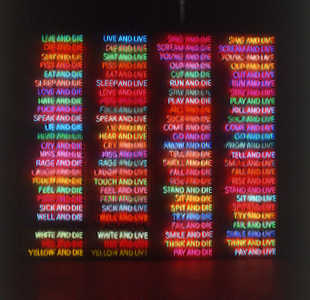
    nauman_100_live_or_die.jpgIn explaining Naoshima, I’ve taken to calling it the Marfa of Japan, but that’s only partly accurate. Benesse represents one collector’s–not an artist’s–increasingly significant attempt to create an internationally recognized destination for contemporary art pilgrims and to revitalize/transform a dying town in the process. I think it’s mostly successful, and definitely worth the trip.
    Benesse Art Site is the new umbrella moniker for four separate art projects: the just-opened Chichu Museum; Benesse House, a small museum/hotel; Seaside Park, a campground surrounded by outdoor sculptures; and Art House, permanent artist installations in abandoned 18th century buildings.
    When we arrived on Naoshima, we headed first to Benesse House, which was designed by Tadao Ando. The staff was extremely helpful, even though we knew we couldn’t stay overnight (the hotel fills up a year in advance). The building was impressive, with two or three of the sublime moments Ando’s Fort Worth Museum has dozens of.
    The work was all over the place; there’s stuff from a collecting phase where money outstripped sense, then from the “let’s open a museum” phase where sense caught up. Exquisite siting was a recurring theme. Hiroshi Sugimoto’s Time Exposed seascape photos, installed in a courtyard overlooking the sea; Yoshihiro Suda’s invisible Weeds, and Bruce Nauman’s neon 100 Live or Die, which, by restrictions on how frequently it would be turned on, was transformed from sculpture to eagerly awaited performance spectacle.
    A businessman on the ferry had boasted, “There’s a $6 million Monet up there.” [A Water Lilies diptych, which was probably more than that.] Meanwhile, the locals remain unimpressed by the $10 million early Johns hanging next to the Zen-like Pollock.
    I’ve mentioned it before, but I’ll post more on the Art House Project later.

    Hiroshi Sugimoto’s Accelerated Buddha

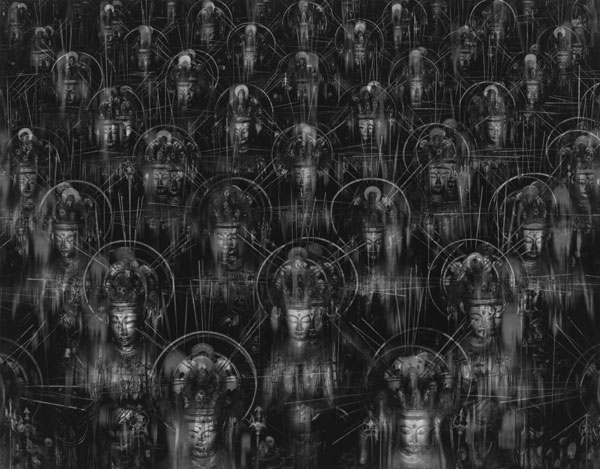
    sugimoto_hall_of_33_bays.png
    Hall of Thirty-Three Bays, 1995, Hiroshi Sugimoto
    Hiroshi Sugimoto: I came for the Seascapes, I stayed for the Hall of Thirty-Three Bays. I love Sea of Buddhas, 1995, his series of nearly identical photos of the Sanjusangendo, shrine in Kyoto. They’re generally under-appreciated, partly because they work best when seen all together.
    Fortunately, Chicago has started making up for the Cow Parade embarrassment by putting the whole series of Sea of Buddha on view at the Smart Gallery at the University of Chicago until Jan. 4th.
    sugimoto_accelerated_buddha_still.jpg
    Hiroshi Sugimoto, Still image from Accelerated Buddha, added 2013
    Also on view, the artist’s rarely seen video, Accelerated Buddha, which rocks like only an increasingly shimmering animation of nearly identical still photos with a sharp electronic soundtrack by Ken Ikeda can.
    Related: an interview with Hiroshi Sugimoto [update, which I retrieved from the Internet Archive, since the original site is gone.]

    Interview with Hiroshi Sugimoto, March 1997
    by William Jeffett
    Edited from Sainsbury Centre for Visual Arts, University of East Anglia, Norwich, UK Catalogue Hiroshi Sugimoto, from an exhibition held 1997
    WJ. How and when did you first take up working with photography?
    HS. When I was six or seven years old, the science teacher at my elementary school taught us to make photographs with light sensitive blue paper. By placing an object on this paper under direct light we could transfer its shape to the paper’s surface. This activity made a strong impression, not only on the paper, but on my mind. As I think about it now, it was as if I had started at the very moment of the invention of photography as if I was reliving the experiences of photographers like Niepce, Daguerre and Fox Talbot.
    WJ. You have lived in the United States for most of your career. How has this shaped the development of your approach to photography?
    HS. Wherever I lived, art was the only activity that interested me. But both the move to a new country and the fact that photography is a relatively young medium seemed to welcome new attitudes. However, while living in a new country, I started to deal in ancient Japanese art and consequently was involved with continuity and tradition. I think my work is the product of both of these influences.
    WJ. What does it mean for you to have a show in the Sainsbury Centre with its rich collections of world art?
    HS. The Sainsbury Centre has a collection of several works of ancient Japanese art that were acquired from me while I was still a dealer, and I feel that this exhibition of my own work brings these two parts of my life and activities together. I think it is very good to see one’s work together with ancient art. Looking back gives a sense of perspective you cannot get when looking at works of your contemporaries.
    WJ. Often there is a sense of stillness in your work, as if time were somehow frozen. Indeed, time is one of the features more evident in your work, and in the past you have even used very long exposures in a time lapse. Could you tell me about your thoughts on time in your work in general?
    HS. Time is one of the most abstract concepts human beings have created. No other animals have a sense of time, only humans have a sense of time. But time is not absolute; the time measured by watches is one kind of time, but it is not the only kind. The awareness of time can be found in ancient human consciousness, arising from the memory of death. Early humans buried their loved ones and left marks at the grave site, trying to remember images of the dead. Now, photography also remembers the past. I am tracing this beginning of time, when humans began to name things and remember. In my Seascape series, you may see this concept.
    WJ. Your work has taken both natural and highly artificial subjects as a point of departure (Seascapes and Dioramas). Where would you situate yourself in relation to artifice, on the one hand, and nature on the other?
    HS. The natural history dioramas attracted me both because of their artificiality and because they seemed so real. These displays attempt to show what nature is like, but in fact they are almost totally man-made. On the other hand, when I look at nature I see the artificiality behind it. Even though the seascape is the least changed part of nature, population and the resulting pollution have made nature into something artificial.
    WJ. Do you manipulate the image? In what way does your work interrogate the process of looking?
    HS. Before we start talking about manipulation, we have to confirm the way we see. Is there any solid, original image of the world to manipulate from? Each individual has manipulated vision. Fish see things the way fish see, insects see things the way insects see. The way man sees things has already been manipulated. We see things the way we want to see. Of course I manipulate. Artists create excitement by manipulating a boring world. All art is manipulation, to take still photography with black and white images is further manipulation, but before all this the very first manipulation is seeing.
    WJ. You work in series and in this respect your work parallels the approach of movements like Minimalism or even Pop Art. Could you tell me why you have adopted a serial approach and how you see your photography in relation to other forms of contemporary art?
    HS. I see the serial approach in my work as part of a tradition, both oriental and occidental – Hokusai’s views as well as Cézanne’s landscapes or Monet’s Haystacks, Cathedrals and Waterlilies.
    WJ. Do you see time as an important component in the Hall of Thirty-Three Bays series?
    HS. Time is an important component of all of my work. In my videotape Accelerated Buddha, time takes on an accelerated shape.
    WJ. Your earlier series devoted to the Dioramas, Seascapes and Theatres depict subjects which are not recognizably Japanese, while the Hall of Thirty-Three Bays is based on one of the most important shrines in Japan. Could you tell me why you chose this series to work on over the last six years and how it relates to your other work?
    HS. All of my works are related conceptually. The photographs of the Hall of Thirty-Three Bays extend the concept behind the Seascape series: repetition with subtle differences. Even though these images seem similar to those of the Wax Figures, I see them more as a ‘Sea of Buddhas’.
    WJ. In what way does the series have a connection with Buddhist thought?
    HS. I don’t think that this series has more of a connection with Buddhist thought than any of my others. It interested me, however, that I was photographing this temple, built as a result of the fear of a millennium 2000 years after the birth of Buddha, at a time when we ourselves are approaching a millennium 2000 years after the death of Christ.
    WJ. You said you made each of the photographs from this series at the same hour of the morning. Could you say why and explain a little about your working method?
    HS. The photographs were all taken between 6.00 and 7.30am so that the natural light would be soft and diffused, also so that each image would be photographed in the same light. Working at this hour also allowed me to be alone in the Temple since the monks are not around until 7.30am. Each subject calls for different working hours. Only the Seascapes allow me to work 24 hours non-stop.
    WJ. The Hall of Thirty-Three Bays depicts a sacred subject. Do you see your work as in any way engaged with the sacred?
    HS. The relationship between the Buddha series and religious thought is somehow parallel to the one between the Seascapes and nature. Pollution has made nature artificial and the commercialization of traditional religions has de-spiritualized them.