Biography Of On Kawara: 29,771 Days

Most reports of On Kawara’s death place it on July 10, the day the news was made public. I have heard from sources who would know that the artist passed away as much as two weeks earlier. Given the nature of Kawara’s practice, it seems like a non-trivial point to identify the actual date. Given his family’s prerogative and their loss, it seems indelicate to speculate or pry.
As Roberta Smith wrote in her NY Times obituary for Kawara, published today,

Mr. Kawara’s family declined to provide the date of death or the names of survivors, in keeping with his lifelong penchant for privacy.

But she also ends with this:

Keeping the viewer focused on time’s incremental, day-by-day omnipresence was one reason for Mr. Kawara’s deliberately low profile and his habit of listing his age in exhibition catalogs in terms of the number of days he had been alive as of the show’s opening date. In the catalog to a show at the David Zwirner Gallery, an otherwise blank page titled “Biography of On Kawara” put the count at 26,192 days on Sept. 9, 2004. Last week the gallery calculated he had reached 29,771.

When news of Kawara’s death began to circulate, his birthdate, via Wikipedia, was reported as January 2, 1933. Wikipedia’s citation is the Encyclopedia Britannica. But calculating back from the Zwirner show results in a birthdate of Dec. 25, 1932.
The artist’s bio in Henning Weidemann’s book, On Kawara is reported as “(June 9, 1991) 21,351 days,” which also calculates back to Dec. 25, 1932.
Given this birthdate, it becomes clear that Kawara’s family and gallery chose to report, on his own terms, not his death, but the culmination of his life, 29,771 days later, on June 29, 2014.
Update: Now we have a situation. Dia lists Kawara’ bio as “29,622 days on January 15, 2014,” which calculates back to a birthdate of Dec. 10, 1932. Now I feel compelled to cross-check Kawara’s other published biographies. Any citations are appreciated.
The canonical source, such as it goes, would be Kawara’s own 100-Year Calendar, on which he indicates he was born Dec. 24, 1932. Which could mean everything above is off by one day.
According to Weidemann, filling in a dot on his calendar was the very last thing he’d do every day. A green dot meant one date painting. A red dot meant more than one; a yellow dot meant none. It’s conceivable that the artist lived through the 29,771st day, the 28th, but did not complete the 29,772nd. Suddenly, this calculation feels intrusive.
Other biographies:
For the opening of On Kawara 1973 –One Year’s Production at Kunsthalle Bern, his bio reads, “(August 16, 1974) 15 211 Tage.” [Dec. 24, 1932.]

On Kawara Today

on_kawara_with_the_kids.jpg
News came today of On Kawara’s death, and I’m finding it difficult to articulate much of my own reaction. It’s a sense of profound loss, coupled with naturalness, a frustrating mix of the inevitable and the unexpected.
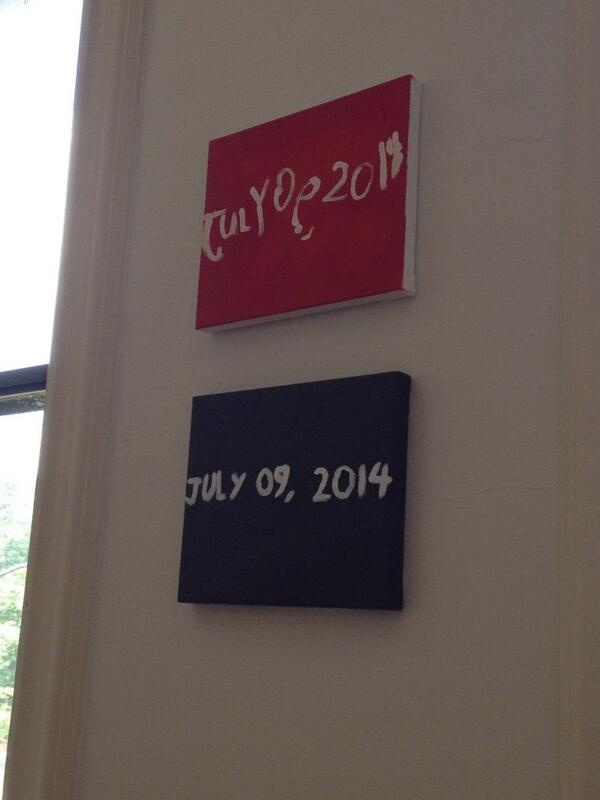
The kids and I just painted new Today series paintings yesterday, to update the ones they painted for me in 2012 as preparation for RO/LU’s Today series project at the Walker Art Center. So we’ve had On on our minds.
And of course, the Guggenheim just announced that the artist was collaborating with curator Jeffrey Weiss on a full-scale retrospective set to open in February. And I fired off some exuberant tweets about getting my turn in the booth to read for the One Million Years project.
And my recent foray onto tumblr had reminded me that I have to reinstall fromnowon.us, the project we announced during RO/LU’s Walker residency, of commissioning Chinese Paint Mill to continue the Today series, first to fill in the days when Kawara himself didn’t complete a painting, and then to open the project up to everyone when eventually, some day, far in the future…
This idea had struck me during Kawara’s huge 2012 show at Zwirner’s, which had Today paintings from four decades and dozens of cities. The newest painting was Jan. 3, 2012, just three days before the opening. And other paintings appeared during the show’s run, though the artist himself, of course, did not. But Lei Yamabe wrote in the catalogue that on those days when Kawara did not complete a painting, he was like Schrodinger’s Cat, “shut in the closed room of time, simultaneously alive and dead.” And, most alarmingly, and unexpectedly, at least for me, that “the series will be complete when Kawara’s body ceases to exist.”
Damien Hirst had just floated the possibility that his spot paintings could continue into infinity, and frankly, the idea that Hirst would persist and Kawara would not felt devastatingly wrong. Thus, fromnowon.us. But I think the project only gelled because I really didn’t imagine Kawara not continuing himself. Yet now here we are, and now here he is not.

Rachel’s tweet shows, not everyone was as impervious as I, was but reading back a bit today, I see the shadows of non-existence throughout Kawara’s entire practice, which I either ignored or relegated to an abstraction before. In 1991 Henning Weidemann wrote that “the picture of a past date becomes a memorial,” and the very title “lead[s] us to suppose that for the spectator it will always be a question of a “Yesterday”-series.”
Even when using the speediest means of communication available to him in 1970, the telegram, Kawara’s I am still alive was fraught with contradiction:

In a certain sense the phrase “I am still alive” can never be sent as it cannot be received by the addressee instantaneously…It is only valid at the very instant that it is being written, and in the very next second it no longer is a certainty. If the addressee receives the telegram a few hours or days later and reads it, he merely knows that the sender was alive at the very instant the telegram was sent. But when he is reading the telegram, he is totally uncertain if the content of the text is still relevant or if it is still valid The difference, the small displacement between sending and receiving, is that particular unseizable glimpse of the presence of the artist. Likewise, it is a sentence of self-reassurance…”I am still alive.” The activity of telling oneself and the world “I am still alive.”

Now the uncertainty is removed, and that difference, that once-small displacement, will stretch into history. In fact, it’s already bigger than we first thought. I’ve heard from a couple of folks that know that Kawara actually passed away as far back as two weeks ago, after some period of difficulty, but that the artist’s family had requested his passing not be made public before now. [update: according to this calculation, Kawara’s 29,771th and last day was June 29, 2014.]
And so our paintings, my exuberance about the Guggenheim announcement, my continued procrastination, it all went down when I [we] only thought Kawara was still alive, when in fact, he was not.
For some as-yet unknown time, all but Kawara’s close friends and family thought he was still possibly/probably alive, shut in that closed room of time, but he was not. This specific moment, this window, this condition, of knowing something that turns out no longer to be true, feels significant in ways I cannot pin down right now. I’ll think about it every time I see my kids’ paintings, which are now not prescient memorials of Kawara’s own last full day, but which instead mark the last day of our thinking he was still alive.
But it also highlights an important distinction that’s so often lost, especially here, between the artist and his practice, the human being and his work. Just a couple of weeks ago I wondered if Kawara’s family or lover or the deli guy was included in I Met, or was it just his work contacts.
Kawara had a wife, and at least two children. He lived on a street in SoHo. He had neighbors. Kawara didn’t give interviews or talk about his work, but when Nick Paumgarten called about a young Leo Koenig crashing at the Kawaharas’ loft, On answered the phone and gave a quote. Kawara’s work marked one man’s passage through time, space and society, and the end of that project which has inspired me for so long makes me sad. But these were “the traces left on paper and canvas,” as Yamabe wrote, “the shadows that Kawara cast.” For others who shared Kawara’s life, he was a husband, a father, a friend. 謹んでお悔やみ、申し上げます。
2016 update: as time passed, I thought about this project more and decided not to pursue it. after a couple of years, I have taken the unusual (for me) step of letting the domain name expire. I still think about Kawara’s work often, and it is possible that a related project responding to it might arise in the future. But not right now.
Previous Kawara on greg.org:
On Kawara Data
On’s Location
Setting: Fredericianum, Documenta 11 | The voice of a woman reading from within a freestanding glass booth echoes
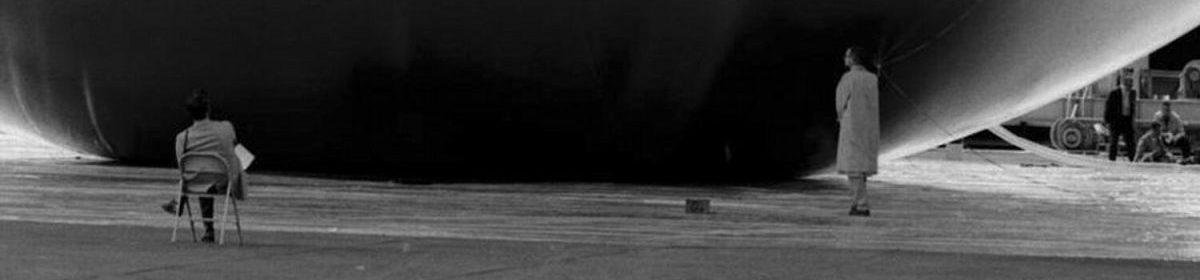
On Kawara Data

kawara_journals_66-2010.jpg
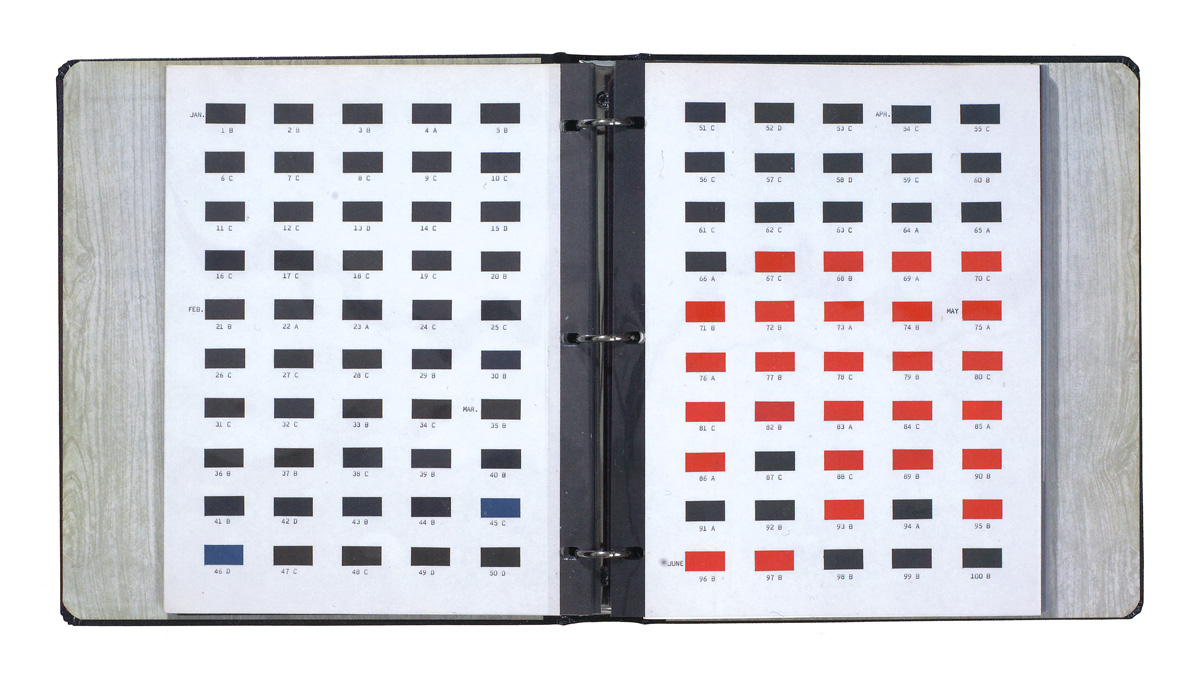
I’ve had this image of a spread from On Kawara’s Journal on my desktop for months now. I love the reduction of the Today Series paintings to desk calendar size. There is one binder journal for each year since 1966, when the series began. [chungwoo has more images and details the content and format of the journal. In Korean.]
on_kawara_boites_trilogy_didier.jpg
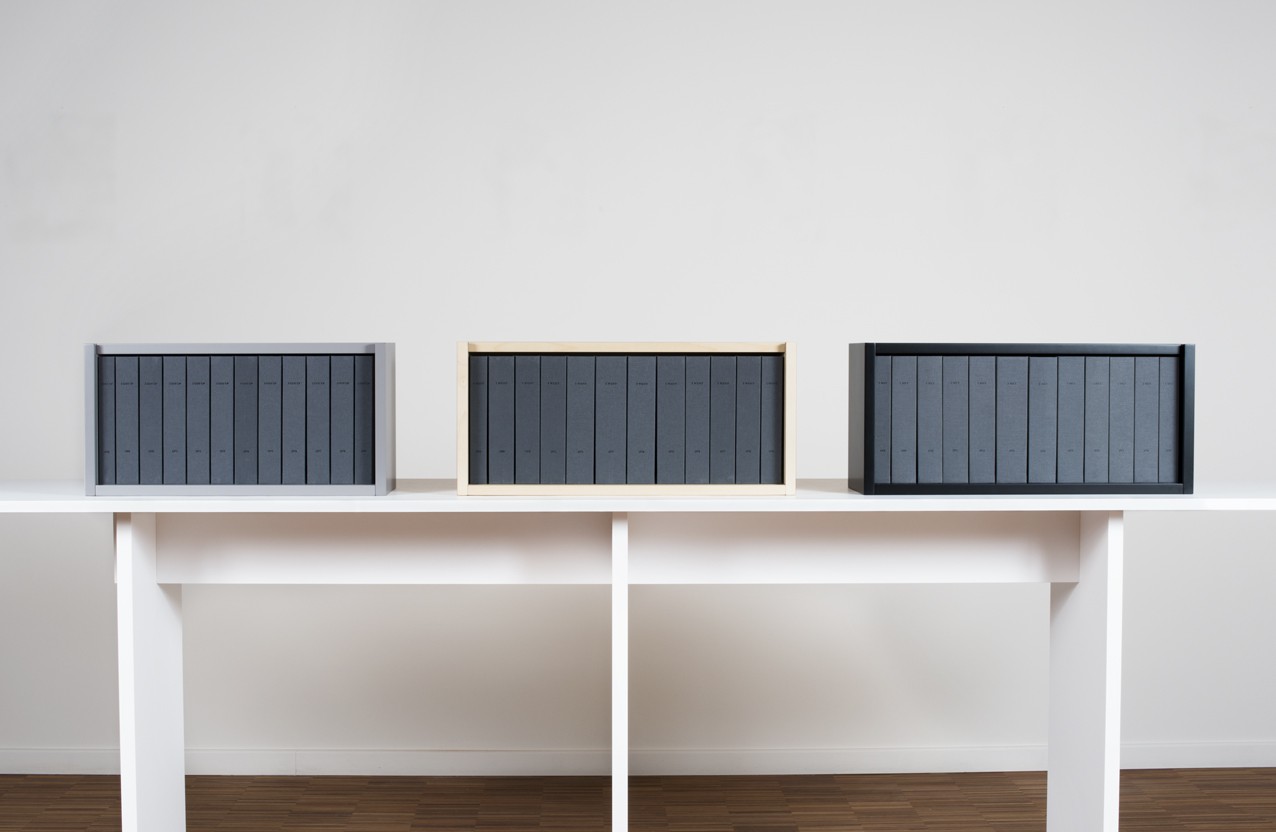
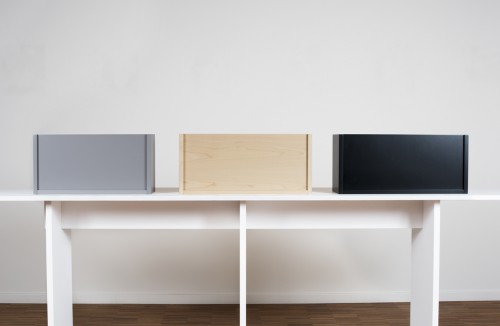
Anyway, while surfing through Michele Didier’s site just now, Kawara’s Trilogy stood out for a couple of reasons. First, and obviously, is its sculptural presence. They look so Juddy, especially with the sliding front covers on.
on_kawara_boites_closed_didier.jpg
Kawara’s not necessarily known as a sculptor, but then, it’s not just these boxes, is it? The paintings are objects in boxes, too. And books and binders and CDs, however unreadable their information, always read as physical objects. [The file name on this image even turned out to be on_kawara_boites.jpg,]
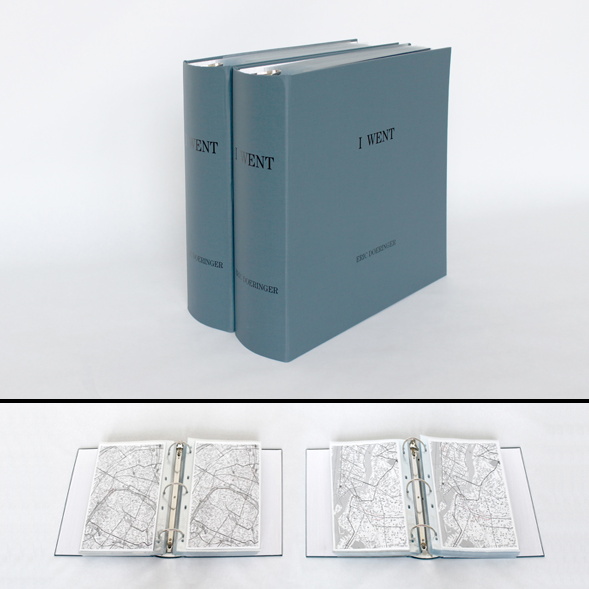
Didier published the Trilogy over four years: I Met (2004), I Went (2007), and I Got Up (2008). Each twelve volume set is an edition of 90, with 10 APs. I Met is now only available as part of Trilogy.
kawara_i_got_up_didier.jpg
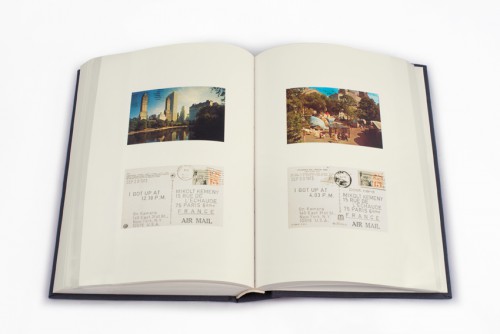
I Got Up, detail. Wait, so will there also be a I Photographed Postcards? How did he get pictures with postmarks? Did he get the cards back? This is no small task. [images: micheledidier]
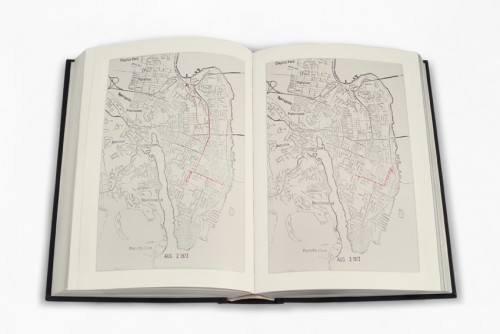
The sets overlap in time, an 11.5-year period from May 10, 1968 to September 17, 1979. Actually, I Went, in which Kawara traces his movements on a map of whatever city he’s in, didn’t start until June 1st. Which now makes me curious. Did it take a couple of weeks to figure out? Did the idea only come once he’d started logging his interactions [the people he met and the ones to whom he sent his wake up postcards]? Did he have somewhere to hide?
on_kawara_i_went_1973_didier.jpg
Or to use Didier’s term, “the information within [I WOKE UP] intersects with the facts reported in I MET and I WENT.” Information and facts. Data. Kawara was logging by hand exactly the kind of information our computers and phones now track automatically. As metadata. For Kawara, metadata is the data. The difference, of course, is that he’s tracking himself, intentionally marking his passage through time and space, and across his social matrix. [btw, does I Met include the cashier at the deli? Does he live in a doorman building? Is his partner in there? His hookups? What do these maps of Kawara’s mindfulness communicate?]
eric_doeringer_I_went_after_kawara.jpg
The takeaways here are clear: What IS it like maintaining such total personal information awareness? Since Kawara’s not talking publicly about it, we can turn to Eric Doeringer, who has re-enacted three Kawara projects, including I Got Up (2008-13) and I Went (2010) [above].
Also, who’s going to digitize the 14,000 pages of Trilogy to create the On Kawara Database Beautiful boxes of books are great, but information wants to be free of the box. Why flip through a book when we could be reliving Kawara’s 1970s day by day on Street View? At a time when we’re all unwitting, indifferent, or dispirited subjects of constant surveillance, the lessons of Kawara’s project have never been more important.
UPDATE: Or it might be the exact opposite, hard to say.
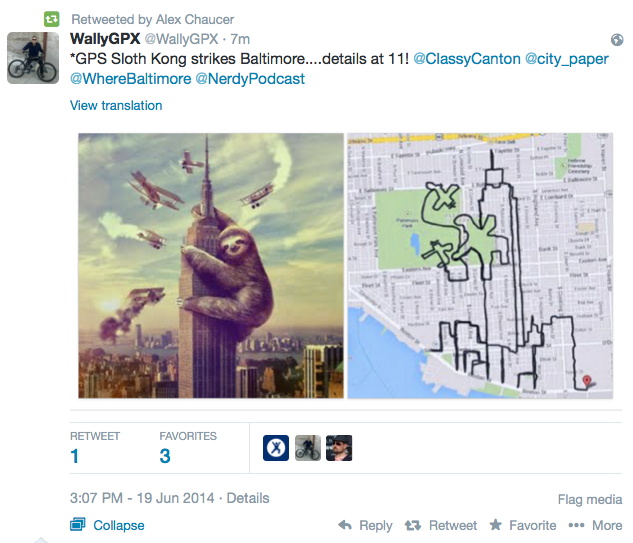
gps_sloth_kong_wallygpx.jpg

36 Links From My Life With Ubu

I’m really stoked to contribute a top ten list to UbuWeb this month.
When Kenny Goldsmith invited me to submit a list, I first tried to come up with some new, revealing, conceptual strategy for generating it. I thought of the top ten most viewed items, and then the ten least viewed. But then I learned that Ubu doesn’t keep logs. I thought of the ten largest files, but then figured it’d just be the longest movies, and big whoop. I thought of a top ten list of top ten lists. And when I worried that I would just be mirroring some taste or trend, I thought of identifying the ten items most frequently included in other peoples’ lists. Several more ideas were patiently disabused out of me, and I began running through my chance operations options.
Then I realized I’d already begun making my list, starting back in 2002, when I linked to ubu.com from my blog for the first time. Ubu at that point was still quite mysterious, and much smaller–mostly ancient and arcane concrete poetry reprints I frankly hadn’t heard of. But I kept coming back. A huge collection of video and audio appeared, Kenneth Goldsmith came out from behind the curtain, seeming much older and august in my mind than he turned out to be–I imagined he was a survivor of this lost underground scene, not an explorer.
Anyway, I assembled my list from twelve years links here at greg.org, highlights from my life with UbuWeb. They’re roughly chronological which has become an indispensable collaborator, not just a source of discovery and inspiration.

Continue reading “36 Links From My Life With Ubu”

On’s Location

So I did as I was told this morning, and clicked:
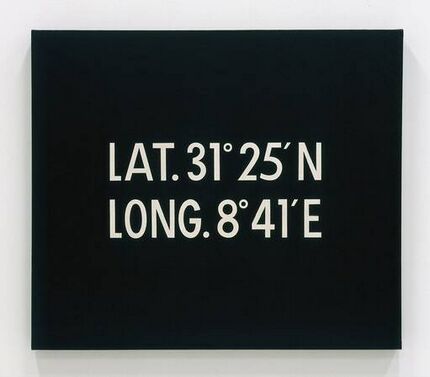
on_kawara_location_1965_vanabbemuseum.jpg
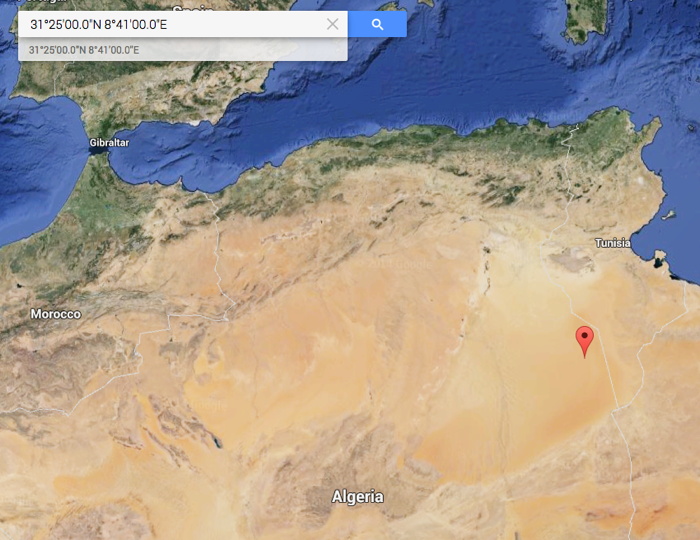
And now I’m confused. So I googled:
on_kawara_location_algeria.jpg
And now I’m even more confused. The painting is from Joseph Kosuth, but it’s by On Kawara. It’s titled Location, 1965, one of his earliest canvases still in existence. It’s one which predates, but obviously prefigures, his Today series, which began in 1966.
Only it’s not a series. And its coordinates, in the middle of the Sahara desert in eastern Algeria, don’t indicate where it was painted. It happens to be called the Grand Erg Oriental, the Great Eastern Sand Sea. But as a location it’s so utterly remote and barren, it’s more like a noplace than a someplace.
on_kawara_title_vietnam_nga.jpg
Title, 1965, collection nga.gov, image via
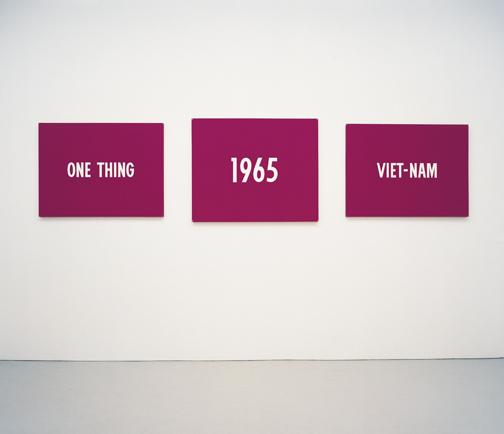
So what is it, and why? I have no idea. At first I thought it might have some highly political resonance like another of Kawara’s early paintings, Title, also 1965, the magenta triptych that seems like a protest against American military involvement in Vietnam.
Algeria had been the site of a devastating and anti-colonialist war against France, the aftermath of which continued well into 1965. Kawara moved to Paris from Mexico in 1962, just as France was losing, and hundreds of thousands of Franco-Algerian refugees began pouring into the country.
Kawara’s not one to explain his art, though, or talk or write about it at all. In fact June 1965 was the last time he discussed his work publicly, in an interview with Bijutsu Techo critic Homma Masayoshi. I’m trying to scare up Homma’s text from some Japanese library stack, but otherwise, who knows?
Well, maybe Joseph Kosuth does. Kosuth donated the atypical Kawara painting to the Van Abbemuseum in 1980 with the tagline, “in memory of Fernand Spillemaeckers,” his Belgian dealer who passed away in 1978. Spillemaeckers was instrumental in introducing conceptual art to Belgium, and he gave Kosuth a show in 1975. I imagine he was instrumental in Kosuth’s Text/Context billboard exhibition, which kicked off in Europe at the van Abbemuseum.
kosuth_grey_art_idea_vanabbe.jpg
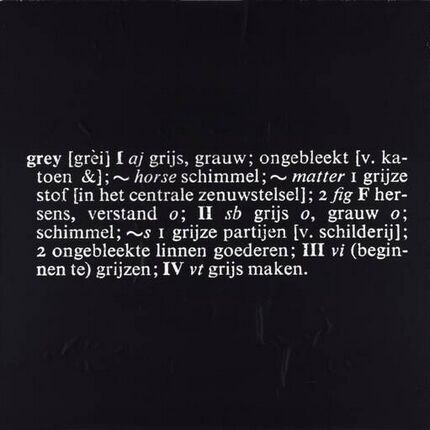
Art as Idea as Idea, 1968, collection vanabbemuseum.nl
Or maybe Kosuth threw the Kawara in for free after Spillemaeckers sold the van Abbemuseum a half dozen formally similar Kosuths in 1977-78, including five Art as Idea as Idea photostats from 1968, and the ink-on-glass series One and Nine A Description, from 1965.
Location hasn’t been shown much, or written about almost at all. It was reproduced in the catalogue for GNS [Global Navigation System], a 2003 collective show at the Palais de Tokyo. According to their blog, the organizers had proposed a project to Kawara, who rejected it, but allowed them to include Location. [So it’s not that Kawara doesn’t talk about his work; he just doesn’t talk about it with you.]
And of course, it will be included in The Part In The Story, an exhibition curated by Heman Chong and Samuel Saelemakers, which opens at Witte de With in May. If they’re tweeting about it with this much lead time, maybe this is finally our chance to find out what’s going on with this Kawara painting.
The Part In The Story Where A Part Becomes A Part Of Something Else opens May 22 at Witte de With [wdw.nl]

On Stage

on_kawara_documenta.jpg
In 2002, as I was still trying on various kinds of public writing, I tried to capture the transformative experience of listening to–no, experience is the better word–On Kawara’s One Million Years.
That post was even titled like a screenplay: “Setting: Fredericianum, Documenta II, Kassel.”
mightymac_on_kawara.jpg
image via mightymac
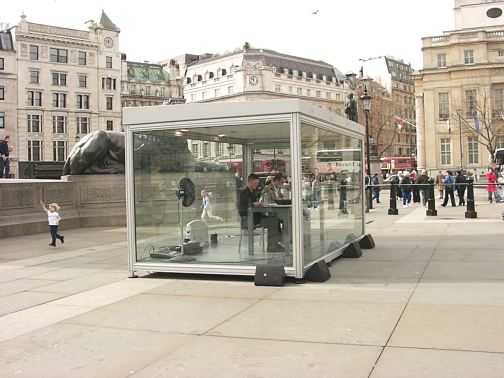
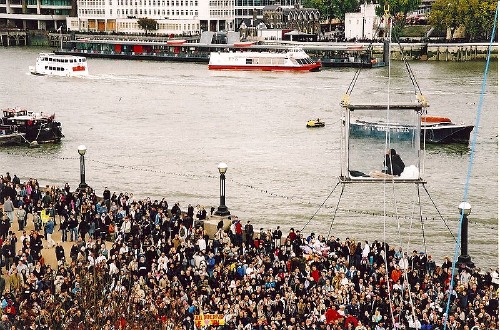
In April 2004, South London Gallery staged a week-long, round-the-clock marathon reading of One Million Years in Trafalgar Square. Many passersby unfavorably compared Kawara’s volunteer readers in their glass box to David Blaine, who had, just a few months before, spent 40 highly publicized days in a plexiglass cube suspended from a crane next to the Thames.
david_blaine_thames.jpg
In 2009, when David Zwirner staged a reading/recording of One Million Years, Brian Sholis wrote touchingly and with great acuity about the experience of reading the years 79,936 AD – 80,495 AD with his then-fiancee.
And yet only just now, somewhere between finding Jerry Saltz’s characteristically gossipy, angst-ridden account of reading in the same show, and watching this comical YouTube video of Martin C. de Waal, a Dutch club kid/stylist/Orlan-style conceptual self-portraitist and his dance remix singing partner Marina Prins [!] getting all dolled up for their reading on the open platform at the Stedelijk–the one we’d been standing on a few weeks ago–do I realize the powerful performative essence of Kawara’s piece. And with less than a hundred of an anticipated 2,700+ CDs burned, it’s barely even begun.

The effect of living in a post-Marina world, I suppose

‘On Kawara’s Last Piece!’

ON_Kawara_MAY.jpg
Maybe it was the news, or those long family car rides over Christmas with his cousin’s evangelical radio station going the whole way. But Frank Wick has of late been considering The Big Questions of Life, questions such as, “When The Rapture comes, will On Kawara have enough time that day to finish his painting?”
I guess the answer has been there all along in Kawara’s audio piece, Kawara’s Four Thousand and Four Years, B.C. and Two Thousand and Eleven Years, A.D.. He that hath ears, let him hear.

Is That An On Kawara Boardbook? Yes, Please.

Our stop at the Stedelijk over the weekend gave me On Kawara on the brain.
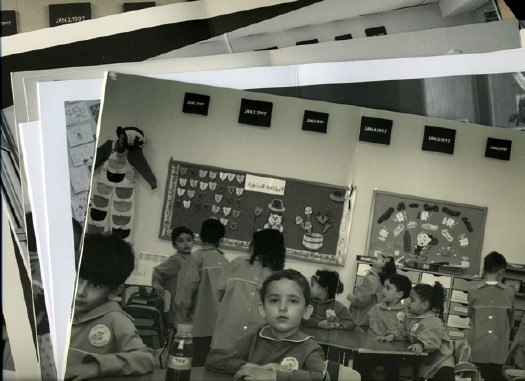
Which makes me sad to have missed the San Francisco Art Institute’s show this summer, On Kawara: Pure Consciousness In 19 Kindergartens. It was about a project where Kawara installed a week’s worth of his date paintings in kindergarten classes around the world. [It’s not new; I first heard of it in 2003 at an Ikon Gallery show.] Because just look at this tasty documentation. Is that an artist’s book? Or better yet, an artist’s boardbook? aha, a box set?
kawara_kindergarten_sfai.jpg
From the gallery site:

The purity of the consciousness in question thus could be seen as the children’s perfectly beautiful indifference to the spectacle of exhibitionism before which, be they never so fully alive and absorbed in the round of their activities, they could not even begin to know how to react, how to become present. It is this radical failure in the know-how of response, this “blindness” before the panopticality of artworks raised on high, this easeful neutrality, that the archival project On Kawara: Pure Consciousness at 19 Kindergartens aims to invite its own “beholders” to consider and, perhaps, to emulate–no doubt with the same unwitting theatricality and slight desperation that the sophisticated adult always betrays when attempting to rediscover within herself what Friedrich Nietzsche called, in Beyond Good and Evil, the seriousness that one had as a child at play (den Ernst . . . , den man als Kind hatte, beim Spiel).

That is one helluva sentence.

On & On & On

on_kawara_jun301967.jpgYou have 9 days and counting to see David Zwirner’s show of 40 years of On Kawara’s date paintings. Kawara began painting these works on January 6, 1966, and he has developed a particular set of rules for their creation: he must complete the painting by the end of that day; the date format is determined by the country where he happens to be (Esperanto where they don’t use Roman characters, and always hand-painted, not stencilled); there are eight color (mixed fresh every day) and five size variations; he eventually stopped including a page from that day’s local newspaper in the box.
While working with a strict, uniform, and imposed subject matter, Kawara’s method offers subtle reminders of the act of making, little shoutouts of “I am still alive.”
Just as Dan Flavin’s work uses the barest means to make us aware of space, Kawara’s makes us aware of time. Why do I suddenly have the urge to see I ♥ Huckabees?
On Kawara at David Zwirner, through Oct. 16
On Kawara at Dia:Beacon, the second-largest grouping around. Also check out Lynne Cooke’s essay.
Other Kawara-related posts, including Kawara’s amazing piece at Documenta XI

Artist Books for the Holidays

If you’re still looking for just the right gift for your Jewish (you better hustle) or Christian friend (you have a little more time), try an artist book from Printed Matter. Here are my, ahem, suggestions:

  • David Hammons, The Holy Bible: Old Testament. The complete works of Marcel Duchamp, rebound as a bible.
  • On Kawara’s CD, One Million Years (Past), which covers the years 998,031 BC to 997,400 BC.
  • Erin Cosgrove’s take on romantic fiction as conceptual art project, The Baader-Meinhof Affair, which sounds like The Rules of Attraction if Bret Easton Ellis had gone to Williams instead of Bennington.
  • J. Meejin Yoon’s Absence, a simple, remarkable “portable memorial” of the World Trade Center. It consists of diecuts on 127 pages (one per floor, including the radio mast), which create sculptural voids in the shape of the towers when the book is closed. The perfect gift for the nonfinalist memorial competition entrant in your life.
  • One Million Years (Future), on MP3

    Last year, I wrote about the utterly moving experience of On Kawara’s work, One Million Years (Past) at Documenta XI. Now, I find the brilliant art site, ubu has put out a 73-minute excerpt of One Million Years (Future) in mp3. (Heads up: it’s 105Mb.)

    On Kawara exhibition, image:diacenter.org
    On Kawara @ Dia, 1993, photo: Cathy Carver, image: diacenter.org

    Originally intoned for the first time in an exhibition at Dia in 1993, “with the CD the amount of time is limited, 74 minutes [sic], and contains a set number of years (1994 AD to 2613 AD), thus transforming the infinite time of the exhibition into the finite time of the CD.”
    From their About page:

    UbuWeb posts much of its content without permission; we rip full-length CDs into sound files; we scan as many books as we can get our hands on; we post essays as fast as we can OCR them. And not once have we been issued a cease and desist order. Instead, we receive glowing e-mails from artists, publishers and record labels finding their work on UbuWeb thanking us for taking an interest in what they do; in fact, most times they offer UbuWeb additional materials. We happily acquiesce and tell them that UbuWeb is an unlimited resource with unlimited space for them to fill.

    On Kawara bonus: Dia: Beacon opens this weekend.

    Intonation

    The cadence of the names read out this morning reminded me of On Kawara’s moving piece at Documenta, One Million Years (Past and Future) which I wrote about here. It is currently on exhibit/being performed at the Akira Ikeda Gallery in Berlin (through Nov. 23). The way the names formed a cross-section of the New York region, as if they could have been read from a New York phone book, reminded me of Chris Burden’s 1991 work, The Other Vietnam Memorial [It’s the first image on the page], where names from Vietnamese phone books were recombined to generate three million names, representing civilians who died in anonymity and chaos.

    Setting: Fredericianum, Documenta 11, Kassel,

    Setting: Fredericianum, Documenta 11, Kassel, Germany
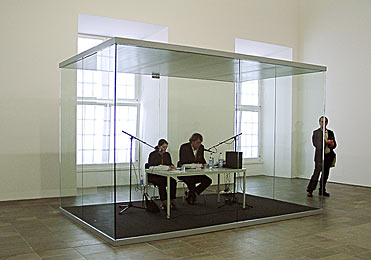
    The voice of a woman reading from within a freestanding glass booth echos through the gallery: Nine hundred eighty eight thousand four hundred and twelve. B.C.
    You watch, slightly amused. A set of black binders in a vitrine bear the title, One Million Years (Past and Future). One binder is open, showing columns of numbers, years. A couple enters the gallery and stops right in front of the booth. If it were the window to someone’s home, they’d be standing invasively close. They stare into
    The voice of a man reading from within the booth: Nine hundred eighty eight thousand four hundred and eleven. B.C.
    the booth. The woman acknowledges them, but doesn’t speak. They keep staring for a moment, then move on. The gallery is basically square, typically classical, on the central axis of the building, with an extremely high, domed ceiling. The doorways are placed enfilade, creating a path for traffic right in front of the booth. That booth is kind of nice, though. Seamless, slightly grey glass. At least ten feet high, including the suspended ceiling and diffused lighting. Grey carpet, a black table with two places. One chrome mike stand, one binder,
    Woman: Nine hundred eighty eight thousand four hundred and ten. B.C.
    and one glass of water for each place. A pile of CD jewel cases on the floor? Ah, they’re recording this, too. (Wouldn’t you? I mean, how much would it be to get interns to record this for you?) How long will it be before the guy reads his next year? If they cough, does that get edited out of the CD, or do they leave it in? More people walk in, pause, smirk at each
    Man: Nine hundred eighty eight thousand four hundred and nine. B.C.
    other, look at the label, and move on. OK, now time the interval. Well, maybe later. I mean, they’ll be there a while, right? You move on to the next gallery. Hmm. Not very interesting. The next one is dark, though. A row of thirty or so film projectors lined up on a shelf that spans the entire gallery, but they’re not on. Ein Tagebuch (A Diary) by Deiter Roth. It starts at 11:00, in just about
    Woman’s voice, still audible: Nine hundred eighty eight thousand four hundred and eight. B.C.
    five minutes. Push ahead and come back. You know, there are all those little photos culled from Der Spiegel. That should take about five minutes.You head back through the central gallery, past the booth again. Do those people in there think you’re lost? or at least aimless? En route, you try to look purposeful, make eye contact, acknowledge their humanity, their contribution to art and culture. You get it, after all. You know On Kawara’s paintings, too, so,
    Man: Nine hundred eighty eight thousand four hundred and four. B.C.
    thanks.
    The photos are small, pinned under glass, and extend all the way around the gallery. There’s a crowd. a riot, a group of soldiers. Another crowd. Demonstraters in handcuffs. Billy clubs. Another crowd, another riot, another, another. Isa Genzken has found an unsettling aesthetic similarity between these photos spanning decades of unrest and violence on every continent. Now the game is to identify the country and the
    Man: Nine hundred eighty eight thousand three hundred and seventy nine. B.C.
    era from the clothing the subjects wear and the cars and advertisements in the backgrounds. You check your watch. Almost five minutes. You hustle back through the galleries just as two attendants are signalling each other. They start the projectors from the outside moving in. Little home movie-like images slowly populate a grid on the wall, which the attendants focus and fine tune. Roth’s explanation is in the catalog: “I wanted to show my daily life in the films here…so I didn’t have to do anything courageous…For instance, it would be courageous to make a point
    Woman: Nine hundred eighty eight thousand three hundred and seventy four. B.C.
    of showing badly made films individually; but because I’m afraid of this kind of exposure, I will show 30 films of this kind at once–a flickering, which dazles and distracts from the poverty of each individual film.” Hmm. Sound like weblogging to me. Looks like it, too. You head back to watch the rest of that documentary on the India-Pakistan border which revitalizes the philosophy of non-violence, considered “quaint” (when it’s considered at all), passing once again through the
    Man: Nine hundred eighty eight thousand three hundred and sixty one. B.C.
    gallery with the booth. But this time something hits you and you stop. The cycles of life, violence, death, the attempts of people to make sense of it, to be remembered, to gain dignity and avoid embarassment, the lessons unlearned over centuries of conflict, the conceptual memento mori offering no illusions of progress or respite, the same inexorable flow of time giving unexpected comfort that things will pass. You choke back tears as you take up place against the door jamb, yielding to the years that pass over you. The woman looks up briefly, acknowledging my humanity, my contribution to art and culture, and then turns her eyes back to her page.
    Woman: Nine hundred eighty eight thousand three hundred and sixty. B.C.