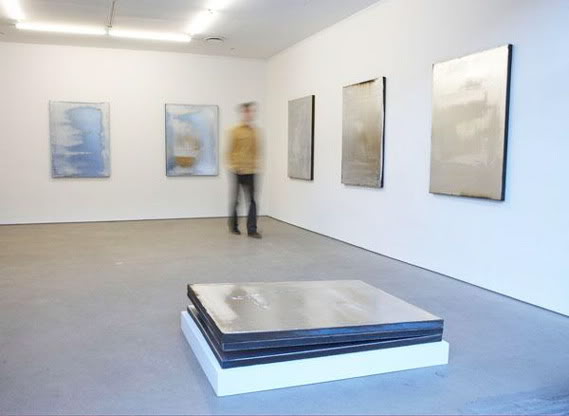
Jacob Kassay’s silvered paintings appeared in early 2009, “elegantly abused luxury goods” whose distorting mirroring surfaces were instantly desirable to collectors. Then their glinting allure proved irresistible to financial speculators whose only lesson from the recent implosion of the global financial markets was that they’d never face any consequences.
Then and now, Kassay worked through the wave of flipper interest as it crested, crashed, and inevitably moved on to swamp the next young artist’s practice.
The untitled work at the literal center of the Eleven Rivington show comprises three silvered canvases, separated slightly by an unseen rock, resting on a wooden plinth.
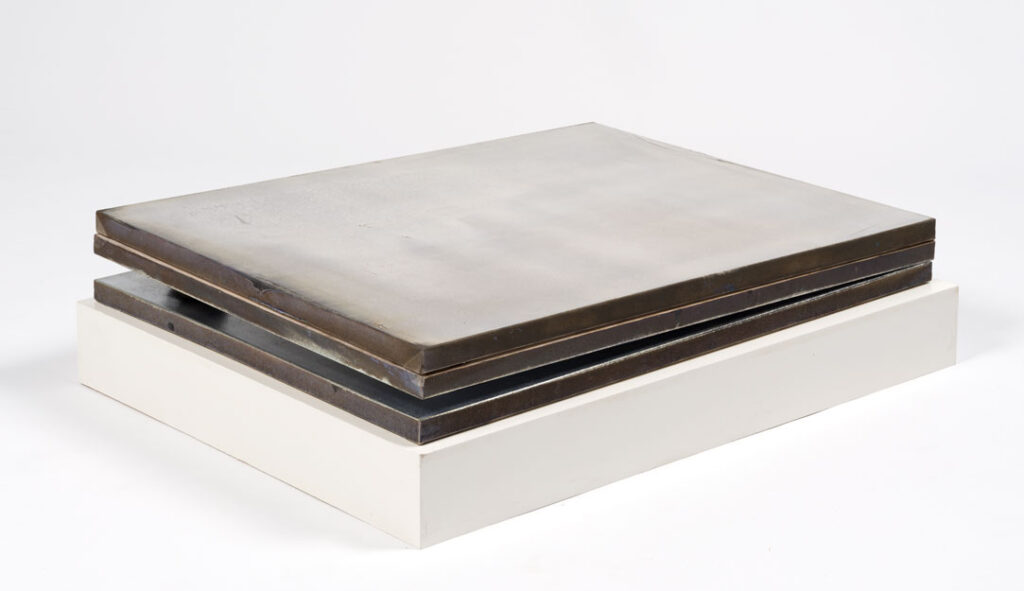
According to LA Modern’s provenance, it has changed hands once; the original 2009 buyer (from Florida, save that sales tax!) sold to someone in Los Angeles, who is now selling it.
It is not clear for how much this ur-Kassay changed hands–or when, but it was after trying to sell it for $150k in 2012, and certainly for more than the current estimate. This could be your chance, savvy connoisseur, to acquire a beautiful and historic work of the artist’s, restore balance to the force, and cause someone to lose a hundred thousand dollars, all at once.
Oct 18, 2020, Lot 157: Untitled, Jacob Kassay, est. $40-60,000 [lamodern]
update: it didn’t sell. that we know of.
May 2021 update: This major work appeared at auction again, at Rago, and because I was unable to keep track of what day it is, I missed it selling on May 19, where it sold for $4,550, including premium. I am hugely bummed to have not bought it, but applaud the connoisseur who did. Of course, if there’d been another bidder, the price would have been higher. Anyway, HMU, winner!
June 2026 update: While researching other works by Kassay, I discovered that the provenance for this work did not match that presented by LA Modern or Rago in 2019 and 2021, respectively.
It was presented as being “acquired directly” by its 2019 L0s Angeles-based seller from a “Private Collection, Florida” “in 2009,” which acquired it from Eleven Rivington in 2009, i.e., Kassay’s original show. This would mean the LA collector was the one who attempted to sell it at Sotheby’s in 2012. But the Sotheby’s seller was listed as the original buyer.
What I and everyone from Art Basel Miami to Palm Beach missed was the work’s appearance at auction on December 2, 2019: at Bill Hood & Sons Art & Antique Auctions in Delray Beach, Florida. Where, after two internet bids, it sold for $11,000.

Hood & Sons, amazingly, provide photos of all three paintings. Alas they do not show the pedestal or the rock, which is usually sandwiched between the faces of paintings 1/3 and 2/3. They also documented the presence of Eleven Rivington labels, as well as Sotheby’s stickers for the 2012 sale. Which I think makes this seller “Private Collection, Florida.”

Hood & Sons sold another Kassay, in August 2019, a small work on paper from 2010 that, though silvery, was not the kind of object art world speculators fixated on. The silver tape in the penciled grid suggests to me the temporary wall and ballet barre on which Kassay installed a row of sheets of silvered paper at his 2011 show at L&M Los Angeles. So this was not a leftover, but a product of the artist’s ongoing exploration, the kind of thing the buyer of a major work from a breakout show would be interested in.
The Hood sales were parts 1 and 2 of a single-collector sale. Looking through their now-dispersed haul, I am certain I have been in a room with this person more than once. But that’s not important now.
What’s important is that my initial karmic narrative of speculation was wrong. This artwork at the heart of a significant show—and this collector who bought it new—traveled the entire arc of the Kassay Silvered Age together: the thrill of prescience and emerging support; the rush of validation and critical recognition; the reward of ongoing engagement in the midst of frenzy; the crushing tsunami of market madness; and the subsidence to more stable, perhaps mature, levels of interest. There was even the frisson of a big auction payout—minus, of course, the payout. In place of the missing 20x return, the collector got to live with the iconic work they admired until the end. Or at least until they cleared out their place in Florida.
It’s only the Angeleno who picked it up online from the back of the Hoods’ truck, who thought they’d flip it for a quick $30k, and who ended up losing a few thousand dollars instead. Truly the pandemic was hard on everyone, sometimes in different ways.