Owen Simmons’ The Book of Bread, 1902/3

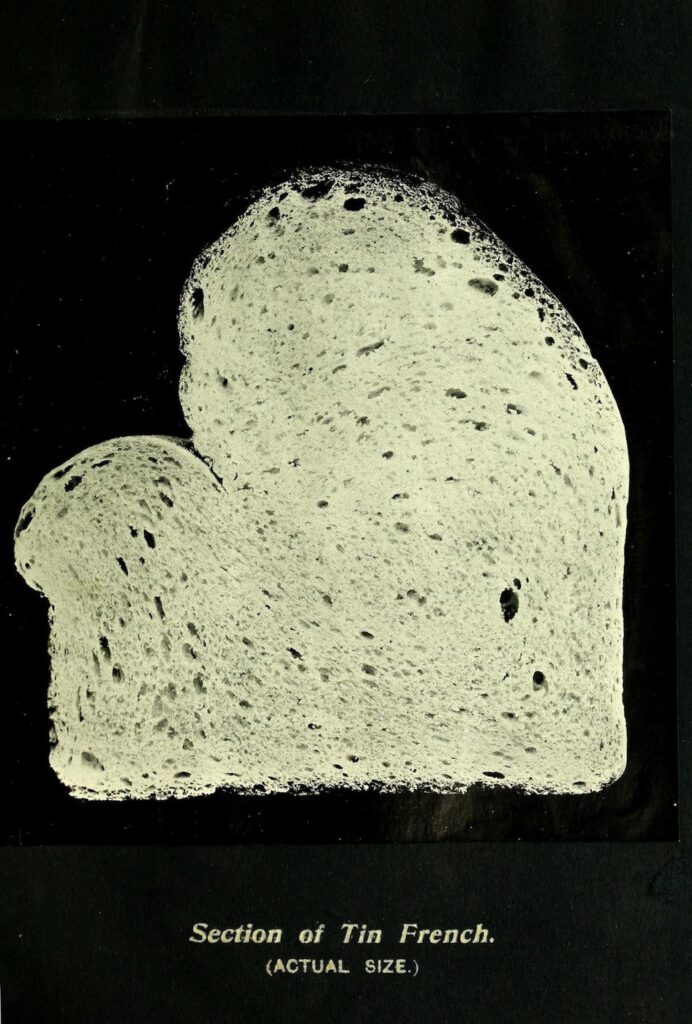
an asymmetrical slice of white bread, shaped a bit like a right handed oven mitt, is photographed in incredible detail and precision against a black background, with the caption, "the french tin" underneath it. this is the photogravure version of owen simmons' the book of bread, so it feels perhaps a little harsher
Tin French loaf cross section from Owen Simmons’ The Book of Bread, 1903, via Public Domain Review

Owen Simmons’ scientific guide for commercial bakers, The Book of Bread, was published in an elaborately produced edition de luxe in 1902, and in a trade edition in 1903. The de luxe edition includes original silver bromide prints of full-size photos of various types of bread pasted in, while the trade edition uses photogravure.

Martin Parr considers it to be the first artist’s photobook, and I can’t think of a reason to disagree.
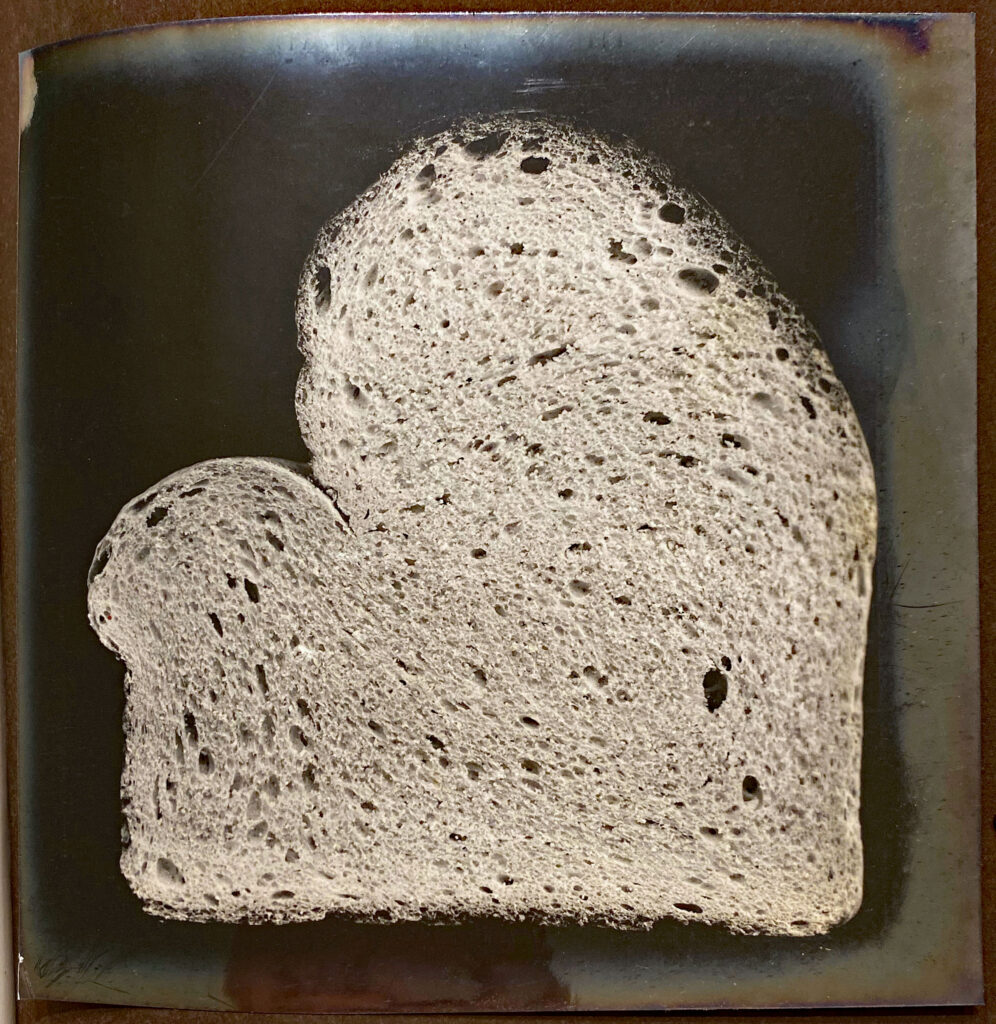
an asymmetrical slice of white bread, shaped a bit like a right handed oven mitt, is photographed in incredible detail and precision against a black background, with liquid undulations around the right and lower edges. this is the silver  bromide print of the bread in actual size, from the deluxe 1902 edition of owen simmons' the book of bread. these prints are somehow more vivid and artful, even, while also being supremely factual or indexical, with a sense of depth or thickness to the bread that the photogravure edition does not quite capture
French Tin loaf in actual size but not here, silver bromide print from The Book of Bread deluxe edition, 1902, via a link mentioned on Public Domain Review

Prof. Shannon Mattern [@shannonmattern.bsky.social] brought this back to my attention this morning, after Public Domain Review posted about it in January, referencing a 2020 thread by a rare book dealer I don’t mention on a social media site I don’t link to. But that dealer’s thread did include images of the silver bromide prints, which are extraordinary, whereas the PDR scan is of the beautiful-but-more-conventional trade version.

The photographer remains unidentified, though not for any known nefarious reasons.

[2025 update]: I reposted this, and Jörg of CPhMag rightly took issue with Parr’s characterization—and with Parr—of this as the first photobook, since it ignores the entire 19th century, and the work, in particular of Anna Atkins.

I think Parr’s claim could only make sense if you defined the photobook as a conceptual art object in, say, the mode of Ed Ruscha, something shot through with, if not straight up irony, then some knowingness of the art objecthood of the book itself. Simmons does praise the excellence of the photos in The Book of Bread, but it’s not the same thing at all. The Book of Bread, indeed, is a book illustrated with photos, 12 plates among 300+ pages. At best Parr saw the title and the indexical photos and saw the hand of a self-conscious artist at work. At worst, he strapped a contemporary concept onto a found, archaic, technical manual.

Jörg’s larger point certainly feels more interesting, though: to explore the history of the photobook back to the origins of photography itself. Photography was so quickly compared to—and comparing itself to—painting as part of its artistic development. But it’s almost easier to argue that photography was born as an art based in the book, with Anna Atkins’ extraordinary book of cyanotypes, Photographs of British Algaes, published in various forms over a decade beginning in 1843.