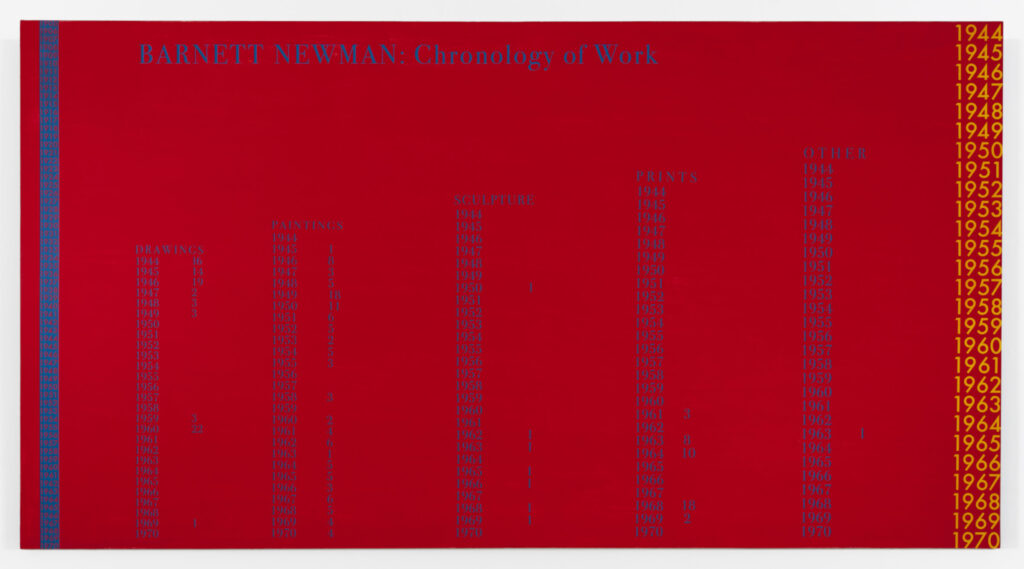
One of many epic paintings David Diao made about Barnett Newman’s catalogue raisonné is a yearly tally of work, sorted by category, into zips. Every time I see it I think, “Other? What was the one other?”
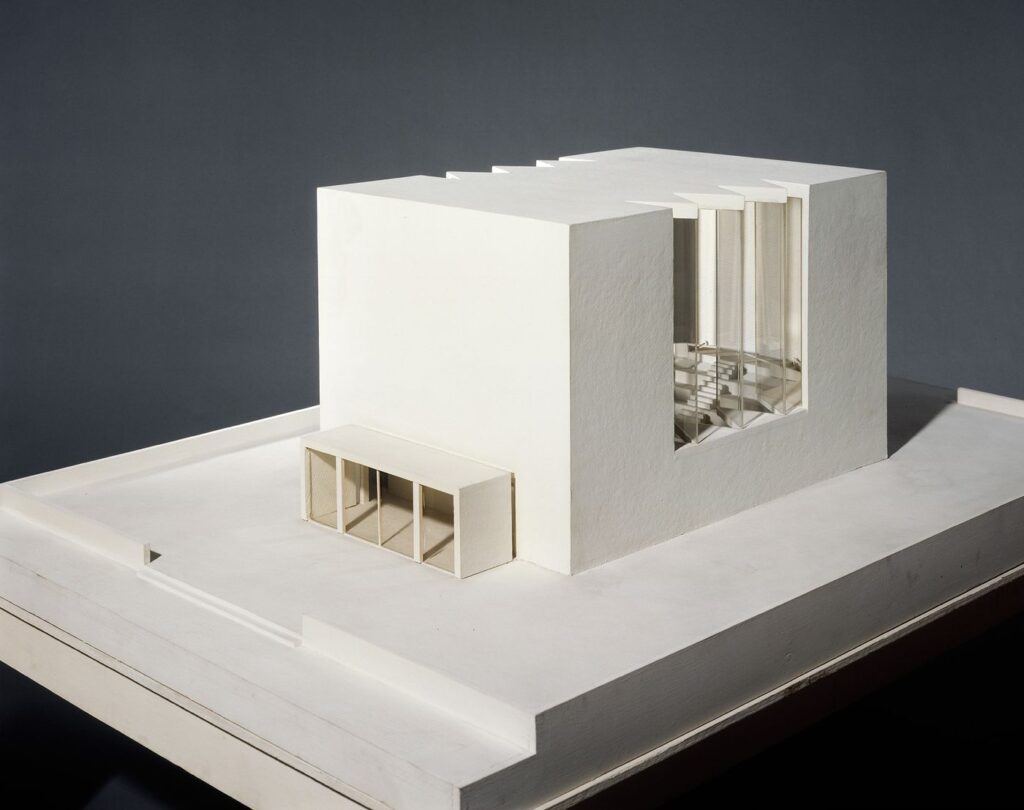
And then rewatching Diao’s 2013 Dia talk last night, I am reminded that Other is a synagogue Newman designed, Diao said, for an architectural competition. There’s a 2014 story at Grupa O.K. about Harald Szeemann wanting to borrow the model [fabricated by Robert Murray] for a show in 1983, and Annalee refusing to lend it. She left it to the in the CCA in Montreal in 1991.
LATER TONIGHT UPDATE: EXCEPT. Newman did not make this for a competition, but for an exhibition. In mid-1963 he was working on the Cantos print series when Richard Meier, of all people, invited him to be the only non-architect in a show at the Jewish Museum, Recent American Synagogue Architecture. Newman also wrote an essay for the catalogue about synagogue architecture in the postwar context. His relationship with the Jewish Museum soured a couple of years later when he opposed what he felt the museum was wrongly implicating him with constrictive labels of Jewish Artist or Jewish Art. Mark Godfrey gets into this and other early postwar artists’ reckoning with Jewish identity and culture a bit in his 2007 book, Abstraction and the Holocaust.