Richter On Idiots

A 2001 visit to Gerhard Richter’s studio, from when Michael Kimmelman used to write about art:

He puts a canvas on an easel at the end of the room and slides the photograph into a projector. The photo appears, projected onto the canvas, and Richter begins to trace it with a piece of charcoal and a ruler. Tracing each minute detail of a photograph, as he does, usually takes Richter a couple of hours. Then he is ready to paint.
”Idiots can do what I do,” he says, although of course he doesn’t really think so. ”When I first started to do this in the 60’s, people laughed. I clearly showed that I painted from photographs. It seemed so juvenile. The provocation was purely formal — that I was making paintings like photographs. Nobody asked about what was in the pictures. Nobody asked who my Aunt Marianne was. That didn’t seem to be the point.”
The point, among other things, was to distance himself from the clichés of artistic expression — all the spontaneous, fiery, warm and fuzzy modes of painting — so as to make people really look and not reflexively swoon. By using deliberately banal photographs, impersonally mimicked, he was doing the exact opposite of what painting was expected to do, not grabbing a viewer by the lapels but methodically copying an everyday image. In time, some of the pictures have come to look expressively painted, perceptions having changed, but making methodical copies was Richter’s intent.

An Artist Beyond Isms [nyt via john bailey]

Mind The Storr: On Gerhard Richter’s September

gerhard_richter_september_mg.jpg
Seriously, I could fall into Gerhard Richter’s website and not surface for days. There’s just so much stuff. And related stuff. And meta-stuff. Auction histories for specific works? Cross-referenced Atlas pages? It just goes on and on and on.
Recently, two interviews with Rob Storr were added: one is about Richter’s Cage Paintings, which Storr showed at the Venice Biennale in 2007, and which are now at the Tate. [It’s a comically great business model to make and sell giant series of paintings intact instead of slogging it out one by one.] There’s a lot of discussion and still photos of the making of palette knife & squeegee process for the abstract pictures–I always thought Richter only painted them on a table, but there he is on his ladder. And Storr has a thoroughly enjoyable smackdown of the fiercely “deterministic” Rosalind Krauss’s connection of Richter and Johns. I’d pay cash money to see that panel discussion.
Same day/same outfit is another video, Storr is in the office at Marian Goodman, discussing September, the small monitor/TV screen-sized painting of the World Trade Center attack that opened Richter’s latest show at the gallery. [Yeah, I know it was actually a photo of the painting.]
It’s funny, I’d conveniently forgotten how central war, destruction, civilian casualties, and terrorism have been to Ricther’s work and his experience. How does that happen? Anyway, it’s interesting stuff.
Gerhard-Richter.com [gerhard-richter.com]

What I Looked At Today – Gerhard Richter

richter_4900_serpentine.jpg
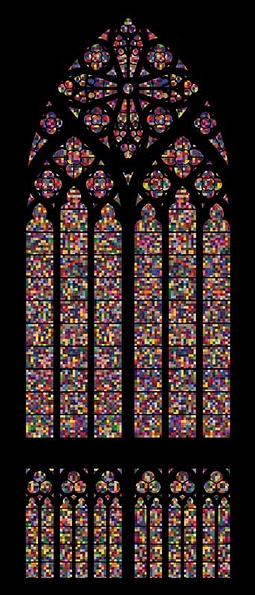
Gerhard Richter used a randomizing computer program to place the 11,500 hand-blown squares of glass in 72 different colors in his 2007 stained glass window for the Cologne Cathedral.
He used the same program at the same time to create 4900 Colours, a work which revisits the color chart and color chip paintings he made in the 1970s. For 4900 Colours, square acrylic paint chips were glued to Aludibond, a European brand of aluminum composite panel.
4900 Colours, Version II, shown at the Serpentine Gallery last fall, consists of 196 panels, each nearly 1m square and containing 25 computer-placed chips. The panels were hung in randomly selected groups of four to make one work comprised of 49 panels. Hans Ulrich Obrist talks about the work and its various versions in this video.

I can’t get over how gorgeous they look, even in the crates. Watching the installation and listening to the several random elements Richter deployed reminds me of John Cage’s rolywholyover exhibit from 1993-4. Using a a list and map created each day by an I Ching-based program, the museum’s art handlers would essentially perform by installing, moving, and removing artworks selected for the show. When not on the walls, paintings and such were stored on rolling walls, still visible, in a roped off section of the gallery. One of my absolute favorite art experiences ever.

A Favorite Kippenberger Made From A Favorite Richter

The Martin Kippenberger retrospective closed yesterday at MoCA, which means it’s just a few weeks away from opening at MoMA, which means I’ll finally be able to see one of my favorite-from-afar Kippenbergers in person.
The Happy Ending To Franz Kafka’s Amerika is always fun. And I love the Metro-Net subway stairs and vents for the trains that connect the world–the NY-style ventilation grate in the front lawn of LA’s Schindler House on Kings Rd still conflates those two cities for me.
kippenberger_richter_modell.jpg
“Haven’t you people ever heard of coasters??”
But the one I’ve been waiting to see is Modell Interconti. It’s a coffee table that Kippenberger made in 1987, and the top is made from a Gerhard Richter Grau painting. Kippenberger bought the painting as a Richter, then sold it as a Kippenberger, promptly destroying–or at least disappearing–a significant percentage of its market value.
Though I’m sure he didn’t take too big a hit. Richter’s grey paintings have never been as pricey as his less boring work: the blurred photo-based paintings, the gloppy aerial landscapes, the hard color grids, the squeegees. Which is part of why I like the grey paintings so much; they can be so successful at eliminating the extraneous elements and letting you focus purely on the paint, the surface, the object. And the range is anything but boring. Those giant grey glass paintings at Dia:Beacon create a space as seductive and perceptually disorienting as any Serra.
Ten years after Kippenberger made Modell Interconti, you could get a slightly smaller Richter grey painting at the Armory Show for around $10,000. Which was probably the price of a major Kippenberger by then, too. So within a decade, Kippenberger had caught up with Richter’s market. And now a major Kippenberger–like, say, Modell Interconti–is surely worth more than a small, demure Richter. At least it was pre-meltdown.
kippenberger_richter_moca.jpg
Modell Interconti, 1987, collection Gaby and WIlhelm Schürmann [image: swo.de, link broken (2016)]
The MoCA photo used by the LA Times is probably better. [latimes]
2016 update: Chin-Chin Yap’s case study of the moral rights associated with Modell Interconti, from July 2009 [artasiapacific]

Gerhard Richter’s Stained Glass Window For The Cologne Cathedral

gerhard_richter_stained_glass.jpg

It took over 600 years to complete [from 1248 t- 1880], so it should surprise absolutely no one that it takes the Cologne Cathedral [or Kölner Dom] over 60 years to fix a broken window.
Gerhard Richter has been commissioned to recreate a 20m tall window for the Cathedral’s south transverse; the original was blown out during World War II, and the design was lost. The new Richter window will consist of 11,500 handblown glass squares about 10cm each, in 72 different colors; the design was inspired by Richter’s 1974 presciently pixellated painting, 4,096 Colors, which has been overlaid onto window’s original Gothic mullions and tracery.
The top donors to the window’s fabrication costs [estimated at 350-400,000 euros] at the end of the year will receive a signed thank you memento from Richter, as well as invites to the Spring 2007 dedication. [I’d certainly hope so.]
Cologne Cathedral at wikipedia. also, see and read details in German at Koelner-dom.de [via artnet]