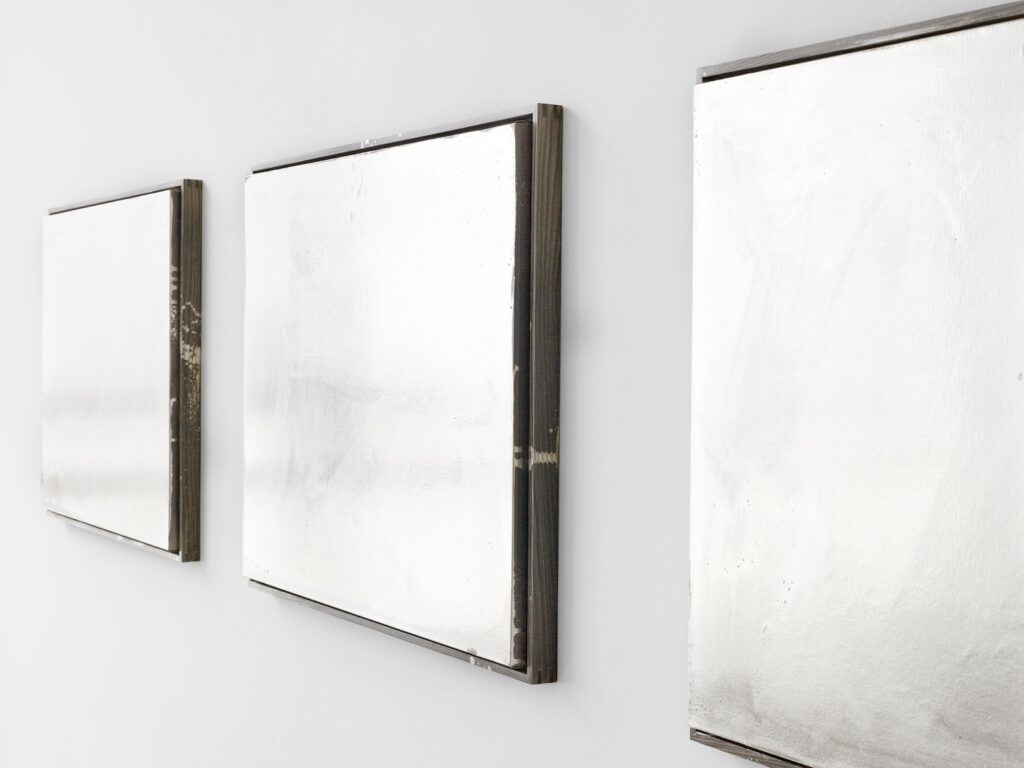
Jacob Kassay Dummy Wedge

a glass wedge is in a library book, presumably discarded, with a stamp from the buffalo and erie county public library on the top edge of the pages, bisected by the glass wedge. the book's title is barely legible, but the whole point of this post is that it might not matter so much. via printed matter/artsy
Jacob Kassay, No Title, 2013 — ongoing, glass, library book, from the Printed Matter Benefit Auction ending May 2, 2025 at Artsy

I guess I’ve never actually asked, but all this time I assumed that the books Jacob Kassay inserted his prisms into were all on an undisclosed reading list of some kind. An esoteric phenomenology syllabus, ex libris Alain Robbe Grillet, whatever, some kind of over-arching epistemology that may have been invisible on the scale of a lone volume, but that cohered in some way of the artist’s devising.

And that the glass prism was then crafted to fit precisely in a certain spot in the book—or at least in a certain volume—that, when you looked in, distorted and perhaps simultaneously revealed one piece of a larger informational puzzle.

a jacob kassay artwork consisting of a glass wedge fitted precisely in between the pages of a library book, this one in french, with a cream cover and a red border, oh fine, it's a collection of poemes by constantin cavafis published by gallimard, and there's a library bar code sticker on the cover, in the lower left corner. from the portfolio page of ross art studio dot com
Jacob Kassay, coin de verre & livre de bibliothèque, via Ross Art Studio

And now I wonder if I have it exactly backwards, and it’s the wedges that are the drivers. Kassay has donated a glass & library book sculpture to the upcoming Printed Matter benefit auction [less than four days left to bid!], and the winning bidder will receive, “a dummy book and wooden dummy wedge to be used only to procure the correct format of library book.” So maybe there are instructions of genre or title, but it sounds like the determining factor is “correct format”? Which you test with a dummy wedge and dummy book?

Indeed, it’s right there, in the artist packet from Galerie Art Concept in Paris, which characterizes the wedges as glass sculptures, and the books as support:

“The positions of the glass wedges inside the library books are necessarily temporary. The wedges don’t belong to any particular book but rather shift from book to book like a hermit crab, finding the other book that precisely fits it. This is why I chose to house them in library books – as a kind of format logic which focuses on their qualities as objects, rather than as texts with specific content.”

And now the image of distorted texts is replaced by roaming wedges, ever in search of a new book—or at least ready to trade up if the fit is right.

the sun hits the white veined marble panels sandwiched between an undulating grid of light grey granite beams, beveled to a wedge profile that rises to each joint, on the facade of the beinecke rare book library at yale, designed in 1963 by gordon bunshaft and photographed by lauren manning of vermont danby marble dot com
the white veined marble and light grey granite façade of Gordon Bunshaft’s Beinecke Library, 1963, image: Lauren Manning via Vermont Danby Marble

Also, I found this comment from Kassay’s glass fabricator, that the wedges are “inspired by the façade of the Beinecke Library at Yale.” which, I assume is a reference, not to the translucent marble, but to the beveled granite lattice that holds it. Maybe I should just ask.

Destroyed Or Unrealized? Jacob Kassay Princeton Mural

Installation and drips on frames view, OVR Jacob Kassay, Galerie Greta Meert, Brussels, 2023

While exploring the ostensible paradox of putting frames on Jacob Kassay paintings, I came across an entire set of paintings with frames by the artist himself. In January 2023, Galerie Greta Meert in Brussels staged an online/backroom exhibition of eight new Kassays, at once familiar and strange.

The OVR’s only text, from a 2010 essay by Anthony Huberman, links these works to Kassay’s silvery, electroplated and singed paintings which lit up the art market’s way out of the global financial crisis. But there is also silvery runoff and splatter on the floating cedar frames. Which would mean Kassay was dipping the whole framed objects in his electroplating bath? It reminded me of Rauschenberg’s order, “DO NOT REMOVE…FRAME IS PART OF DRAWING.” written in all caps on the back of Erased deKooning Drawing. If that were the wildest discovery in this virtual show, it would have been enough.
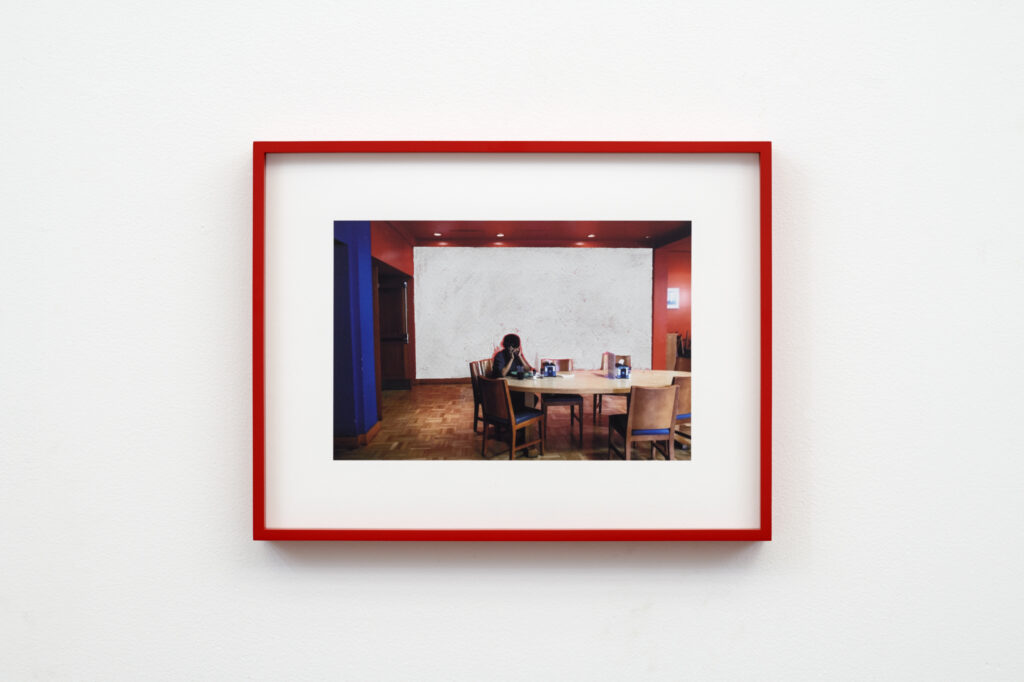
20210104_JRose_Princeton_060-scaled-2-1024×682.jpg via Galerie Greta Meert

But there was also this completely other mystery:

It’s an overpainted photograph that appears to be a study for a mural [?] at Princeton. The extensive caption reads: “Jacob Kassay, Princeton Charlie (studies for the removal of Woodrow Wilson mural), 2018, paint on photograph
Washington Post article, Princeton to remove ‘overly celebratory’ mural of Woodrow Wilson, Mary Hui and Susan Svrluga, April 27, 2016: 
https://www.washingtonpost.com/news/grade-point/wp/2016/04/27/princeton-to-remove-overly-celebratory-mural-of-woodrow-wilson.” To the dates, 2016 and 2018, the jpg filename adds 2021, for a study shown in 2023.

A seven-year span of events, yet I could find no image of the completed mural. Or even a mention. Or any confirmation that it even is a mural.

Continue reading “Destroyed Or Unrealized? Jacob Kassay Princeton Mural”

In Conclusion, Buffalo AKG Is A Land Of Contrasts

Maybe it’s living on the border, or the multiple additions, but my strongest sense of visiting the Buffalo AKG, the museum formerly known as the Albright-Knox, is of marveling at the things they put next to each other.

By entering through the parking lot and the new Gundlach Greenhouse, I ended up walking backwards, chronologically, through the museum, beginning with a gallery of large paintings made in 2013. Then there was the 90s room, then on back, to the room with this pairing of a Rothko and a Frankenthaler that just felt wild for some reason. But at least I got a picture. The mid-70s pairing of a Susan Rothenberg horse next to a blurry pre-squeegee abstract painting by Gerhard Richter was so unexpected, I forgot to photograph it.

The Coenties Slip room, though, was pleasantly sublime, with Ellsworth Kelly’s 1950s NY NY living across from Agnes Martin’s Tree just like old times. That’s a detail below, obviously; just imagine that extending in infinity.

There were some other nice moments in the permanent collection—the Stanley Whitney retrospective was spectacular, btw. Those little paintings he makes at the end of the day with his leftover paint!

Olafur’s pavilion tree situation was nice, and better than the courtyard it replaced, for sure. Is it worth having to have the Gundlach wing, too? I will defer to the Buffalovians, who did seem pleased with the place.

But the surprise and delight was the Jacob Kassay installation, developed in collaboration with the visually impaired education folks, where he lined the outer edge of the handrail with the letter H in Braille, creating a tactile onomatopoetic evocation of breathing, or sighing, as visitors drag their hand along. It was the perfect opposite of spectacle.

Jacob Kassay, BRUSH, 2020

Jacob Kassay, 'BRUSH', 2020 – Interview filmed in March 2022 at Art : Concept, Paris.

In March 2020, as was the custom of the time, Jacob Kassay did an OVR, with a show no one could see at Galerie Art Concept in Paris of 19th century bricks made in Buffalo. That was followed by a bigger show, F’O’O’T’A’G’E’, in the summer. This past March, he talked about them in a brief video, above, which, like the rest of this pandemic, feels like time and space have collapsed.

The project is balanced in the space between these quotes: “I mean, I am relying on the pretension of people knowing about my relationship to painting for these to operate in a certain way.” and “I don’t think I have the ego enough to say like, ‘Oh, this is a readymade.'”

The word “balance” suddenly made me think of another work of saliently stamped bricks, but since it dates from the year after Ana Mendieta’s death, I’m not going to mention it here.

Ur-Kassay

installation shot of Jacob Kassay’s March 2009 solo show at Eleven Rivington, via 16 miles of string

Jacob Kassay’s silvered paintings appeared in early 2009, “elegantly abused luxury goods” whose distorting mirroring surfaces were instantly desirable to collectors. Then their glinting allure proved irresistible to financial speculators whose only lesson from the recent implosion of the global financial markets was that they’d never face any consequences.

Then and now, Kassay worked through the wave of flipper interest as it crested, crashed, and inevitably moved on to swamp the next young artist’s practice.

The untitled work at the literal center of the Eleven Rivington show comprises three silvered canvases, separated slightly by an unseen rock, resting on a wooden plinth.

It is now for sale.

Los Angeles Modern Auctions (LAMA) October 18, 2020 Modern Art & Design

According to LA Modern’s provenance, it has changed hands once; the original 2009 buyer (from Florida, save that sales tax!) sold to someone in Los Angeles, who is now selling it.

It is not clear for how much this ur-Kassay changed hands–or when, but it was after trying to sell it for $150k in 2012, and certainly for more than the current estimate. This could be your chance, savvy connoisseur, to acquire a beautiful and historic work of the artist’s, restore balance to the force, and cause someone to lose a hundred thousand dollars, all at once.

Oct 18, 2020, Lot 157: Untitled, Jacob Kassay, est. $40-60,000 [lamodern]
update: it didn’t sell. that we know of.

May 2021 update: This major work appeared at auction again, at Rago, and because I was unable to keep track of what day it is, I missed it selling on May 19, where it sold for $4,550, including premium. I am hugely bummed to have not bought it, but applaud the connoisseur who did. Of course, if there’d been another bidder, the price would have been higher. Anyway, HMU, winner!

June 2026 update: While researching other works by Kassay, I discovered that the provenance for this work did not match that presented by LA Modern or Rago in 2019 and 2021, respectively.

It was presented as being “acquired directly” by its 2019 L0s Angeles-based seller from a “Private Collection, Florida” “in 2009,” which acquired it from Eleven Rivington in 2009, i.e., Kassay’s original show. This would mean the LA collector was the one who attempted to sell it at Sotheby’s in 2012. But the Sotheby’s seller was listed as the original buyer.

What I and everyone from Art Basel Miami to Palm Beach missed was the work’s appearance at auction on December 2, 2019: at Bill Hood & Sons Art & Antique Auctions in Delray Beach, Florida. Where, after two internet bids, it sold for $11,000.

three four by three foot jacob kassay paintings that are normally stacked with a rock in between two of them are instead lined up side by side here, their smooth electroplated silver surfaces reflecting the studio light, and highighting the dents in the upper corner of two paintings caused by the rock that is supposed to be between them. as sold in 2019 by hood and sons, del ray florida
Jacob Kassay, Untitled, 2009, unstacked, without pedestal (4 x 50 x 38 in.) or rock (yea big), acrylic and silver deposit on canvas,each canvas 48 x 36 in., as sold in 2019 by Hood & Sons

Hood & Sons, amazingly, provide photos of all three paintings. Alas they do not show the pedestal or the rock, which is usually sandwiched between the faces of paintings 1/3 and 2/3. They also documented the presence of Eleven Rivington labels, as well as Sotheby’s stickers for the 2012 sale. Which I think makes this seller “Private Collection, Florida.”

a row of four square pieces of silver tape centered on the upper half of a sheet of paper, with fine ruler lines in pencil extending like a grid from the edges of each square. the sheet is torn from a perforated sketchbook. the sheet floats in a thin maple frame with the paper fringe along the top. a 2010 work by jacob kassay sold at hood and sons in 2019
Jacob Kassay, Untitled, 2010, silver tape and graphite on paper, 13 1/3 x 16 1/4 in., sold in 2019 by H&S

Hood & Sons sold another Kassay, in August 2019, a small work on paper from 2010 that, though silvery, was not the kind of object art world speculators fixated on. The silver tape in the penciled grid suggests to me the temporary wall and ballet barre on which Kassay installed a row of sheets of silvered paper at his 2011 show at L&M Los Angeles. So this was not a leftover, but a product of the artist’s ongoing exploration, the kind of thing the buyer of a major work from a breakout show would be interested in.

The Hood sales were parts 1 and 2 of a single-collector sale. Looking through their now-dispersed haul, I am certain I have been in a room with this person more than once. But that’s not important now.

What’s important is that my initial karmic narrative of speculation was wrong. This artwork at the heart of a significant show—and this collector who bought it new—traveled the entire arc of the Kassay Silvered Age together: the thrill of prescience and emerging support; the rush of validation and critical recognition; the reward of ongoing engagement in the midst of frenzy; the crushing tsunami of market madness; and the subsidence to more stable, perhaps mature, levels of interest. There was even the frisson of a big auction payout—minus, of course, the payout. In place of the missing 20x return, the collector got to live with the iconic work they admired until the end. Or at least until they cleared out their place in Florida.

It’s only the Angeleno who picked it up online from the back of the Hoods’ truck, who thought they’d flip it for a quick $30k, and who ended up losing a few thousand dollars instead. Truly the pandemic was hard on everyone, sometimes in different ways.

Kassay at von ammon

installation view of Jacob Kassay show at von ammon co, dc

There is a new show by Jacob Kassay at von ammon co in Georgetown.

Ten OG silvered paintings from 2009 are mounted on the edge of columns in the gallery, facing the door, basically.

They reflect the daylight that comes in from the gallery’s north facing glass wall. The array of LED spots on the gallery’s black timber ceiling provides fill, but does not light the paintings individually. It’s more ambient, environmental.

The lights also snap on and off in relation to a candle in the corner. The candle is held by a bracket in front of a plug-in nightlight, which is connected in turn to a relay controlling the gallery’s lights. When the candle light wanes, the nightlight turns on–and the gallery lights turn off. When the candle is bright, the nightlight turns off, and the lights stay on.

In the absence of turbulence, the candle can burn brightly and steadily, and the lights stay on as expected. But the candle, like a Calder mobile, invites disturbance. When the candle’s doing its thing, the uncertain stroboscopic perturbations can be unnerving. To remain in the gallery thinking of art brings back visceral memories, not of Martin Creed, but of Bruce Nauman. Any prolonged exposure, meanwhile, might feel like shift work under a failing fluorescent light, with all the internalized bodily and psychic stresses that entails.

Installation view of Jacob Kassay’s show at von ammon co, dc

While the paintings remain as gorgeous and seductive as ever, with movement dancing across their reflective surfaces, Kassay’s candle-driven gallery also illuminates the intrinsic precarity of the art system in which they’re consumed.

I should have asked about the light situation, but the paintings are for sale.

Jacob Kassay’s show remains on view through August 31 at von ammon co [vonammon.co]

Erased Kassay JPEG

kassay_diptych_christies_screenshot.jpg
Lot 247: Jacob Kassay, Untitled, 2010, two 14×10 silver on acrylic (not gesso?) canvases, est $10-15,000 [image via christies]
Scanning the catalogue for this month’s Christie’s sale turned up something unexpected: an affordable Jacob Kassay painting. Two of them, in fact. After his ominously seductive debut show opened at Eleven Rivington in the wake of the 2008 financial crisis, Kassay’s silvered gesso canvases were transmuted into auction gold. Shiny objects reflecting distorted images of their viewers, Kassay’s paintings were the first to get churned and flipped in a frenzied art market obsessed with declaring-and cashing in on-a steady stream of new stars.
It’s the kind of limelight that can wreck a girl’s practice, if not her complexion, and Kassay has been reticent, even diffident sometimes, of the hype. He’s generally refused to engage the art market star process, at least on anything other than his own terms. For a while he refused to have his picture taken. His website, a kaleidoscope of semi-transparent images, would kick you off after a few seconds, presumably when you’re just tryna do some research for an upcoming auction.
Kassay has also always been fairly specific about images of his shows, especially photos of his silvered paintings. So it should make all the sense in the world that he’d care about the proliferation of auction-related reproductions of his work. What was more surprising, though, was the apparent removal of all images of his work from Phillips’ website.
phillips_kassay_screenshot_gregorg.jpg
Sotheby’s has done this for a while now, removing images of works shortly after the sale is completed, but this is the first time I’ve seen all of an artist’s images removed from a site. Or should I say, replaced. If you thought Kassays all looked the same before, well, brother, you’re in for a treat. I’d like to see these in mirror finish, please.
kassay_diptych_phillips_screenshot.jpg
[FWIW, this particular pair, from 2010, was flipped at Phillips in 2011 for $104,500. If there’s anything more alluring than a shiny object, it’s two. And if there’s anything more seductive than that, it’s a 90% discount. [Update: indeed, they sold for $8,000 bid, $10,000 with premium. That is some Cady Noland-level collector anxiety inducement and value erasure. Well played.]
Sept 28, 2017, Lot 247: Jacob Kassay diptych, 2010, est. $10-15,000 [christies]
8 Nov 2011, Lot 205: Jacob Kassay, Untitled diptych, est. $30-40,000, sold for $104,500 [phillips]

Mirror, Mirror

kassay_concept_2013.jpg
OK, I am a bit in love with Jacob Kassay right now, in my head.
In Art F City Eva Heisler reviews Kassay’s current show at Art:Concept in Paris [above], his second, and it looks remarkably like the first, in 2010 [below].
kassay_concept_2010.jpg
Do you see what he did there? Did he really just answer the perennial art journo question about how he’ll top with the extraordinary popularity of his electroplate paintings by just cold restaging an entire show of them? Apparently, no.
Heisler explains that these are not Kassay paintings, but “canvases,” “props in lieu of paintings.” In fact, they’re in exactly the same lieux and same dimensions as Kassay’s first show. And the installation shots of 2013 are almost all identical to those of 2010. And despite what it looks like, this situation Kassay has set up is one in which, as Heisler astutely puts it, “his paintings are present only through their staged absence.”
But these present absences, these “not paintings,” are–are you sitting down?–not for sale. They will be destroyed after the show. At least the canvases will be. The “stretcher bars (will be) recycled.” Which seems like an odd detail, but hey.
phillips_kassay_25.jpg
There were actually not 25 paintings at Phillips, only 17, with one sold twice. Which, holy smokes, nice placement. Does anyone hold onto these, ever?
And not only do these new canvases have a uniform, non-gestural, more mirror-like facture, Heisler reports, again, kind of oddly, that “this time the artist did not touch the surfaces at all.” Which would seem like the least determinative factor possible for a non-painting these days, until this one:

The fact that Kassay’s mirror objects are emphatically “not paintings” and earmarked for destruction implies that the definition of what counts as a “Kassay painting” has to do with its entry into the art market. If so, then it is an irony that the artist’s attempt to evade the market in fact reaffirms its powers even to name what counts as “a painting by Jacob Kassay.”

Which, what? Why? No way, not even. Kassay can outsource or not sell or destroy what he wants. But the only reason Kassay’s “not paintings” are not paintings is because Kassay says they’re not paintings.
What Heisler calls “deflection” I would see as negation. Looking back, and following the artist’s chosen mediations, the Art:Concept show reflects [sic] a sustained strategy of negation and “staged absence” as a constructive part of Kassay’s practice.
kassay_pr_sidebyside.jpg
Art:Concept’s press release for the current show is, so to speak, Exhibit A. Just as the 2013 canvases bear striking resemblance to the 2010 paintings, The new press release, too, [left, pdf] turns out to be an excised, barely augmented, near-replica of the old [right, pdf] And you know what the funniest thing about Kassay in Europe is, it’s the little differences.
kassay_pr_hilite_01.jpg
To make it easier to see what’s changed, or specifically, what’s been deleted, negated, from Kassay’s presentation, I converted his strikethroughs to highlights. You can download the complete, highlighted pdf here. What’s erased crossed out? Well, data [Dates, “New York,” “collaboration,” and “works on paper,”] but also things like “industrial,” “chemical,” “conceptual,” and every reference to photography and his monochrome and mirror forebears such as Yves Klein and Robert Smithson. Also blacked out: any privileging of “the perception of the painterly surface,” and particulars of how “the artist carefully keeps control of their reproductions.” Which, he may not want to talk about it, but since the 2013 installation shots match perfectly to the 2010 photos, I think it’s safe to say he still cares.
It’s a stretch, perhaps, but there seems to be a non-trivial overlap between what was blacked out and the terms, references and concepts initially used to hype Kassay’s paintings in auction catalogues and the media. [“Whilst Kassay uses industrial techniques, they retain an engaging, painterly quality.”]
What’s less speculative but feels quite instructive is to see what stays:

“the modernist and maybe absurd desire to put an end to classicism by producing monochromes.”
“…creating a distance between his work and the nostalgia that was seemingly implied by the use of an obsolete technique.”
“…multiple considerations on illusions created by serial production and the impossibility to operate exact reproductions; defining the loss involved both in the transfer-processes and in any interpretive attempt.”

The Art:Concept show also invites a reconsideration of Kassay’s just-ended exhibition in New York, Untitled (disambiguation) [or as I liked to call it, “leftovers at The Kitchen”], which consisted, remember, of stretched scraps of canvas from which his earlier paintings had been cut. The staged absence of paintings.
kassay_kitchen_concept1.jpg
It also included several silvered paintings, installed/photographed in conspicuously offhand, even marginalized spaces: propped in the foyer, behind a column, or in a storeroom. These images are, in fact, included in Art:Concept’s press release.
kassay_kitchen_concept2.jpg
And now that you mention it, their surface looks as uniform and non-painterly as the “not paintings” of Paris. Did anyone look into The Kitchen’s mirrors, to see what their status was? Were they, too, “props in lieu of paintings”? Were they dismantled or destroyed? Were they for sale? Is there any place better than the gallery of a performance space to stage absence?
I looked back at reviews and such, and found that, again, the press release had been altered, this time without leaving a trace. The early text preserved–along with Ben Davis’s mug–in this photo contains facts about the making of which are omitted from the archived version. [pdf] What had been explained and presented as the artist’s intent was eliminated, transformed through negation into historical hearsay.
Which makes me think again of the Henry Codax Incident last year. That’s when Christie’s, citing Gallerist NY’s report, described a dark grey monochrome by the fictional artist Codax as the product of a collaboration between Kassay and Olivier Mosset. Kassay protested, and insisted that Christie’s read a statement before the auction “disassociating his name” from the painting.
So in addition to Codax paintings which are “not Kassay paintings,” we can add canvases in a Kassay show which are “not paintings.” To paraphrase John Cage, Kassay has nothing to paint, and he’s not painting it.
But just as Rauschenberg demonstrated erasure as a generative act, Kassay gives hints that negation for him is constructive and not repudiation or “deflection.” Art:Concept’s current Kassay slideshow also includes two non-not-painting objects: used French library books with prismatic acrylic wedges inserted into them. One is a collection of work by the late Greek poet Constantin Cavafy.
kassay_blanchot.jpg
The other: l’Entretien Infini, The Infinite Conversation, by philosopher/theorist Maurice Blanchot. Blanchot and Mallarmé argued that the power of language derived from its ability to negate a thing and replace it with an idea. And that both thing, the disappeared/negated thing and the idea that replaced it were equally valid, constant, and stable. And that the idea was even moreso, because the thing was subject to change. So really, instead of looking at the not paintings as destined for destruction; we should see them as ideas which will never be tarnished by time, atmosphere, or white-gloved flippers.
Jacob Kassay at Art : Concept, Reflection or Deflection? [artfcity]
Jacob Kassay, 23 février – 6 avril 2013 [galerieartconcept.com]
Jacob Kassay, 8 mai – 5 juin 2010 [galerieartconcept.com]
Previously: Henry Codax at Auction; also, Speculation
Also, Jacob Kassay, Johns & Rauschenberg, and collaboration

Artforum Reviews Jacob Kassay Press Release

kassay_lm_angle.jpg
Huh. I guess Artforum’s back-of-the-book review section does not purport to ignore the art market’s overdetermining forces any more.
Ben Carlson’s review of Jacob Kassay’s show this summer at L&M Arts in Los Angeles is framed around the burning question, “Does Kassay’s work properly account for the auction hype and thus, its own presence in this high-end gallery?”

But L &M Arts’ interest in this young painter is no mystery: Regardless of their merit, Jassay’s silvery-reflective monochromes made a splash at auction last fall. Anticipating the cynics, the staff penned a press release that was quick to distance Kassay’s older output from the new work he made for this show. Calling attention tot the differences in surface treatment, it announced that his most recent paintings would feature a “surprising yet deliberate lack of reflection.”
[part where 29-yo Kassay is chided for not taking better hold of his secondary market and is as yet found to be no Ryman or Kelly omitted]
Offered a chair at the high rollers’ table, Kassay could have made only one compelling move–a wager with the potential to break the bank. Of note: His Paris dealer, Art: Concept, has already offered public assurances that the artist is not about to meet the market’s demand for more of the same. In fact, had Kassay overperformed (or overproduced) this summer, he might have presented a distance from these overdetermining forces or even productively embraced them…It appears, however, he’s chosen to ignore them altogether. [ellipsis original]

Some day, maybe the discussion of what we see when we look at Kassay’s distorted, mirror-like work will not be characterized by such a surprising yet deliberate lack of reflection. But that day is not yet.
Previously: On Jacob Kassay and collaboration

On Jacob Kassay And Collaboration

Kassay_11Riv_portlandart.jpg
image: portlandart.net
I confess, I was as taken as the next guy by the Shiny Object-ivity of Jacob Kassay’s electroplated solo debut at Eleven Rivington in 2009. Next guys like Portland Art’s Jeff Jahn, who wrote the show felt “more in touch with the unsettled world of 2009.” And Andrew Russeth, who nailed the charred & mirrored monochromes as “look[ing] like elegantly abused luxury goods.”
And I had a big setup here, which I just deleted, about how I’m really not trying to add to the burgeoning body of Kassay concern trolling, articulated most clearly by Sarah Douglas, about the risks of overnight market success on the emerging artist.
But then I read Ed Schad’s earnest attempt to strip the market hype preconceptions from his review of Kassay’s current show at L&M Gallery in Los Angeles. And I have some issues.
On their face, Kassay and his silvered paintings seem almost too perfectly suited for the Art World’s Next Top Model cautionary tale. It’s like they’re a trap, paintings perfectly calibrated to separate the most narcissistic collectors from their dough. The installation of silvered paintings at Art Basel [below] didn’t help, and neither did Kassay’s dealers’ assertion that the paintings, a suite of eight, would only be sold together–and to a museum–for somewhere around EUR250,000.
Jacob Kassay: Untitled, 2011 / Art Unlimited / Art Basel 42
It’s hard to counter this narrative; or to wonder how much discourse around Kassay’s work is critical backfilling prompted by dealers or other vested interests. And I think Schad captures the difficulty well, questioning the conceptual underpinnings of Kassay’s show in the face of his monochromes’ unambiguous, materialist beauty:

I get the impression that the center of L&M’s show, a large work on paper placed on rough 2 x 4 studs with a ballet barre positioned in front, is Kassay’s attempt at giving us what may be a position, although that its orientation towards giving the show a conceptual reading also does a disservice. The work is ineffective, pitching a now typical rough D.I.Y look that is often misconstrued for sincerity and humility. Work like this neither sincere nor humble, but instead uses tropes of sincerity and humility as a cop-out for rigorous thinking. I have to admit, that Kassay’s center piece looks grad-school and virtually destroys the mood of refinement and elegance created by the smaller works.
I can’t fault Kassay entirely for this. After all he is young, and perhaps the impulse is to bring a little resolution and a little art history positioning to a practice that is probably more at home in explanation-less experimentation and straight ahead aesthetics. With the ballet barre, suddenly we are allowed to think of performance, of metaphor, of the history of Rauschenberg, his performative collaborations, and his white paintings, the idea of a monochrome as blank surfaces or “landing strips” for dust, light and shadow

kassay_lm_angle.jpg
Schad’s identification of the monochrome as Kassay’s field of bold engagement is right-on, but I think his skeptical de-emphasis of the artist’s reference to Rauschenberg, the conceptual and the collaborative is a mistake. These may turn out to be central elements of Kassay’s practice.
From the L&M press release:

This installation conceit engages Kassay’s interest in artist collaborations such as Rauschenberg and Johns designing sets for Merce Cunningham performances and an abundant history of multi-media collaborations. It evokes these ideas, but also takes into consideration the gallery as a place for practice, repetition and the natural gradients provided by the light, the white walls and the work itself.

Which, hmm. There’s a crossed up analogy there–sets and performance vs barre and practice–which effectively conflates gallery show with studio practice [all puns presumably intended].
I didn’t want to be all Johnny one-note, but since he/they mentioned him first, I can now point out that the paradigm Kassay’s debut on the art world stage most closely resembles is not Ryman or Klein, or even Rauschenberg, but Johns. Rauschenberg’s 1953 Stable Gallery show of white and black monochromes was more scandale than succes, and he fought the unserious bad boy image for many years, while Johns’ work was hailed–and sold–right out of the gate. And while flags and targets might stand out, most of Johns’ earliest exhibited works [1957-58] were monochrome paintings.
And though Rauschenberg’s reputation as a dance collaborator is well known, somehow Johns’ image of painterly solitude persists [at least for me], even though he was deep in the mix. Here’s a quietly remarkable comment Johns made in 1999, while discussing the creation of the artists-for-artists-oriented Foundation for Contemporary Arts, which he still heads:

In 1954 I had helped Bob Rauschenberg a bit with his Minutiae set, his first for Merce Cunningham, and I continued to assist him with most of his stage work through 1960. We were friends with Merce and John Cage and saw them frequently. In 1955 there was an evening of Cunningham/Cage performances at Clarkstown High School in Rockland County where we met Emile de Antonio. In 1958 de, as he was known, Bob and I formed Impresarios Inc. which financed and produced the 25-year retrospective concert of John Cage’s music at Town Hall in New York.

I guess this is all an aside, but the Walker is preparing Dance Works I: Merce Cunningham and Robert Rauschenberg, a show this fall of their Cunningham archive holdings which, at least in the title, doesn’t consider Johns’ collaborative role. Not that the Walker ignores Johns’ dance work; they have his Duchampian set structures for Walkaroundtime, after all.
codax_moment_carr_trade.jpg
henry codax, installation view, via carriage trade
So what’s this got to do with Kassay? Are his only collaboration references in his L&M show? In fact, he’s apparently got another show up right now which takes the model collaboration and the issue of individual artistic creation and authorship head-on. Andrew Russeth reports that Carriage Trade’s current show, an exhibition of monochrome paintings by the fictitious artist Henry Codax, is actually a joint project of Kassay and the minimalism-inflected French Swiss conceptual artist Olivier Mosset.

And now that you mention it, in May 2010, before any of the auction madness, Kassay opened his show in Paris with a collaboration as well. Iconic minimalist trumpter/composer Rhys Chatham performed at Art Concept, with a pair of Kassay’s silvered paintings as a backdrop. Watching video of the gig [Here are parts 2 and 3, total runtime is about 55 minutes.], I’m struck by how the paintings function as screens, reflecting the movements of the small, otherwise invisible crowd.
For the two previous summers, at least, the Paris-based Chatham loomed large in New York. His landmark composition, A Crimson Grail, an orchestra for 200 electric guitars, was rehearsed and rained out at the last minute in 2008 as part of Lincoln Center’s Out of Doors series. It was finally, triumphantly performed the next year. Andrew Hultkrans recounted the euphoric experience for Artforum.
In September, Primary Information is releasing a limited edition LP of the Kassay performance, with an additional work, under the title, Rêve Parisien. And in October, Kassay is having a show at the ICA in London, which is apparently still operating. For the moment, Eleven Rivington is surprisingly not mentioned in ICA’s brief bio of Kassay.
UPDATE Ultimately I’m glad I ended so abruptly; maybe it was enough to spur Andrew into action. He reminded me of the collaboration I’d forgotten, the one which had finally pushed me over the colabo-writing edge. From Karen Rosenberg’s NYT review of this year’s so-called Bridgehampton Biennial, where the backyard is strewn with Lisa Beck’s satelloon-lookin’ sculptures, and the front yard features a 1964 Ford Galaxy awaiting “an ‘artist’s renovation’ by Servane Mary, Jacob Kassay and Olivier Mosset.” Those shiny silver balls’ll throw me ever’ time. [Of course, this show also brings up Bob Nickas’s role in launching Kassay’s work into the discourse. This is at least the third Nickas-curated show to include Kassay. Dance with the one who brung ya.]