“And with art, there are always boobs, liberated by liquor, out where they shouldn’t be, pointing around at paintings they don’t understand and could never afford.”
–The NY Observer’s Rebecca Dana reporting from the opening of art dealer Jack Tilton’s new East 76th Street gallery.
Bottle Racket [Don’t scroll down so fast you miss:
-Some adman praising his own scripts for Dasani commercials, written “intending Wes Anderson to direct” [Coke spends $2bn/yr on ads, so of course, they got him, duh]–why do I find the idea of Wes directing Anderson-esque commercials written by Coke’s agency laughably sad?
-George Gurley accosting Catherine Deneuve in print and in the, um, flesh.]
Category: art
Damien Who?
From the Times:
But, at first, the thought of painting in this Photo Realist manner intimidated him. When he began in earnest about three and a half years ago, he realized why.
“I started out airbrushing,” he said. “But the images looked flat, dead. For two years I didn’t think it was going to work.” Finally, he said, he disciplined himself to represent each image faithfully by hand.
Still, he doesn’t consider himself a serious painter. “I would feel uncomfortable putting myself in a category with other painters like Goya or Bacon,” he said. “I’m more interested in the images than the painting.”
From Linda Yablonsky on Artforum.com:
Though many guests made the connection, Hirst may have thought he was avoiding comparisons to Jeff Koons by ordering hired hands to paint each piece in this chilling body of work rather badly. (One assistant was reportedly fired for painting too well.)
But I hope he didn’t think he was avoiding comparisons to another Damien who makes paintings “in photo-realist style from pictures in magazines and print ads”: Damien Loeb.
But my favorite quote from Yablonsky captures a whole swath of the art world’s, “I’m here, so it must be important” sense of audacious self-consciousness, without a hint of self-awareness:
At these prices [up to $2mm] it’s difficult to understand how paintings that are not going to get any better with time can continue to acquire value. Though truth be elusive, let’s just say that that is exactly Hirst’s point: to empty art of meaning. In a market where money is so disposable, how can art transcend mere currency to become more than just a brand? If this is indeed Hirst’s message, then he has issued a galling challenge to every other living artist. It will be interesting to see who takes it up.
Or not. Because it’s not like anyone’s ever paid more than $2 million for a painting before, or even for a Hirst.
As some smart aleck said in the NY Times, “Just because you’ve spent a lot of time and money on something doesn’t mean it’s very good.”
Taste for the Macabre but No Pickled Sharks [nyt]
High and Dry, Linda Yablonsky [artforum.com]
Has Anyone Seen The Flavin Show in Fort Worth?
AND at The National Gallery? I’d love to hear how it’s installed in Ando’s (probably) more sympathetic building.
Huh. They call The Modern Art Museum of Fort Worth “The Modern”.
On Demand
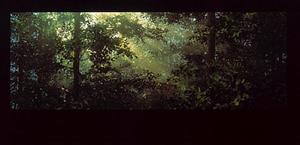 The other night Thomas Demand offhandedly described some of the insane details of the production of Clearing, the massive photograph of a forest which is now built into The Modern at MoMA. The photograph was laminated onto two sheets of architectural safety glass that were so large, they had to use satellite-curing ovens at ESA, the European Space Agency–at night–to fabricate it. When the request for the work, Thomas said, “no one quite knew what they were getting.”
[On an irrelevant note, the lifesize set for Clearing happened to be in Demand’s studio during a MoMA Jr Associates visit I set up. It was so stunning, the trustees quickly added the studio to their Berlin itinerary, and curator Kynaston McShine suggested the Modern acquire the work. And I still can’t get a reservation.]
I mention this–obviously I mention the studio story for self-aggrandizement, but remember the tagline of this site, yo–because not quite knowing what you’re getting seems like one of the underlying currents of Demand’s work.
Walking through the show, I tried to recall the portentous actual setting that was obscured behind each photograph’s generic title: Kitchen was Saddam’s, Archive was Riefenstahl’s, etc., but I kept remembering them wrong, which made me load all kinds of historical baggage onto each image; turns out only some of the bags actually matched. Barn was Pollock’s, not Kaczynski’s; the cluttered desk was L. Ron Hubbard’s, not Bill Gates’. The Bauhaus-style stairway was from Demand’s middle school, but it turns out even he remembered it wrong.
Thomas Demand opens today at MoMA [moma.org]
Michael Kimmelman calls it “hypnotic” [nyt]
No one goes to The Modern; it’s too crowded
NFS: Art You Can’t Buy
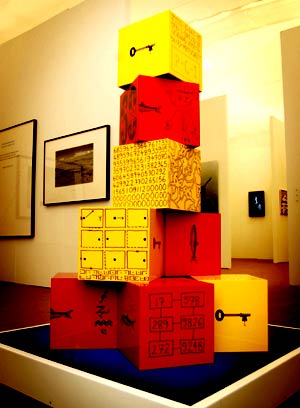 Tangentially related to both preparations for my upcoming talks on the art market in Rotterdam and to The Gates being rather showily not for sale, I’ve been thinking about art you can’t buy or sell.
The Times of London has Tyson’s full puzzle [timesonline.co.uk]
I’m Speaking In Rotterdam This Week
Shameless plug first: I’m speaking and participating in two panel discussions at Art Rotterdam this week. Thursday at 2000 hours [when is that? someone please tell me.] I’m talking about the effects on art and artists of the art market’s global dynamic. That’s at Het Wilde Weten, an alternative art space in Rotterdam, where the other panelists include: artists Jeanne van Heeswijk and Joep van Lieshout; Mondriaan Foundation director Gitta Luiten; journalist Marc Spiegler; and Amsterdam gallery owner Maurice van Valen.
Then on Friday afternoon at 1500 hours, I’m on a panel about private funding of art and museums. The other folks are Peggy Guggenheim Collection’s special events officer Claudia Rech; Rainald Schumacher, Director Goetz Sammlung; Kees van Twist, Director Groningermuseum; and
Frank Lubbers, deputy-director Van Abbemuseum, Eindhoven. The moderator is Prof. Dr. Arjo Klamer of Erasmus University.
Now Available: Apprentice of Nothing T-shirts
 I just made myself a little batch of “apprentice of nothing” t-shirts, which should be here in about 10 days. I’m taking a couple,
 and the rest are available–first come, first served–for $20, domestic shipping included. [mon. night update: they’re gone.] They’re American Apparel superfine jersey, not fitted (L, XL) and come in just one style: white text screened on saffron.
[limited edition apprentice of nothing t-shirt]
[update: in the spirit of transparency, I thought it best to lay out the budget and revenue projections for MY saffron-colored project:
Printer: Customink.com [highly recommended]
Batch size: 12 shirts
Total unit cost: $13.75
Shipping expense: free for standard delivery
Total cost: $165.00
Unit sales price: $20
Gross margin: $6.25
(less postage) $1.85
(less envelopes) $0.50
Unit contribution: $3.85
Total units available for sale: 10
Total contribution: $38.50
(less cost of 2 shirts): $27.50
Project Operating Profit: $11.00
(less design expense, $450/hr): $900
(less managment expense, $$900/hr): $1,800
Net profit (loss): ($2,689)
You’re welcome.
“You Ridiculous Apprentice of Nothing”
To: greg.org
From: someone using the name of a recognizable artist of Christo’s generation
Date: 2/20/05, 22:06
Subject: the blog of greg allen!
Allen, the fastidious analysis of Christo’s project you make, the stupid remarks and investigations over his car, his plates, his parties and his private parts [?? -g.o] make you look a moronic paparazzo searching for the Olsen Twins for a cover in “Daily News” or any other tabloid of your choice. Now, you should say that this art is a waste of money, the artists are rich and they should give the money to charity. You really have a lot of free time or either you don’t know to write about art, so waste your time in freaky painstaking accounts of other’s money and stolen photos. Pathetic, laughable, useless, pointless. Shameful and childish. Get a life and write something interesting, you ridiculous apprentice of nothing.
And I thought the Claymates were sensitive.
I Get Around With A Little Help From My Friends
Just to clarify a couple of points: the Christos’ $350,000 Maybach is not part of the $20 million; in fact, it’s not even theirs. It’s being
made available to them by their friend–in the Maybach marketing department. Maybach’s Leon Hustinx, coincidentally, purchased two C&J-C works related to The Gates, which he has graciously made available to the Daimler Chrysler Art Collection.
The Christos’ do not accept donations or sponsors for their projects, preferring to pay for everything themselves. While the Christos’ Maybach 62 is the extra-long version, it was not custom manufactured in any way; it’s safe to call it a common Maybach. Maybach, you may be interested to know, is German for “people’s car.”
Maybach involved in art project [daimlerchrysler.com]
Christo’s Maybach on flickr with the NJ dealer plate obscured, how thoughtful [flickr.com]
Well That Took About A Day. Gates Jokes

No doubt after a euphoric and joyous walk through the park yesterday morning, and a group hug with the world, Daily Show writer Rob Kutner got back to work–making Gates jokes.
My favorite is above: “Shut UP Jen. I’m totally at The Gates.”
The Gates A Photo Essay By Rob Kutner [supermasterpiece.com]
The Gates Bill
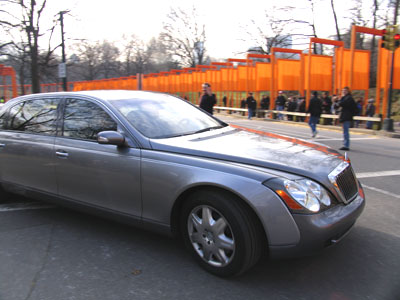
Don’t get me wrong; I’m just as giddy as the next schoolgirl [sic] about The Gates, I just can’t see how they cost $20 million. That’s what the Christos say they cost, and it’s a figure which is dutifully reported in every story, but it’s something which I’ve never seen examined or analyzed.
Most discussion of The Gates focuses on their populism; this is not just public art, but an artistic experience given to the people. The back seat of a Maybach seems an unlikely spot from which to promote “art for Everyman,” [to use Michael Kimmelman’s phrase and Andy Towle’s picture] but for underlining the noblesse that comes with your self-proclaimed noblesse oblige, it’s just about perfect [even if it is borrowed].
I don’t think it’s being ungrateful to take a closer look at this $20 million figure. We don’t consider it an act of magnanimity when Paramount ponies up $200 million to provide us with the grand collective experience of Titanic. In fact, I believe the Christos’ consider the budget to be an important aspect of their work. The artists themselves make a big deal about how much their projects cost, how they don’t accept government financing, donations or sponsorships, and how they pay for everything themselves by selling related drawings, models and ephemera.
They also consider the sometimes decades-long process–materials testing and procurement, engineering studies, bureaucratic navigation and and political negotiations–as intrinsic to their work. Their website is full of factoids on fabric, hardware, topographic studies, and the corporate machinery and machinations that underpin their projects. [To see an example, scan developments for Over The River, a project-in-progress.]
Using the Christos’ own descriptions and published reports of the installation, I priced out The Gates. Let me just say that to get to $20 million requires some rather creative–maybe even artistic–accounting. Whatever else they may accomplish, Christo and Jeanne-Claude may have also created a unique approach to the subjective and often arbitrary exercise of valuing a work of art.
Advertisers and Links Of Note
First, I’d like to welcome and give a passionate cry to new greg.org advertiser Kinsey, an American Experience documentary airing Monday, February 14th on PBS. Psst, even though Kinsey’s work is half a century old, don’t tell the Secretary of Education.
Meanwhile, Daddy Types may sound like something Kinsey would’ve been into, but it’s actually a site for new dads. Check that one out, too.
All The Vermeers In New York (Plus The One In Boston)
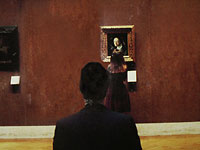 I can’t quite say why, but I had a pretty intense Jon Jost phase when I first moved to New York. I saw his All The Vermeers In New York several times, lured in by the title, but kept there by the film’s demanding and precise construction, and its underlying art-vs-money themes. [That said, I don’t remember it too well; better add it to the rental queue.]
Anyway, I’m sure–pretty sure. kind of sure. hoping–that when the Whitney Museum put then-Vivendi/Universal chairman Jean-Marie Messier on its board in the late 1990’s, it was NOT it in the hope of adding one more Vermeer to New York City’s collection.
FBI looking at Messier as part of its investigation of the Isabella Stewart Gardner Museum theft, which netted someone a Vermeer and some Rembrandts [bostonherald.com]
All The Vermeers In New York[imdb.com, amazon]
FYI, New York’s Vermeers are at the Met [5] and the Frick [3]
“Ladies, Step Away From The Bags”
Artforum’s gossip columnist Rhonda Lieberman wasn’t on the list for artfully poseurish artworld duo [Yvonne Force-Villareal and Sandra Hamburg] Mother, Inc.’s recent Fendi-sponsored CD listening party, so she traded a blowjob for entry. At least that’s how it reads.
A little context: Mother, Inc. started as backup singers for Fischerspooner. The title quote above comes from the oh-so-vigilant guards watching the sponsor’s display case.
Hot Commodities [artforum scene & herd]
Every Building On The Sunset Strip–And Then Some
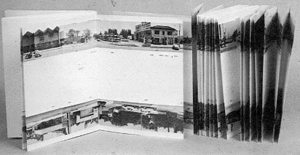 When I saw Amazon’s A9 Local yellow pages feature, the first thing I thought of was Ed Ruscha’s 1966 artist book, Every Building on The Sunset Strip. It was the first Ruscha book I bought, and it makes me laugh to remember how I thought I paid too much for it way back when (it’s easily 10 times as expensive now).
Anyway, using Mikel Maron’s A9 whole-street-grabbing script, I tried all through that weekend to re-create Ruscha’s Sunset Strip. The result was a lot of technical annoyance.
First, starting from a given address, Maron’s script grabs an entire street–a damn big proposition in the case of Sunset Blvd. (Technically, The Strip itself is only a fragment, the section from Doheny to Crescent Heights, from Gil’s Liquors to the Virgin Megastore.)
Trying to save the giant series created some odd results: one seemingly random image would intersperse itself all the way along. After trying to edit this one out, the resulting series were suddenly non-continuous. Something odd was happening when I saved the series and then reconstituted it.
I hadn’t yet cropped the image series at the appropriate intersections, so I didn’t get to try knitting them together into two long panoramas. Actually, I found the A9 images’ redundancy kind of nice; the periodic picture-taking indirectly revealed the (non)movement of the traffic along the Strip.
Anyway, then I saw Jason pointing to Eric Etheridge’s discussion of Every Building, and I think, better to throw this out to the lazyweb and see if someone can tell me how to figure this out, or just do it and make their own selves net-famous.